StarRTT: Eliminating Blind Spots — A New Framework for Real-Time RTT Prediction in Starlink

StarRTT eliminates identification blind spots by end-to-end fusing per-second satellite identification with RTT prediction, significantly reducing LEO network latency prediction error.
Frequent satellite handovers in LEO constellations cause dramatic RTT fluctuations, while traditional serving satellite identification completes only at the end of the scheduling cycle, creating an "identification blind spot" that constrains real-time RTT prediction. The StarRTT framework end-to-end fuses per-second serving satellite identification with RTT prediction, eliminating the time gap between identification and prediction. Its core RT-LSTM model uses a dual-LSTM structure: the historical branch encodes historical RTT observations and real-time geometric features, while the future branch processes TLE-propagated future features, capturing both non-stationary RTT evolution and time-varying geometric relationships. In strict real-time backtesting, RT-LSTM achieves an average MAE of 1.405 ms, reducing error by 4.3%, 11.6%, and 22.1% compared with LSTM, StarNet, and ASTM, respectively, and by 12.5% relative to LSTM at the scheduling instant. This work identifies a neglected system-level bottleneck and provides a pragmatic real-time paradigm.
The high-speed movement of LEO satellite constellations such as Starlink causes frequent satellite handovers, which makes network round-trip time (RTT) fluctuate dramatically. Accurately predicting RTT is key to mitigating this fluctuation, but traditional methods are constrained by an "identification blind spot"—serving satellite information is only identified at the end of the scheduling cycle. A new paper proposes the StarRTT framework, which attempts to fundamentally eliminate this blind spot by end-to-end fusing per-second serving satellite identification with RTT prediction.
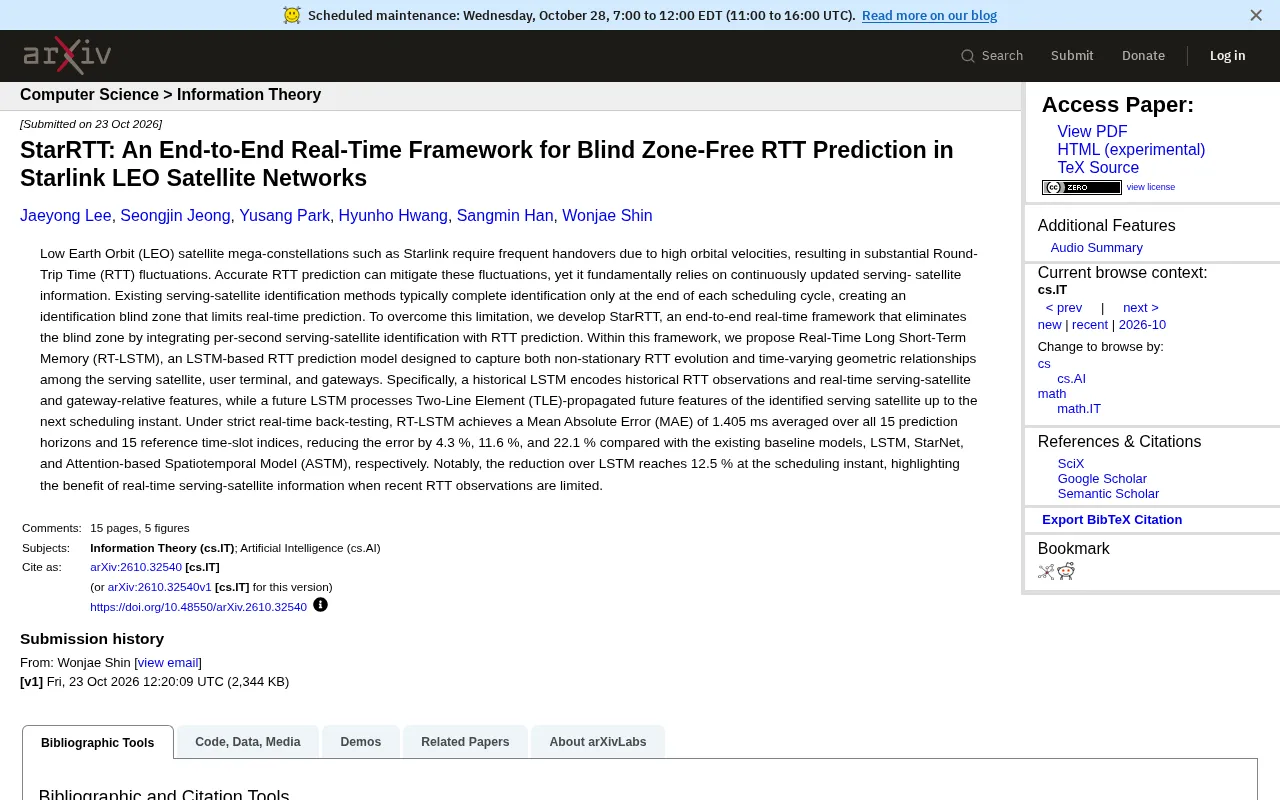
Root Cause: Identification Blind Spot at the End of the Scheduling Cycle
In LEO constellations like Starlink, satellites orbit the Earth at extremely high speeds, and user terminals must continuously hand over between serving satellites. This frequent handover causes significant and non-stationary RTT fluctuations. To predict RTT, the prerequisite is knowing which satellite is currently serving.
However, existing serving satellite identification methods typically complete identification only at the end of each scheduling cycle. This means that for most of the scheduling cycle, the prediction model cannot know the real-time serving satellite identity, creating an "identification blind spot." Within this blind spot, RTT prediction can only rely on historical observations and cannot incorporate current geometric relationships, so accuracy is naturally limited.
The paper's authors point out that this blind spot is the fundamental bottleneck limiting real-time prediction capability. To break through it, identification and prediction need to move from a serial relationship to a parallel, end-to-end relationship.
Scheduling Cycle and Identification Blind Spot
In LEO satellite networks, the scheduling cycle is the time unit in which the system allocates time-frequency resources to terminals, typically ranging from tens of milliseconds to several seconds. Traditional serving satellite identification methods rely on downlink reference signals or pilot measurements and require collecting sufficient observations within the scheduling cycle before solving, so identification results can only be output at the end of the cycle. This causes the prediction model to be unable to know the current serving satellite identity throughout the entire period from the start to the end of the cycle, forming an "identification blind spot." The length of the blind spot depends on the scheduling cycle length and the processing delay of the identification algorithm. In high-frequency handover scenarios such as Starlink, this blind spot may cover most of the RTT variation period, forcing the prediction model to rely only on historical RTT extrapolation and preventing it from using real-time geometric relationships to correct forecasts.
StarRTT Framework: End-to-End Fusion of Identification and Prediction
The core idea of StarRTT is to integrate per-second serving satellite identification and RTT prediction into a single end-to-end framework. Specifically, the framework no longer waits until the end of the scheduling cycle to update satellite information; instead, it continuously identifies the serving satellite at second-level granularity and feeds the identification results into the prediction model in real time.
This design eliminates the time gap between identification and prediction. Every second, the prediction model can obtain the identity of the current serving satellite and its geometric relationship with the user terminal and gateway, enabling more accurate judgments even when RTT observations are limited.
From a system perspective, StarRTT is not a simple replacement of existing prediction models but a reconstruction of the "identification-prediction" pipeline. It turns two originally serial, delayed stages into a tightly coupled real-time process.
RT-LSTM: Dual-LSTM Structure Captures Non-Stationary Evolution
The RT-LSTM model proposed within the framework is key to prediction accuracy. It adopts a dual-LSTM structure: the historical LSTM encodes historical RTT observations and real-time relative features of the serving satellite and gateway; the future LSTM processes future features derived from Two-Line Element (TLE) propagation, from the identified serving satellite to the next scheduling instant.
This division of labor allows the model to capture two types of information simultaneously: first, the non-stationary evolution pattern of RTT itself; second, the time-varying geometric relationships among the serving satellite, user terminal, and gateway. The historical branch is responsible for "looking back," while the future branch is responsible for "pushing forward," and their combination keeps predictions stable around the scheduling instant.
The paper emphasizes that RT-LSTM is designed to work under strict real-time backtesting conditions, not offline fitting. This means the model must complete predictions without using future information, relying solely on real-time available identification results and TLE propagation features.
Two-Line Element (TLE) and Orbital Propagation
The Two-Line Element (TLE) is a standard satellite orbital parameter format published by the North American Aerospace Defense Command (NORAD), containing elements such as satellite number, orbital inclination, right ascension of the ascending node, eccentricity, argument of perigee, and mean anomaly. Based on TLE, propagation algorithms such as the Simplified General Perturbations model (SGP4) can be used to compute satellite position and velocity at a given time. In StarRTT, the future LSTM branch uses TLE propagation to obtain the geometric position of the identified serving satellite at the next scheduling instant, thereby constructing future features. The accuracy and update frequency of TLE directly affect propagation error and thus prediction performance, which is the key reason the framework relies on TLE.
Measured Performance: MAE 1.405 ms, Outperforming Baselines Across the Board
In strict real-time backtesting, RT-LSTM achieves an average MAE of 1.405 ms across all 15 prediction horizons and 15 reference slot indices. Compared with existing baseline models, the error is reduced by 4.3% (vs. LSTM), 11.6% (vs. StarNet), and 22.1% (vs. the attention-based spatiotemporal model ASTM), respectively.
More notably, performance at the scheduling instant deserves attention. At the scheduling moment, RT-LSTM achieves a 12.5% error reduction relative to LSTM. The authors explain that this improvement precisely reflects the value of real-time serving satellite information: when recent RTT observations are limited, real-time identification results can significantly compensate for prediction bias caused by insufficient observations.
These data show that the benefit of eliminating the identification blind spot is not uniformly distributed but is most prominent at the moment when information is scarcest—the scheduling instant. This also indirectly verifies the severity of the blind spot problem.
MAE and Real-Time Backtesting
Mean Absolute Error (MAE) is a commonly used accuracy metric in prediction tasks, computed as the average absolute error between predicted and true values, in milliseconds (ms). In RTT prediction, a smaller MAE indicates predictions closer to measured latency. Real-time backtesting is a strict evaluation protocol: at each prediction instant, the model can only use information available before that instant, and future data is prohibited, to simulate real deployment conditions. The 1.405 ms reported in the paper is the MAE averaged over 15 prediction horizons and 15 reference slot indices, and this backtesting condition ensures that the conclusions do not depend on the optimistic bias of offline fitting.
Significance and Limitations
The value of StarRTT lies in identifying a neglected system-level bottleneck: prediction accuracy depends not only on model structure but also on whether input information is available in real time. End-to-end fusing identification and prediction is a pragmatic engineering approach.
However, the framework relies on TLE propagation and per-second identification, and its computational overhead and identification stability in actual deployment still require further verification. In addition, the backtesting is based on specific constellation configurations and link conditions, and generalization capability across constellations and frequency bands has not yet been discussed. For researchers and engineers focused on LEO network performance optimization, StarRTT provides a real-time paradigm worth learning from.
One-line Summary
StarRTT eliminates the identification blind spot by end-to-end fusing per-second satellite identification with RTT prediction, significantly reducing latency prediction error in LEO networks.
Paragraph Summary
Frequent satellite handovers in LEO constellations cause dramatic network round-trip time (RTT) fluctuations, while traditional serving satellite identification completes only at the end of the scheduling cycle, creating an "identification blind spot" that constrains real-time RTT prediction. The StarRTT framework proposed in the paper end-to-end fuses per-second serving satellite identification with RTT prediction, eliminating the time gap between identification and prediction. Its core RT-LSTM model adopts a dual-LSTM structure: the historical branch encodes historical RTT observations and real-time geometric features, while the future branch processes future features based on TLE propagation, thereby capturing both non-stationary RTT evolution and time-varying geometric relationships. In strict real-time backtesting, RT-LSTM achieves an average MAE of 1.405 ms, reducing error by 4.3%, 11.6%, and 22.1% compared with LSTM, StarNet, and ASTM, respectively, and reducing error by 12.5% relative to LSTM at the scheduling instant. This work identifies a neglected system-level bottleneck and provides a pragmatic real-time paradigm.
Related articles

Why Does Self-Play AI Always Get Crushed by Cheap Units? An RTS Developer's Account of the Dilemma
An independent developer trained an RTS commander AI with pure self-play, only to find it dominated historical versions but was crushed by human players using cheap tier-1 units. This article analyzes the causes of self-play strategy collapse, explores solutions such as exploiters, diversity rewards, and reward design, and introduces the open Bot Kit and AI league plan.

Which Multi-Agent Platform Wins? A Small Team's Battle Scars and Selection Considerations
A 27-person startup's ops lead tried two multi-agent platforms in four months and both failed. This article analyzes why small-team deployments break down, and offers selection guidance on integration depth, observability, and progressive rollout.

Thrive Holdings Takes ADT Private in $7.6 Billion Deal
Thrive Holdings acquires ADT for $7.6 billion in an all-cash take-private deal expected to close in Q1 2027. Analysis of the deal structure, ADT's asset value, and impact on the smart home security industry.