Stop Building Cookie-Cutter AI Websites: 3 Tools That Transform Your Coding Agent

Three tools give coding agents video processing, interface design, and behavior customization.
The article covers three tools attachable to coding agents like Claude Code, Codex, and Cursor. FFmpeg skill enables local video editing without cloud APIs; Hallmark uses 50 design themes and quality checks to fix cookie-cutter AI websites; Jailbreaks offers system prompts and configurations for over 25 models to customize agent behavior. All three repackage existing capabilities into agent-friendly skills.
Stop Building Cookie-Cutter AI Websites: 3 Tools That Transform Your Coding Agent
AI coding assistants can already write code and fix bugs, but many users have run into two awkward problems: the websites they generate all look the same, and the agent can barely do anything besides write code. A creator on YouTube recently shared three lesser-known tools that tackle video processing, interface design, and agent behavior customization respectively—and the approach is worth learning from.
According to the video, what these three tools share is that they attach capabilities to coding agents like Claude Code, Codex, and Cursor in the form of "skills" or "configurations," turning them from simple code generators into versatile workers. Let's break them down one by one.
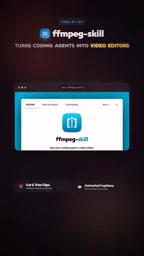
FFmpeg Skill: Turn Your Coding Agent into a Local Video Editor
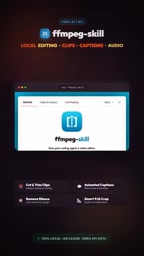
The first tool is the FFmpeg skill, which gives Claude Code and Cursor direct video editing capabilities. Specific features include cutting clips, generating dynamic subtitles, removing silent segments, resizing video, and audio normalization.
The key word here is "local"—the entire processing pipeline doesn't rely on cloud APIs. For developers who need to batch-process assets, this means data never leaves the machine and there are no per-call API fees. The tedious operations video creators often face—like cutting out long pauses during recording or normalizing the volume across multiple audio tracks—can be handled by the agent through natural language instructions, without opening editing software to drag timeline handles manually.
The essence of this approach is packaging command-line tools into skills the agent can invoke. FFmpeg itself is mature audio/video processing infrastructure; what's been missing is an entry point that understands human language, and the skill fills exactly that gap.
FFmpeg is an open-source, cross-platform audio/video processing framework that provides a command-line toolset supporting virtually all audio/video operations, including transcoding, clipping, filters, subtitle overlay, and audio normalization. It's used as an underlying engine by many commercial software products and online services, but its command parameters are complex and the learning curve is steep. In the context of coding agents, a "Skill" usually refers to a packaged instruction file or tool description that tells the agent which commands to call in which scenarios and how to assemble parameters—exposing FFmpeg's capabilities through a natural language interface so users don't need to memorize command-line syntax.
Hallmark: A Cure for the "Template Face" of AI Websites
The second tool is called Hallmark, and it targets a very specific pain point: AI-generated websites all look the same. The video says outright that people are "tired of AI-generated websites looking identical," and Hallmark tries to make coding agents produce more refined interfaces through design skills.
It offers 50 design themes, custom layout capabilities, and a built-in quality-check mechanism. In other words, the agent is no longer just responsible for assembling HTML and CSS—it also applies a set of design constraints during generation and performs a self-check on the output.

This is actually a microcosm of an industry-wide problem. When generating front-end code, large models tend to take the safest path, and the result is that a large number of pages share similar fonts, spacing, and color schemes. Prompt tweaking alone can hardly fix this at the root; injecting a design system as a skill into the agent's workflow is a more engineering-oriented solution. The built-in quality check further turns the fuzzy standard of "looking good" into executable checks.
The "template face" phenomenon in AI-generated front-end interfaces is related to the distribution of model training data: Bootstrap and Tailwind default styles and common landing-page structures that appear frequently in the training corpus are treated by the model as the highest-probability output, leading to highly convergent color schemes, fonts, corner radii, and spacing. Merely asking the model via prompt to "design something more unique" has limited effect, because the model lacks a reference constraint system. Injecting a design system as a skill is equivalent to giving the agent a clear set of font scales, color palettes, spacing rules, and layout patterns, so that it follows structured constraints during generation rather than relying on random sampling.
Jailbreaks: Customize Agent Behavior for 25+ Models
The third tool is called Jailbreaks, a collection of system prompts and agent configurations covering more than 25 AI models. Its purpose is to customize how coding agents behave and to experiment with different operational instructions.

The same model can behave very differently under different system prompts. For developers who want to train an agent into a specific working style, this kind of configuration collection saves the time of figuring out prompts from scratch, letting them directly compare behavioral differences under different instructions. The video's author also emphasizes that its value lies in "experimentation"—using ready-made configurations to iterate quickly and find the combination that fits your own workflow.
A system prompt is a global instruction the model receives before a conversation begins, determining its role setting, output style, and behavioral boundaries. The same model under different system prompts may exhibit completely different working styles—for example, being more conservative and asking for clarification, or more aggressive and executing directly. Agent configuration further specifies available tools, invocation order, and stopping conditions. The value of such configuration collections lies in providing a comparable experimental baseline, so developers don't have to write prompts from scratch but can rapidly iterate based on ready-made templates, observe behavioral differences, and then fine-tune for their own workflow.
The Common Logic Behind the Three Tools
Looking at these three tools together, you'll find they solve the same class of problem: coding agents already have strong general capabilities; what's missing is packaging for vertical scenarios. The FFmpeg skill adds audio/video processing, Hallmark adds design taste, and Jailbreaks adds behavior customization. None of them reinvents the wheel—they reorganize existing capabilities into interfaces the agent can understand.
For developers, what's worth paying attention to isn't the three tools themselves, but this "skillification" approach to extension. Rather than waiting for model vendors to update features, it's better to proactively configure suitable skills and prompts for your agent so it fits your actual work more closely. The video's author mentions that links to all three tools are in the description, so you can explore them yourself if interested, and promises to keep sharing similar AI tool discoveries.
One-line Summary
Three tools use skill packaging to give coding agents video processing, interface design, and behavior customization capabilities.
Paragraph Summary
The article introduces three tools that can be attached to coding agents like Claude Code, Codex, and Cursor. The FFmpeg skill gives agents local video editing capabilities—supporting clipping, dynamic subtitles, silence removal, and audio normalization—without relying on cloud APIs. Hallmark solves the problem of AI-generated websites all looking the same through 50 design themes, custom layouts, and built-in quality checks. Jailbreaks collects system prompts and agent configurations for more than 25 models, used to customize agent behavior and quickly experiment with different instructions. The common logic of all three is to repackage existing capabilities into skills or configurations the agent can understand, rather than reinventing the wheel—a hint that developers should proactively configure skills for their agents to fit their actual workflows.
Related articles

DeepSeek Open-Sources DeepInfer: What Is an Inference Framework Actually For?
DeepSeek open-sources its inference framework DeepInfer under Apache 2.0, supporting DeepSeek V4.1 Flash offline inference. This article explains its request scheduling, FlashMLA/DeepGEMM compute optimization, DSPark speculative verification acceleration, and what it means for developers and ordinary users.

Open-Source AI Learning Agent: A Full Workflow Experience from Topology Graphs to Exam Generation
Explore an open-source AI learning agent: built on DeepSeek API, it constructs knowledge systems via topology graphs, with automatic document generation, notes, super documents, and exams. Learn about its Agent workflow and design highlights.

DeepSeek Whale Girl Open-Source MV Meme: AI Industry Coded Slang About Pivoting to Closed Source
Bilibili's DeepSeek Whale Girl rap MV uses fictional memes to tease the AI open-source vs. closed-source debate, with lyrics full of industry slang. This article explains the meme culture, the Whale Girl symbol, and the open/closed tension.