TactiNavi: Building a More Reliable LLM Game Coach with Explicit Strategy Conditions

TactiNavi models game strategy applicability as explicit conditions, significantly improving LLM coach advice accuracy and reducing misuse.
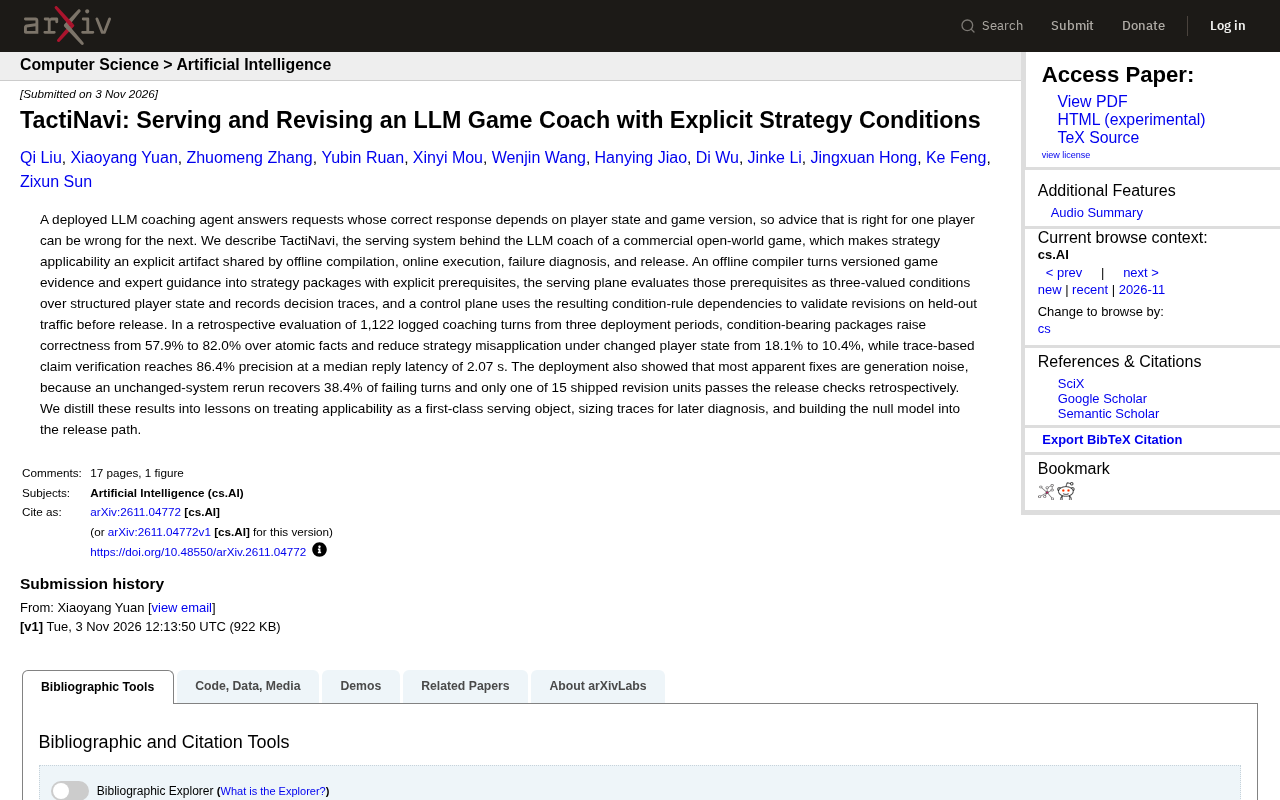
TactiNavi is an LLM coach service system deployed in a commercial open-world game. It treats strategy preconditions as first-class citizens across offline compilation, online execution, fault diagnosis, and release. Using three-valued logic to evaluate conditions over structured player state and recording decision traces, it raises accuracy from 57.9% to 82.0% and reduces misuse from 18.1% to 10.4%. Deployment also reveals that most failures are generation noise, emphasizing the need for a null model in the release process.
In the gaming world, a seemingly correct piece of advice may be completely wrong for a different player or a different version. This "strategy applicability" problem is precisely the core challenge in deploying LLM game coaches. TactiNavi, an LLM coach service system deployed in a commercial open-world game, significantly improves the accuracy and reliability of advice by modeling strategy applicability as explicit conditions.
Strategy Applicability: From Implicit Assumptions to Explicit Conditions
Traditionally, LLM coaches tend to treat game knowledge as a collection of atomic facts to retrieve and generate, ignoring the preconditions under which advice takes effect. The core innovation of TactiNavi is that it treats the applicability conditions (prerequisites) of strategies as first-class citizens, running through the entire pipeline of offline compilation, online execution, fault diagnosis, and release.
The offline compiler transforms versioned game evidence and expert guidance into strategy packs with explicit preconditions. The service plane evaluates these preconditions as three-valued logic conditions over structured player state and records decision traces. The control plane leverages condition-rule dependencies to validate revisions with held-out traffic before release.
This design makes the "applicability" of strategies computable and verifiable, rather than relying on the LLM's implicit inference.
Three-valued logic is an extension of classical two-valued logic that introduces a third truth value beyond "true" and "false," usually called "unknown" or "indeterminate." In TactiNavi, strategy preconditions need to be evaluated over a set of structured player states, and the state information that some conditions depend on may be missing, stale, or undeterminable. If forced into two-valued logic, these cases can only be arbitrarily judged as true or false, leading to incorrect advice. Three-valued logic allows the system to mark such conditions as "unknown" and then adopt conservative strategies—for example, not activating the strategy, downgrading the advice, or requesting more information. This enables the judgment of "applicability" to honestly reflect the reality of incomplete information, rather than masking uncertainty as definitive conclusions, and is one of the key mechanisms that make explicit condition modeling engineering-feasible.
Effectiveness Validation: Improved Accuracy and Reduced Misuse
In a retrospective evaluation of 1,122 recorded coaching dialogues across three deployment cycles, strategy packs with conditions raised accuracy from 57.9% to 82.0% (compared with atomic facts) and reduced strategy misuse caused by changes in player state from 18.1% to 10.4%. Meanwhile, trace-based claim verification achieved 86.4% precision at a median response latency of 2.07 seconds.
These data show that explicit conditions not only improve the accuracy of advice but also effectively reduce incorrect advice arising from changes in player state.
Generation Noise and Release Checks: Unexpected Findings in Deployment
The deployment process also revealed a key issue: most failures that seemed to require fixing were actually generation noise. When the system was rerun without any changes, 38.4% of failed dialogues recovered. This means that hastily modifying the system based solely on failure cases is likely to be overfitting to noise.
More strictly, in a retrospective check, only 1 of 15 released revision units passed the release check. This highlights the importance of building a "null model" into the release path—that is, using repeated runs to distinguish real defects from random fluctuations.
Null model in statistics and experimental design refers to a baseline model that assumes "no real effect," used to estimate how much difference random fluctuation itself can produce. In the release process of LLM systems, a null model means repeatedly running the same batch of inputs without any substantive changes to the system and observing the natural range of fluctuation in the results. If the improvement brought by a "fix" falls within this fluctuation range, one cannot assert that the fix is truly effective. TactiNavi emphasizes building in a null model precisely to distinguish "real defects" from "generation noise": only when the revised performance significantly exceeds the random fluctuation baseline given by the null model should release be allowed. This practice is in line with the ideas of control groups in A/B testing and baseline models in machine learning, but it is especially necessary in LLM generation tasks because sampling temperature and minor context changes can bring considerable output variance.
Lessons and Insights: Applicability as a Service Object
TactiNavi's practice distills several lessons: first, treat applicability as a first-class service object rather than an afterthought; second, design the granularity and scale of traces appropriately for downstream diagnosis; third, build a null model into the release process to avoid being misled by generation noise.
For any system deploying LLM agents, these lessons are valuable references. Especially in scenarios such as gaming, education, and customer service, where the correctness of advice depends heavily on context, explicitly modeling applicability conditions may be a key step toward improving reliability.
TactiNavi's exploration shows that through systematic engineering approaches, LLM coaches can become more reliable and more maintainable. As LLMs are applied more deeply in vertical domains, this applicability-centered design approach deserves more attention.
One-line Summary
TactiNavi models game strategy applicability as explicit conditions, significantly improving the accuracy of LLM coach advice and reducing misuse.
Paragraph Summary
TactiNavi is an LLM coach service system deployed in a commercial open-world game. Addressing the core challenge of "strategy applicability," it treats the preconditions under which advice takes effect as first-class citizens throughout the entire pipeline of offline compilation, online execution, fault diagnosis, and release. The offline compiler transforms versioned game evidence and expert guidance into strategy packs with explicit preconditions; the service plane evaluates conditions over structured player state using three-valued logic and records decision traces; and the control plane leverages condition-rule dependencies to validate revisions with held-out traffic before release. A retrospective evaluation of 1,122 coaching dialogues shows that strategy packs with conditions raised accuracy from 57.9% to 82.0% and reduced misuse from 18.1% to 10.4%, while trace-based claim verification achieved 86.4% precision at a median latency of 2.07 seconds. Deployment also revealed that most failures were actually generation noise: rerunning the unchanged system recovered 38.4% of failed dialogues, and only 1 of 15 revision units passed the release check, highlighting the importance of building a null model into the release path.
Related articles

9 AI Subscription Plans Compared: The Real Cost Per 100M Tokens Revealed
Bilibili creator tests 9 AI subscription plans from Volcano, Alibaba, Tencent, Baidu, Zhipu, Xiaomi, MiniMax and more, converting them all to real cost per 100M tokens, breaking down fixed-quota vs. three-tier coefficient billing and how caching, time-of-day discounts, and window limits affect actual quota.

Vibe Coding for Beginners: Expressing Intent Instead of Handwriting Code
What is Vibe Coding? A 137-episode Bilibili course defines it: the core is expressing intent, not writing code. This article analyzes Vibe Coding's productivity logic, target audience, and entry expectations to help beginners decide if it's worth learning.

LangChain Beginner's Guide: An Agent Development Roadmap from LangGraph to Deep Agents
Clarify the encapsulation relationship among LangChain, LangGraph, and Deep Agents, and master the learning path and selection logic for agent development frameworks—suitable for beginners in large model development.