Teaching Machines to Listen: Paris Smaragdis's Research on Superhuman Hearing
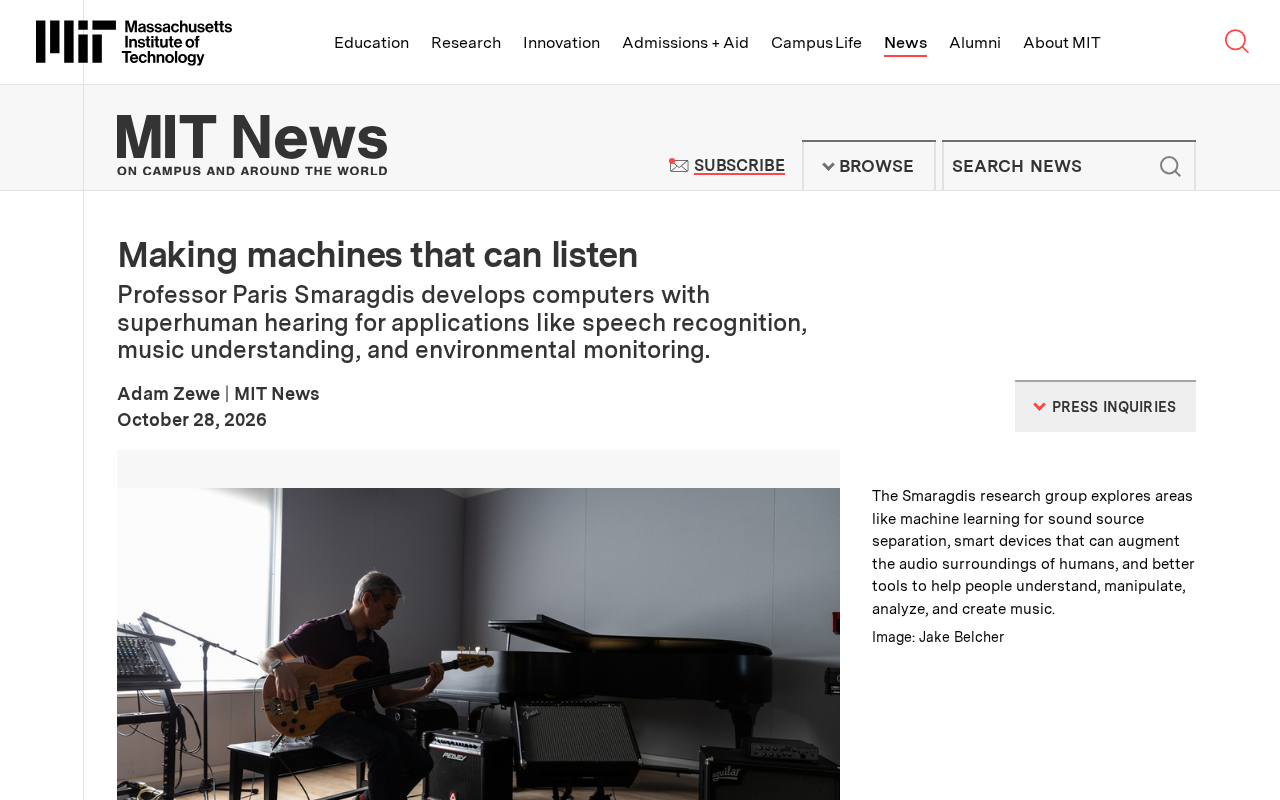
University of Illinois professor Paris Smaragdis researches superhuman hearing machine systems, expanding applications in speech, music, and environmental perception.
The article introduces Paris Smaragdis's research on machine hearing at the University of Illinois Urbana-Champaign. Unlike mainstream voice assistants that only handle close-range clear speech, Smaragdis pursues robust and generalizable superhuman hearing systems that can separate sound sources from noisy environments, parse multi-instrument performance details, and judge equipment status via acoustic fingerprints. His work fuses signal processing and machine learning, balancing physical acoustics with data-driven methods. Applications span speech recognition, music understanding, and environmental monitoring, with potential to improve far-field voice interaction, upgrade music industry tools, and enable industrial predictive maintenance. Machine hearing and machine vision together form the two pillars of intelligent perception.
From Speech Recognition to Environmental Perception: The Broad Landscape of Machine Hearing
Paris Smaragdis, a professor at the University of Illinois Urbana-Champaign, is developing computer systems with superhuman hearing capabilities, with applications spanning speech recognition, music understanding, and environmental monitoring. The core goal of this research is to enable machines not only to "hear" sound but also to "understand" the rich information embedded within it.
Unlike current mainstream voice assistants that can only handle close-range, clear speech, the machine hearing Smaragdis pursues has stronger robustness and generalization capabilities. It needs to separate target sound sources from noisy environments, identify the performance details of different instruments, and even judge the operating status of equipment through ambient sound. If this capability is realized, it will fundamentally expand the boundaries of human-computer interaction.
The Technical Meaning of Superhuman Hearing
"Superhuman hearing" is not simply a matter of improved sensitivity, but refers to a machine's perceptual ability to surpass human hearing in specific dimensions. Although the human auditory system is exquisite, it has physiological limitations in sound source separation, perception of ultra-high frequencies, and long-term acoustic pattern tracking. Machines can compensate for these shortcomings through algorithms and computing power.
Take music understanding as an example: a machine can simultaneously parse the timbral characteristics, rhythmic structures, and harmonic progressions of dozens of instruments—a multitasking parallel processing capability far beyond the cognitive load limit of human hearing. In environmental monitoring scenarios, machines can continuously monitor subtle changes in the acoustic fingerprints of equipment, capturing abnormal signals imperceptible to human ears before failures occur.
Sound source separation refers to the technology of separating individual sound source signals from mixed audio, and is one of the foundational capabilities of machine hearing. Classic methods include beamforming based on spatial information and independent component analysis (ICA) based on statistical properties, while deep learning methods directly learn the mapping from mixed signals to separated signals by training neural networks. In multi-party conversation scenarios, sound source separation needs to solve the "cocktail party problem"—humans can focus on a specific speaker in noisy environments, while machines still face enormous challenges in achieving this capability. Separation quality is usually measured by metrics such as signal-to-distortion ratio (SDR), and current advanced systems are approaching practical levels under specific conditions.
Acoustic fingerprinting refers to the unique sound patterns emitted by equipment or environments under normal operating conditions. Each machine has identifiable characteristics in its sound spectrum due to differences in mechanical structure, wear degree, and operating parameters. By deploying microphones on equipment and continuously collecting audio, combined with anomaly detection algorithms, deviations in acoustic fingerprints can be captured in the early stages of failure—for example, an increase in energy at specific frequencies caused by bearing wear. This method is a non-contact means of predictive maintenance, offering advantages of flexible deployment and lower cost compared to vibration sensors, and has been validated in the monitoring of rotating machinery such as motors, pumps, and gearboxes.
Academic Background and Research Positioning
Paris Smaragdis is affiliated with the University of Illinois Urbana-Champaign, and his research spans both signal processing and machine learning. This interdisciplinary background gives his work both engineering rigor and algorithmic innovation. The difficulty of machine hearing research lies in the fact that sound signals are essentially high-dimensional, highly time-sequential data streams. Traditional signal processing methods often fall short in complex scenarios, while purely data-driven deep learning methods face challenges of interpretability and generalization.
Smaragdis's research approach embodies a fusion of ideas: leveraging the representational power of deep learning while retaining respect for the physical acoustic laws in the signal processing field. This orientation is particularly important in music understanding tasks—the structural regularities of music provide prior knowledge for algorithm design, and relying solely on data accumulation is unlikely to achieve ideal results.
Non-negative matrix factorization (NMF) is one of Smaragdis's important contributions in the field of machine hearing. NMF decomposes a non-negative audio spectrum matrix into the product of a basis matrix and a coefficient matrix, where the basis matrix can be interpreted as spectral templates of sound sources and the coefficient matrix represents the activation intensity of each template over time. This property makes it naturally suitable for tasks such as music separation and speech enhancement, because the decomposition results have clear physical meaning. Smaragdis introduced NMF into audio processing early on, promoting the development of dictionary learning-based sound source modeling methods. NMF is a highly interpretable signal processing framework that complements deep learning methods, reflecting his research orientation of fusing signal processing and machine learning.
Application Prospects and Industry Impact
Speech recognition is the most direct application direction. Current voice interaction systems perform adequately in quiet environments but still struggle in scenarios with multi-party conversations, background noise, and far-field pickup. Superhuman hearing technology is expected to significantly improve these pain points and promote the adoption of voice interfaces in smart homes, in-vehicle systems, remote meetings, and other scenarios.
Music understanding points to a broader content industry. Precise audio analysis capabilities can be used in music recommendation, copyright identification, automatic mixing, and other links, providing creators and platforms with new tool dimensions. Applications in environmental monitoring offer even more imaginative possibilities: predictive maintenance of industrial equipment through acoustic fingerprints, or refined governance of urban noise pollution, are all vertical fields that machine hearing can enter.
From a broader perspective, machine hearing and machine vision constitute the two pillars of intelligent perception. When computers can simultaneously "see" and "understand" the world, the depth of human-computer collaboration will reach a new level. Smaragdis's research is an important part of this process.
One-line Summary
University of Illinois professor Paris Smaragdis researches superhuman hearing machine systems, expanding applications in speech, music, and environmental perception.
Paragraph Summary
The article introduces the research of Paris Smaragdis, a professor at the University of Illinois Urbana-Champaign, in the field of machine hearing. Unlike mainstream voice assistants that only handle close-range clear speech, Smaragdis pursues superhuman hearing systems with robustness and generalization capabilities, able to separate sound sources from noisy environments, parse multi-instrument performance details, and judge equipment status through acoustic fingerprints. His research integrates signal processing and machine learning, balancing physical acoustic laws with data-driven methods. Applications cover three major directions: speech recognition, music understanding, and environmental monitoring, promising to improve far-field voice interaction, drive tool upgrades in the music content industry, and expand new scenarios such as industrial predictive maintenance. Machine hearing and machine vision together constitute the two pillars of intelligent perception.
Related articles

OpenAI Math Breakthrough, Anthropic IPO, and Reasoning Model Tutorial
OpenAI unveils math, CS, and physics results, claiming proof that ETH is false; Anthropic files for IPO, disclosing revenue and customer data; SpaceX gets $40B GPU financing; open-source model tool-calling accuracy issues and constrained decoding; 8-video reasoning model tutorial.

14 Core Concepts of Reasoning Models: From Chain of Thought to GRPO Explained
A systematic breakdown of 14 core concepts of reasoning models: chain of thought, test-time compute, verifiers, RLVR and GRPO, distillation, and reward hacking, plus rules for controlling thinking-token costs to help you decide when reasoning is worth paying for.
OpenAI's Claimed Refutation of ETH Sparks Debate, Meta Bets Big on AI Infrastructure
OpenAI claims an AI-assisted discovery that challenges the Exponential Time Hypothesis (ETH) and launches the mid-tier GPT-6.1 Tera. Cloudflare discloses a cross-customer data leak postmortem, and Meta plans $95B in AI infrastructure financing.