TechCrunch Disrupt 2026 Side Events Preview: NMI, Backblaze, and More
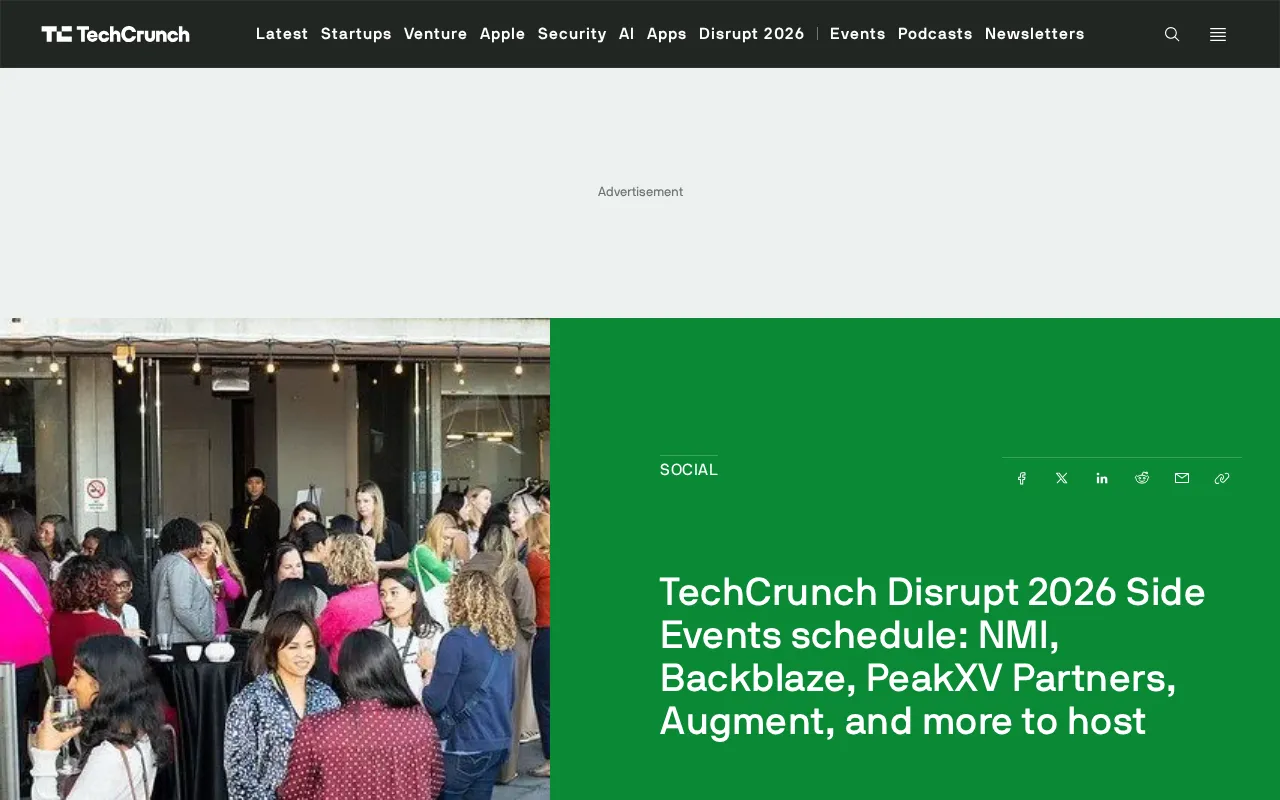
TechCrunch Disrupt 2026 side events feature hosts across payments, cloud storage, venture capital, and AI developer tools.
TechCrunch Disrupt 2026's main conference takes place October 13–15 at Moscone West in San Francisco, but the surrounding side events are equally worth watching. This year's hosts span payment infrastructure (NMI), cloud storage (Backblaze), venture capital (PeakXV Partners, formerly Sequoia India & SEA), and AI coding tools (Augment). The article highlights that smaller side events often outperform the main floor for founders seeking funding or partnerships, and recommends attendees plan ahead and register early based on their goals.
TechCrunch Disrupt 2026 Side Events Are Here
TechCrunch Disrupt has long been a central gathering point for the tech community — a place to build, debate, and connect. The main conference runs October 13–15 at Moscone West in San Francisco, but the real networking doesn't stop when the Expo Hall closes.
The "side events" surrounding the main conference are an integral part of the Disrupt ecosystem. Hosted by various companies and organizations, these events offer smaller, more focused networking opportunities outside the official agenda. According to officially published information, this year's Disrupt side event hosts include NMI, Backblaze, PeakXV Partners, Augment, and several other companies.
Why Side Events Are Worth Your Attention
For anyone attending a major tech conference, the keynotes and booths on the main floor are important — but the conversations that actually lead to partnerships, funding discussions, and lasting relationships often happen at these smaller, more relaxed side events.
Looking at the announced host lineup, this year's Disrupt side events span multiple domains: NMI is tied to payment infrastructure, Backblaze focuses on cloud storage and data backup, PeakXV Partners (formerly Sequoia India and Southeast Asia) is a prominent venture capital firm, and Augment represents the red-hot AI developer tools space. This cross-sector mix of hosts means attendees can engage with practitioners across infrastructure, investment, and AI applications — all within the same stretch of days.
Breaking Down the Host Lineup
Investment and Startup Connections
When a VC firm like PeakXV Partners hosts a side event, it typically becomes a high-value opportunity for startups to connect with investors. For founders seeking funding, these settings are often far more efficient than waiting in line to swap business cards on the main show floor.
PeakXV Partners officially rebranded as an independent firm in 2023, having spun out from Sequoia Capital's India and Southeast Asia operations. With over $9 billion in assets under management, the firm focuses on early- to growth-stage investments in India, Southeast Asia, and other emerging markets globally. Its portfolio includes notable names like BYJU'S, Groww, and Meesho. Hosting a side event at a top North American tech conference is seen as one of the firm's first major public moves since going independent — a signal of its intent to deepen ties with the Silicon Valley ecosystem.
Infrastructure and Tooling Vendors
NMI and Backblaze represent the foundational capabilities that keep modern tech companies running — payments and storage, respectively. For these types of companies, hosting a side event serves dual purposes: maintaining brand visibility and customer relationships, while giving technical teams a venue for in-depth conversations about real-world implementation.
The AI Development Track
Augment's presence reflects the current buzz around AI-powered coding and developer tools. As AI-assisted development becomes a standard part of engineering workflows, companies in this space are commanding an increasingly prominent presence in the conference ecosystem.
Augment is a company focused on AI-assisted software development, with products designed to help engineers understand and scale large, complex codebases. It competes in the "AI coding assistant" category alongside tools like GitHub Copilot and Cursor, but differentiates itself with a stronger emphasis on enterprise-grade code context understanding. The company raised a $227 million Series B led by Index Ventures in 2024 and is one of the most closely watched startups in the developer tools space. As large model capabilities continue to permeate software engineering workflows, players in this category are gaining more and more visibility at industry events.
How to Plan Your Disrupt Schedule
With so many side events to choose from, attendees will need to make strategic choices in advance. The best approach is to filter based on your own goals — whether that's finding investors, landing customers, or keeping up with emerging technology. Since side events are typically limited in size and require separate registration, it's wise to check the full schedule published by TechCrunch and secure your spot early.
It's worth noting that the information currently available covers the host lineup and overall framework for side events. Specific times, themes, and registration details for individual sessions should be confirmed against TechCrunch's official full schedule when it's released.
Takeaway
The TechCrunch Disrupt 2026 side events continue the conference's tradition of community-driven value, offering a diverse host lineup that extends well beyond the main stage. Whether you're a founder, investor, or technologist, these events could easily become one of the most valuable parts of your time at Disrupt.
Related articles

Build a Reasoning Model from Scratch: An 11-Hour Open-Source Course Breakdown
Sebastian Raschka releases a free 8-episode, ~11-hour video course teaching you to build a reasoning model from scratch with Python and PyTorch—from a small Qwen3 model through Verifier, Inference Time Scaling, GRPO, and distillation, with open-source code on GitHub.

An 11-Hour Reasoning Model Course in Practice: How Small Models Learn to Think
Starting from Sebastian Raschka's 11-hour reasoning model course and HN buzz, this analyzes small-model training, legal text version control, Anthropic data policy, and product reliability reviews.

Lightpanda: A Headless Browser Built for AI and Automation
Lightpanda is a headless browser built from scratch in Zig for AI and automation, with 37,852 GitHub stars. This analysis covers its technical approach, design choices, and use cases.