Tencent Open-Sources LoopForge: Self-Hosted Coding Agent Delivery Workflows
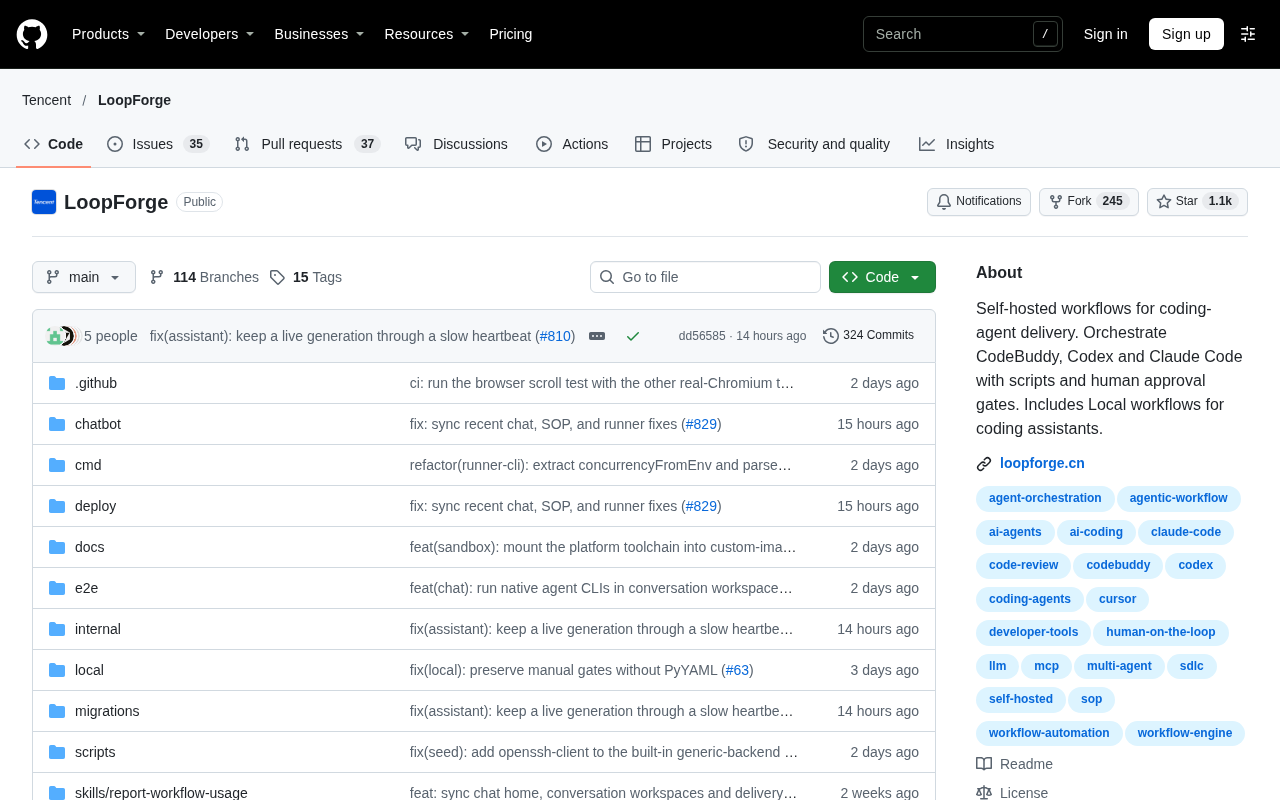
Tencent open-sources LoopForge, a Go-based self-hosted workflow engine that orchestrates coding agents with human approval gates.
Tencent open-sources LoopForge, a Go-based self-hosted workflow engine that brings coding agents like CodeBuddy, Codex, and Claude Code into auditable delivery pipelines. Using script-driven workflows and human approval gates, it tackles trust and traceability, while self-hosting keeps private code secure. It has 1,123 stars; production readiness still needs validation.
Tencent has open-sourced LoopForge on GitHub, a self-hosted workflow engine written in Go with a clear goal: bring coding agents like CodeBuddy, Codex, and Claude Code into genuinely manageable, auditable delivery pipelines. The project currently has 1,123 stars and 244 forks, with 33 new stars in a single day—evidence that "multi-agent orchestration" is becoming a real need in the developer community.

Why coding agents need "workflows"
Over the past year, the capability boundaries of coding agents have expanded rapidly, but the way they're put into practice remains primitive: open a terminal, paste a task, wait for output, check manually. That works fine for one-off use, but as soon as multi-person collaboration, parallel tasks, or compliance traceability come into play, the workflow shows its weaknesses—who triggered which agent, what it did at which step, and who confirmed the result are all scattered across chat logs and terminal history.
LoopForge's entry point is to structure these steps into script-driven workflows and insert human approval gates at key nodes. In other words, it doesn't aim to make agents "smarter"—it solves the engineering problems that arise when agents are used by organizations. This positioning differs from pure agent frameworks: the latter focus on reasoning and tool-calling capabilities, while the former focuses on the determinism and traceability of the delivery process.
According to the GitHub project page, LoopForge supports orchestrating three types of coding agents: CodeBuddy, Codex, and Claude Code. The three cover different usage preferences—CodeBuddy leans toward coding assistance within Tencent's ecosystem, Codex continues the OpenAI lineage of code generation, and Claude Code excels at long context and repository-level understanding. Scheduling them within a single workflow means teams can choose the right agent for each task type without being locked into a single tool.
Coding Agent refers to an AI system capable of understanding natural language instructions, autonomously invoking tools (such as reading and writing files, executing commands, searching codebases), and completing programming tasks. Unlike traditional code completion tools, coding agents have multi-step reasoning and task decomposition capabilities, and can independently complete the loop from requirement understanding to code modification. Representative products include GitHub Copilot's Agent mode, Claude Code, and OpenAI Codex. Their core characteristic is "autonomy"—the agent decides its own execution steps and the order of tool calls, which brings efficiency gains but also introduces risks of opaque processes and uncontrollable results. LoopForge targets exactly this risk, using a workflow engine to constrain the agent's autonomous behavior within an observable, approvable framework.
Self-hosting and human approval: two key design choices
What self-hosting means
LoopForge adopts a self-hosted model, where workflow definitions, execution records, and approval chains all run on the team's own infrastructure. For teams working with private codebases, this is a make-or-break factor—handing source code to a third-party SaaS orchestration service won't pass security review in many organizations. Self-hosting returns the data boundary to the user, at the cost of deploying and maintaining it themselves.
The choice of Go also has practical considerations: a single binary, few deployment dependencies, and strong concurrency handling make it well-suited for long-running workflow scheduling. For teams that need to integrate agents into CI/CD or internal R&D platforms, Go's deployment friendliness lowers the integration barrier.
Self-hosted refers to software deployed on the user's own servers or private cloud environment, rather than a SaaS model hosted by the software vendor. In the AI development tooling space, self-hosting is especially significant: workflow definitions, agent invocation logs, code snippets, and other sensitive data never leave the enterprise network boundary, satisfying data residency and compliance requirements in industries such as finance and government. The cost is that the team must bear the operational work of deployment, upgrades, monitoring, and troubleshooting. LoopForge's choice of Go is precisely to reduce the operational burden of self-hosting—a single statically compiled binary requires no complex runtime dependencies and is particularly easy to deploy in containerized and CI/CD environments, in contrast to solutions requiring Python virtual environments or Node.js runtimes.
Why human approval gates matter
The most worrisome part of coding agents is "directly modifying code." LoopForge sets human approval nodes within script orchestration, so an agent's output must be confirmed before moving to the next step. This design may seem to reduce automation, but it actually solves the trust problem: only when a team can control at which step an agent must stop and wait for human confirmation will it dare to hand it more complex tasks.
This combination of "script-driven + human gates" essentially treats the agent as a workstation on an assembly line rather than an autonomous decision-maker. For R&D processes that require audit trails, this abstraction is closer to reality than a "fully automated agent."
Human Approval Gate is a mandatory pause node in a workflow, where an agent must wait for human confirmation before continuing after completing a stage of work. Conceptually this is similar to manual approval steps in CI/CD pipelines (such as approval before production deployment), but the object of approval shifts from build artifacts to the agent's code modifications. The key value of the approval gate lies in establishing a human-in-the-loop control point: teams can customize approval granularity—whether every file modification needs confirmation, or whether a single approval before a merge request suffices. At the same time, approval records naturally form an audit trail, recording who approved which agent operation and when, providing a basis for post-hoc traceability and accountability. This design combines the agent's automation capabilities with human judgment, striking a balance between efficiency and safety.
How it differs from existing agent orchestration solutions
Several coding agent orchestration solutions already exist on the market, broadly divided into two categories: one is IDE-embedded agent modes tightly bound to the editor; the other is cloud agent services tightly bound to the vendor. LoopForge's difference is that it operates at the workflow layer rather than the model layer or editor layer—it doesn't produce agent capabilities, it only handles scheduling and governance.
The benefit of this layering is decoupling: the underlying agent can be swapped while workflow definitions are preserved, and a team's existing script assets can be reused rather than locked into a platform's proprietary format. According to the project description, LoopForge "includes Local workflows for coding assistants," further indicating that it brings local coding assistant scenarios into workflow management rather than targeting only cloud calls.
One caveat: multi-agent orchestration still lacks a de facto standard. Whether LoopForge's script interface design, approval flow granularity, and the way context is passed between different agents allow teams to migrate smoothly will require more real-world use cases to verify. The star growth on GitHub shows rising attention, but there's still a gap between attention and production readiness.
Multi-Agent Orchestration refers to system design that coordinates multiple AI agents to collaboratively complete complex tasks, involving task allocation, context passing, result aggregation, and conflict resolution. Compared with single-agent scenarios, the challenge of multi-agent orchestration lies in: defining a unified interaction protocol given that different agents have different capability boundaries and output formats; maintaining consistency in the context passed between agents to avoid information loss or misunderstanding; and ensuring the controllability of the overall process when multiple agents work in parallel. The industry has not yet formed a recognized orchestration standard, and vendor solutions differ significantly in interface design, communication mechanisms, and governance granularity. LoopForge's choice of script-driven workflows as the orchestration abstraction essentially treats agents as replaceable execution units and uses deterministic script logic to manage non-deterministic agent behavior—the generality and portability of this approach still need to be tested in practice.
Who it's for, and what to watch out for
LoopForge is likely to appeal to three types of users: mid-to-large R&D teams that need to manage coding agents in private environments, platform engineers who want to integrate agents into existing CI/CD processes, and security/compliance roles that need approval records for agent operations. For individual developers or small teams, the maintenance cost of self-hosting may outweigh the benefits, and using the agents' native interfaces directly would be lighter.
A few things worth evaluating before adoption: whether the team already has a scripted workflow foundation, how approval nodes will connect with existing code review processes, and context consistency issues when switching between multiple agents. The project is at an early stage, and its interfaces and default behaviors may change, so for production use it's advisable to pilot on non-critical paths first.
From a broader perspective, LoopForge represents a trend: the competitive focus for coding agents is shifting from "single-generation quality" to "organization-level controllable delivery." When an agent's ability to write code is no longer a scarce capability, what truly determines the depth of adoption is how to make it work reliably within team processes, how to trace problems when they arise, and how to ensure someone is accountable for key decisions. Tencent open-sourcing such an engineering-oriented project also offers a sample for observing how major domestic companies think about agent governance.
One-line Summary
Tencent open-sources LoopForge, a Go-based self-hosted workflow engine that orchestrates coding agents with human approval gates.
Paragraph Summary
Tencent has open-sourced LoopForge on GitHub, a self-hosted workflow engine written in Go that aims to bring coding agents like CodeBuddy, Codex, and Claude Code into manageable, auditable delivery pipelines. The article notes that coding agents offer a good single-use experience but expose shortcomings in multi-person collaboration and compliance scenarios—opaque processes and unclear accountability. LoopForge addresses trust and auditing through script-driven workflows and human approval gates, while its self-hosted model meets the security needs of private codebases. It sits at the workflow layer rather than the model layer, decoupled from underlying agents and able to reuse existing script assets. The project has gained 1,123 stars and 244 forks, showing rising attention, but production readiness still needs case validation. It suits mid-to-large R&D teams and platform engineers; individual developers should weigh the maintenance cost.
Related articles
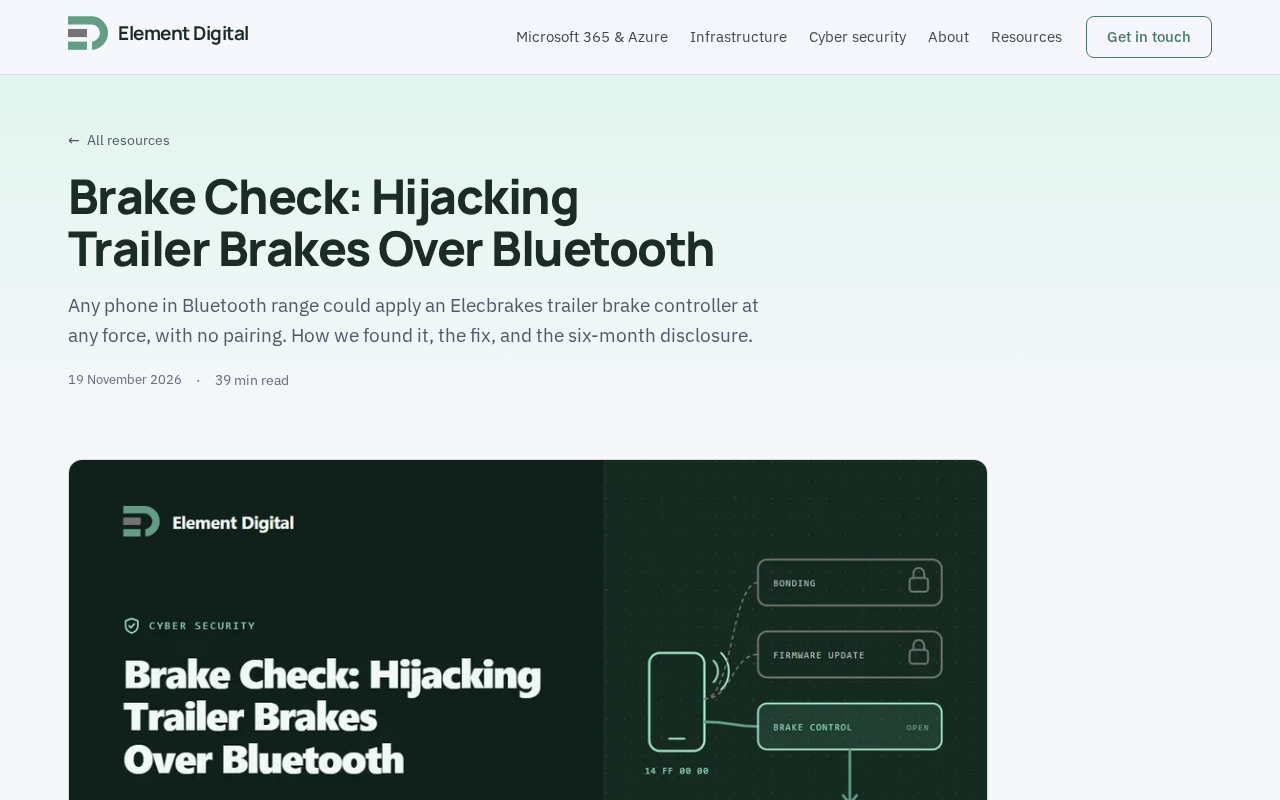
Bluetooth Hijacking of Trailer Brakes: A Security Vulnerability Analysis
Analyzes how the Brake Check project hijacks trailer brake systems over Bluetooth, exploring technical principles, security impacts, and protection recommendations for IoT wireless interface risks.

GTA6 Detail Scrutiny Sparks Debate: Why Players Take Virtual Towers So Seriously
A Hacker News post about GTA6 tower detail scrutiny sparks discussion. This article analyzes the culture of players fixating on open-world details, the boundary between scrutiny and nitpicking, and how community sentiment amplifies detail controversies.

The CPU Designed by AI Itself: Frostbite Rewrites Chip Logic with Interaction Nets
Architect Labs unveils Frostbite: an AI Agent-designed interaction-net CPU carried from theory to 7 nm GDS, with pre-silicon performance at 4.59x an in-order core per watt. We examine the interaction-net hardware approach, how to interpret the efficiency figures, and the verification challenges of Agent-led chip design.