Tesla Leverages Turo to Promote FSD: Test Drive as Experience—Can It Accelerate Autonomous Driving Adoption?
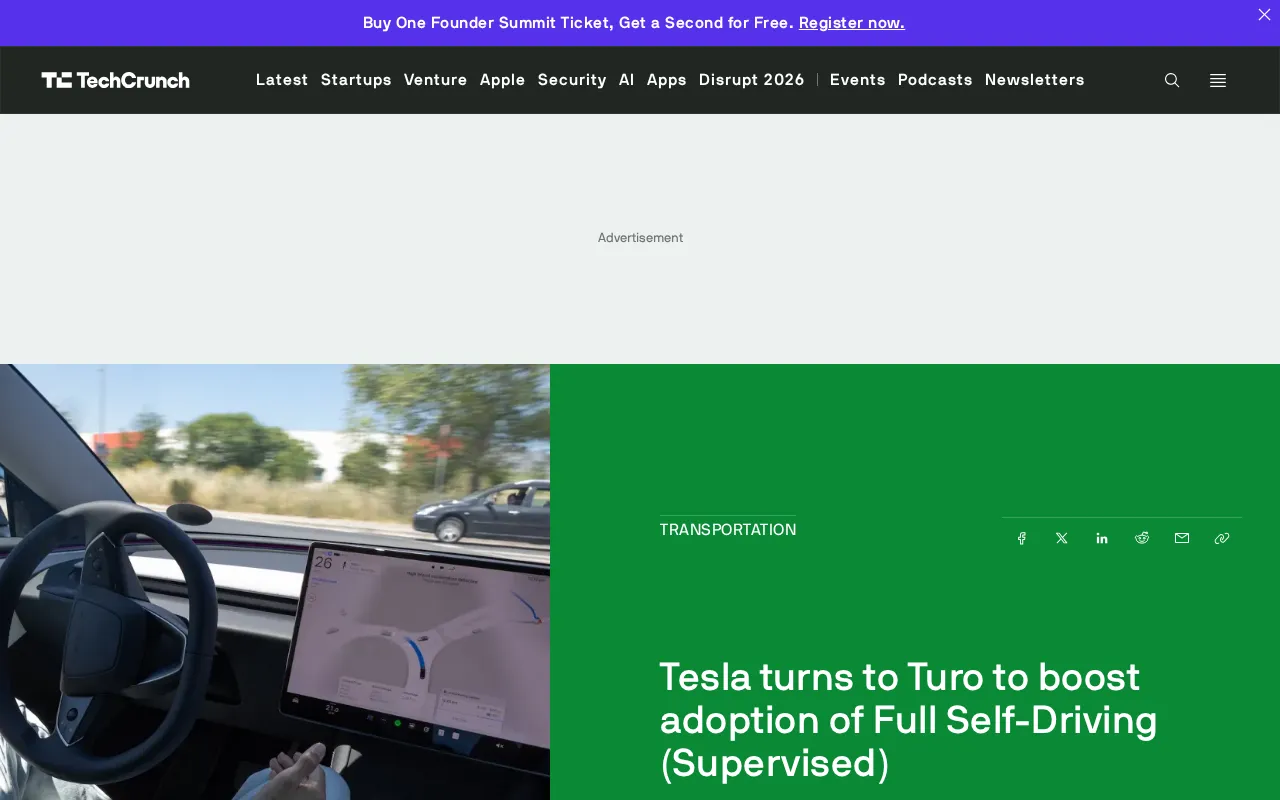
Tesla teams up with Turo to embed the FSD experience into car rentals and give hosts a one-month free trial.
Tesla has partnered with car-sharing platform Turo to embed Full Self-Driving (Supervised) into vehicle rental scenarios, with eligible Turo hosts able to enable FSD on their rental vehicles and receive a one-month free trial. The article argues that this arrangement solves two problems at once: it provides Tesla with a low-cost, high-reach experience entry point, letting renters form product awareness on real roads; and it incentivizes hosts through the trial to proactively enable the feature and spread word of mouth. The move reflects Tesla extending FSD promotion from its own channels into third-party mobility ecosystems, continuing its "experience-driven" strategy. However, whether experiential promotion works still depends on the intuitiveness of FSD's interaction and takeover logic, the consistency of the feature experience, and the speed at which user trust is established; the partnership's specific coverage has yet to be disclosed.
Tesla is seeking new user touchpoints for its Full Self-Driving (Supervised) (FSD Supervised) feature. Recent reports indicate that Tesla has partnered with car-sharing platform Turo to embed the FSD experience into vehicle rental scenarios, with eligible Turo hosts also receiving a one-month free trial of the FSD software. Behind this move is Tesla's attempt at channel innovation on the commercialization path for autonomous driving.
Partnership Details: Entering Through the Rental Scenario
According to RSS sources, Tesla has chosen Turo as a new channel for FSD promotion. Turo is a car-sharing platform that allows vehicle owners to rent out their private cars, and its platform already hosts a considerable number of Tesla vehicles. Under the partnership arrangement, eligible Turo hosts can enable FSD on their rental vehicles and receive a one-month free trial period.
The brilliance of this arrangement lies in the fact that it simultaneously solves two problems: on one hand, it provides Tesla with a low-cost, high-reach entry point for the FSD experience—renters can actually use FSD during their rental period, forming product awareness in real-world scenarios; on the other hand, it incentivizes Turo hosts to proactively enable FSD and spread the word through the free trial, creating word-of-mouth diffusion.
Tesla FSD (Supervised) still requires drivers to maintain attention and be ready to take over at any time, but its capabilities already cover scenarios such as automatic lane changes, automatic parking, and traffic light recognition. For users who have never encountered the feature, the rental scenario provides a low-barrier "test drive" opportunity.
Full Self-Driving (Supervised) is Tesla's official name for its advanced driver-assistance suite, in which "Supervised" emphasizes that the system remains an SAE Level 2 assisted driving system—the driver must maintain attention throughout and be ready to take over at any time, rather than being true driverless operation. The feature is offered as a software option or subscription, covering capabilities such as automatic lane changes, automatic parking, recognition of traffic lights and stop signs, and navigation-assisted driving on city roads. Precisely because it relies on driver supervision, the intuitiveness of the user experience and the clarity of the takeover logic directly determine the trust level of first-time users—which is why Tesla repeatedly emphasizes "experience" in its promotion.
Why Turo? Channel Logic and Industry Background
Tesla's partnership with Turo is no coincidence. Car-sharing and rental scenarios are naturally suited to experiential marketing of autonomous driving features—users experience the feature on real roads and real trips, which is more convincing than showroom demos or advertisements.
From Tesla's perspective, FSD software subscription revenue is a key component of its business model transformation. However, the FSD take rate has always been a focus of outside attention: the feature is priced high, and users' trust in and habits around the "Supervised" version have not yet been fully established. Letting more drivers "try before they buy" through rental channels is a pragmatic way to lower the experience barrier.
Turo, for its part, can use this to enhance the attractiveness of Tesla vehicles on its platform. For renters, choosing a vehicle with FSD means a more tech-forward travel experience, which constitutes a differentiating selling point. The partnership is essentially a complementary exchange of channel resources.
From an industry perspective, the promotion of autonomous driving features is shifting from "technology-driven" to "experience-driven." Tesla has previously pushed FSD penetration through free trials and limited-time transfers, and now by leveraging a third-party rental platform, it has further broadened its reach.
Turo is a US-headquartered peer-to-peer car-sharing platform where individual vehicle owners can rent out their idle cars to renters by the day. The platform handles insurance, identity verification, and transaction matching, and its business model is often described as "the Airbnb of cars." Unlike traditional rental companies such as Hertz and Avis, Turo's vehicle supply comes from dispersed private owners, offering greater model diversity and making it easier to embed owner-side software configurations. For Tesla, this means it does not need to build its own fleet or stores—it only needs to incentivize hosts to enable the feature, and a large number of renters can then encounter FSD on real trips, expanding the experienced population at a lower marginal cost.
The FSD subscription model is an important vehicle for Tesla's business model transformation. Early FSD was mainly offered as a one-time purchase option, with the price raised multiple times; Tesla later introduced a monthly subscription option in North America, allowing owners to activate it on demand and cancel at any time. The subscription model lowers the barrier to trying the feature, but it also makes take rate and retention key metrics for measuring its revenue potential. For this reason, Tesla continues to drive penetration through limited-time free trials, feature transfers for existing owners, and invitation-based experiences—and by leveraging third-party platforms like Turo, it adds touchpoints at the very front of the subscription conversion funnel: the experience stage.
Can Experiential Promotion Work?
Embedding FSD into the rental scenario rests on the core assumption that "experience drives conversion." This logic is nothing new in the software industry, but for autonomous driving features, the depth and safety requirements of the experience are higher.
When renters use FSD during their rental period, they are in effect encountering supervised autonomous driving for the first time without systematic training. This places demands on Tesla's feature design: FSD's interaction prompts and takeover logic must be intuitive enough, or the effect could backfire. On the other hand, if Turo hosts develop daily usage habits after receiving the free trial, they may also convert into long-term subscribers.
It is worth noting that Tesla's FSD promotion strategy is becoming more flexible. From direct sales to subscriptions, and now to partnerships with shared mobility platforms, Tesla is trying different paths for market education. Whether this "experience-first" strategy can raise FSD's actual adoption rate depends on the consistency of the feature experience and the speed at which user trust is established.
At present, the specific coverage and eligibility conditions of the partnership have not been fully disclosed. But what is certain is that Tesla is expanding FSD promotion from its own channels into the broader mobility ecosystem. For observers watching the commercialization of autonomous driving, this is a signal worth tracking.
One-line Summary
Tesla teams up with Turo to embed the FSD experience into car rentals and give hosts a one-month free trial.
Paragraph Summary
Tesla has partnered with car-sharing platform Turo to embed Full Self-Driving (Supervised) into vehicle rental scenarios, with eligible Turo hosts able to enable FSD on their rental vehicles and receive a one-month free trial. The article argues that this arrangement solves two problems at once: it provides Tesla with a low-cost, high-reach experience entry point, letting renters form product awareness on real roads; and it incentivizes hosts through the trial to proactively enable the feature and spread word of mouth. The move reflects Tesla extending FSD promotion from its own channels into third-party mobility ecosystems, continuing its "experience-driven" strategy. However, whether experiential promotion works still depends on the intuitiveness of FSD's interaction and takeover logic, the consistency of the feature experience, and the speed at which user trust is established; the partnership's specific coverage has yet to be disclosed.
Related articles

Hermes Agent Beginner's Guide: A Self-Evolving AI Assistant
Hermes Agent beginner's tutorial: how to install and use the 41.7K-star self-evolving AI Agent. We break down its learning loop, three-tier memory, and Skill self-improvement, compare it with Claude Code and OpenClaw, and include WSL installation steps.

RAG Interview Essentials: Breaking Down the Full Offline Indexing and Online Retrieval Pipeline
A complete breakdown of the RAG retrieval-augmented generation workflow: offline document loading, chunking, vectorization, and indexing; online query rewriting, vector retrieval, reranking, and generation, plus core interview points and system optimization directions.

AI Large Models for Absolute Beginners: Principles and API Calling in Practice
From AI's evolution to large model training principles and core concepts like Token, Temperature, and Top-P, this article explains system prompts, Function Call, RAG, and memory with hands-on examples and four API call scenarios—ideal for beginners.