Testifly: A Zero-Maintenance Autonomous AI Quality Testing Tool
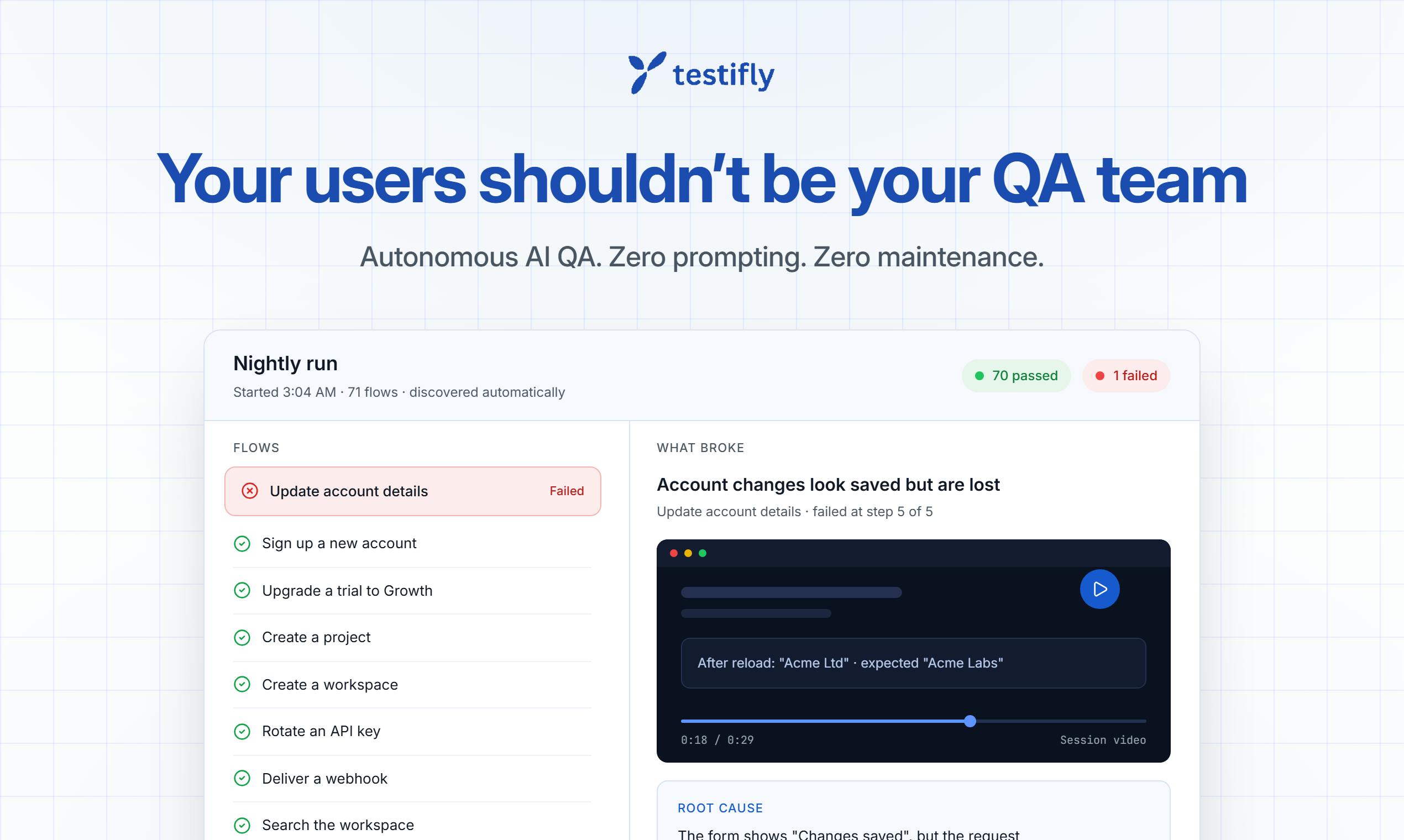
Testifly uses autonomous AI agents for zero-prompt, zero-maintenance software testing, targeting small teams.
Testifly is an autonomous AI quality testing tool that debuted on Product Hunt, featuring no prompts and zero maintenance. It uses AI agents to automatically discover web app user flows, write test cases, and self-heal test scripts when the app changes, and can explain failures via video. Target users are small teams lacking testing resources, and it offers a 30-day free trial. The product received 113 votes and 27 comments on Product Hunt, ranking third for the day, indicating some attention. However, as an early-stage product, its actual effectiveness, false positive rate, and support for complex applications remain unclear and need market validation. The article suggests focusing on verifying self-healing capability and accuracy of failure explanations during the trial.
Introduction
In fast-paced software development, testing is often the most painful part for small teams. CTOs and founders, faced with limited resources and time, find it hard to balance feature development with quality assurance. Testifly has emerged on Product Hunt, positioning itself as "autonomous AI quality testing, no prompts needed, zero maintenance," aiming to provide a brand-new testing solution for small teams.
Core Features: Autonomous Discovery and Self-Healing Tests
Testifly's core lies in connecting to your web app, after which it automatically discovers user flows, writes test cases, and repairs test scripts itself when the app changes. The entire process requires no manual prompt writing or test code maintenance, thanks to the autonomous decision-making capabilities of its underlying AI agent. For small teams lacking dedicated testers, this means they can establish continuous testing capabilities at almost zero cost.
According to its Product Hunt page, Testifly can also explain test failures through videos, helping developers quickly pinpoint issues. This combination of "self-healing + explainability" is relatively unique among current automated testing tools.
AI Agent has been an important paradigm in the AI field in recent years, referring to intelligent systems that can perceive their environment, plan autonomously, and execute multi-step tasks to achieve goals. Unlike traditional single-call models, AI agents typically possess memory, tool invocation, and decision-making capabilities, enabling them to complete complex processes without human intervention. In software testing scenarios, AI agents can simulate the behavior of human test engineers: exploring application interfaces, identifying critical paths, generating test assertions, and analyzing causes when failures occur. Testifly's claimed "autonomous discovery and self-healing" is based on this agent architecture, distinguishing it from automation tools that can only execute predefined scripts. Understanding the boundaries of AI agent autonomy helps evaluate the actual performance of such tools under complex business logic.
Self-healing Tests refers to the ability of testing tools to automatically detect changes and repair locators or steps when application UI or interfaces change (such as element IDs or layout adjustments) causing test scripts to fail, without manual code modification. In traditional automated testing, the cost of maintaining scripts often accounts for a large proportion of total testing investment. Self-healing capability significantly reduces maintenance burden by dynamically matching element attributes, using visual recognition, or AI reasoning to re-locate targets. However, the accuracy of self-healing depends on the complexity of changes, and excessive self-healing may mask real defects. Therefore, when evaluating Testifly, it is necessary to focus on its self-healing trigger conditions, repair success rate, and whether it provides change audit logs.
Target Users and Value Proposition
Testifly clearly targets small teams that lack the time or resources for testing and maintenance. Such teams typically rely on manual testing or simple automation scripts, but often struggle to cover all scenarios, and maintenance costs are high. Testifly's promise of "zero maintenance" directly addresses this pain point.
On Product Hunt, Testifly received 113 votes and 27 comments, ranking third for the day, indicating a certain level of community attention. However, as a new product, its actual effectiveness and long-term stability still need market validation.
Market Positioning and Competitive Analysis
Autonomous testing is not an entirely new concept, but Testifly's emphasis on "zero prompts" and "zero maintenance" distinguishes it from AI testing tools that require writing scripts or prompts. Compared with traditional record-and-playback tools or AI-based test generators, Testifly attempts to automate the entire testing process, from discovery to maintenance. However, its actual capability boundaries remain unclear; for example, key metrics such as support for complex applications and false positive rates are not reflected in public information.
Record-and-playback tools are an early form of automated testing, recording user operations and generating repeatable scripts. Such tools (like Selenium IDE) are easy to get started with, but scripts are fragile; once the UI changes, manual updates are required, resulting in high maintenance costs. AI-based test generators use machine learning to generate test cases from user behavior or requirement documents, reducing the workload of writing scripts, but still require manual prompts or seed data, and generated cases may lack business context. Testifly attempts to automate the entire "discovery-generation-maintenance" chain; its "zero prompts" means no manual input of testing intent is needed, relying on autonomous exploration of application behavior. Compared with the above tools, Testifly's differentiation lies in the end-to-end autonomy of the agent, but this also places higher demands on AI generalization capabilities.
Conclusion
Testifly represents a trend: using AI agents to lower the barrier to software testing. For resource-constrained small teams, it may be an option worth trying, especially since its 30-day free trial reduces decision risk. However, considering the product is still in its early stages, it is recommended to focus on verifying its self-healing capability and the accuracy of failure explanations during the trial.
False Positive Rate is one of the core metrics for evaluating automated testing tools, referring to the proportion of test failures reported when the actual application has no defects. A high false positive rate can cause development teams to lose trust in test results, leading them to ignore alerts and rendering testing ineffective. For self-healing testing tools, false positives may stem from AI misjudging UI changes or incorrect assertions about dynamic content. Test Coverage is another key metric, measuring the extent to which test cases cover application functional paths. Especially for tools that autonomously discover flows, it is necessary to confirm whether they can reach deep business logic rather than just surface operations. Public information does not disclose these metrics; it is recommended to design controlled experiments during the trial to quantify Testifly's false positive rate and coverage in real projects, and compare them with existing testing solutions.
One-line Summary
Testifly uses autonomous AI agents to achieve zero-prompt, zero-maintenance software testing, targeting small teams.
Paragraph Summary
Testifly is an autonomous AI quality testing tool that debuted on Product Hunt, featuring no prompts and zero maintenance. It uses AI agents to automatically discover user flows in web applications, write test cases, and self-heal test scripts when the app changes, and can explain failures via video. Its target users are small teams lacking testing resources, and it offers a 30-day free trial. The product received 113 votes and 27 comments on Product Hunt, ranking third for the day, indicating some attention. However, as an early-stage product, its actual effectiveness, false positive rate, and support for complex applications remain unclear and need market validation. The article suggests focusing on verifying self-healing capability and the accuracy of failure explanations during the trial.
Related articles
Microsoft WebIQ: Verifiable Real-Time Web Grounding for AI Agents
Microsoft WebIQ gives AI Agents real-time, citable web grounding across web, news, images, videos, and Places—164ms P95 latency, 50% fewer tokens, Scopes source control, and MCP integration.
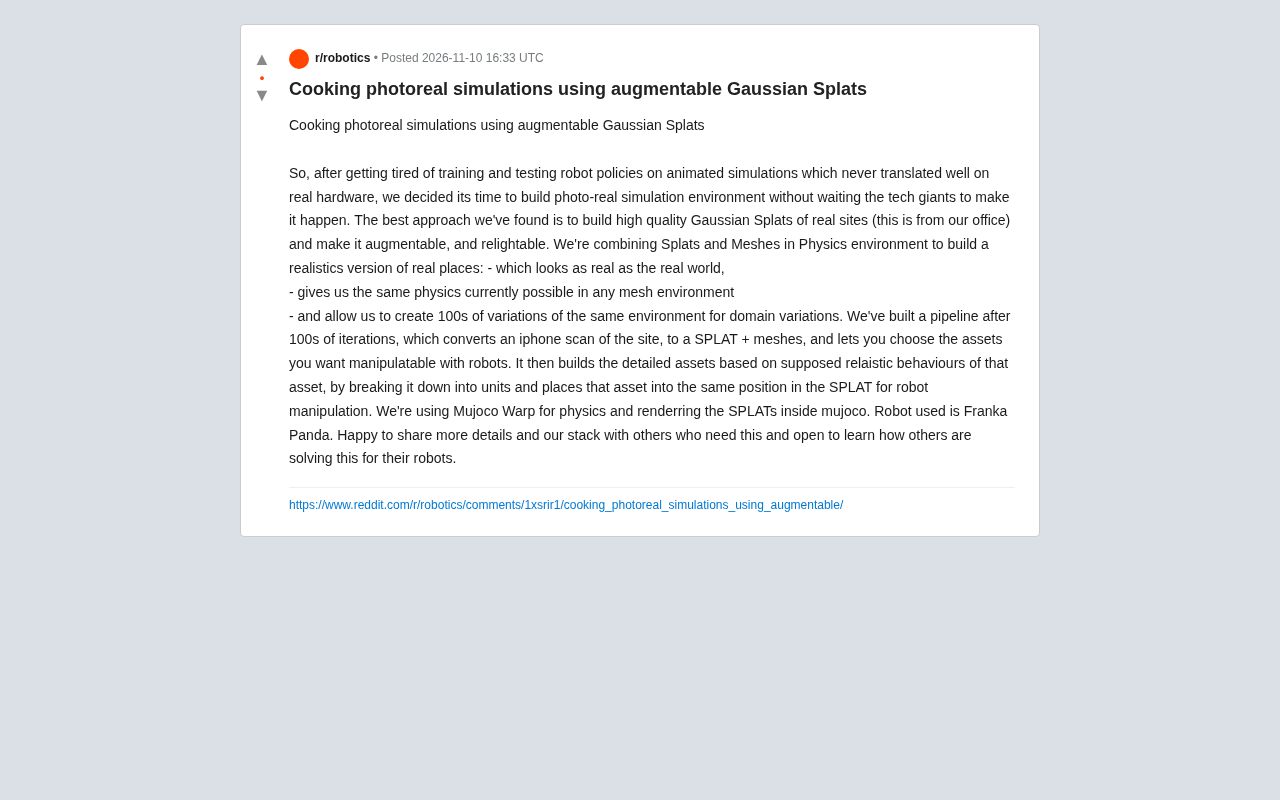
Augmentable Gaussian Splatting: Building Photorealistic Simulation Environments for Robot Training
Team combines Gaussian Splatting with meshes to build photorealistic robot simulation environments, integrating MuJoCo Warp physics and Franka Panda for augmentable, relightable real-site simulation.

Gemini 4 Carbon Released: The Leap from Gemini 3 to Gemini 4 in Under a Year
Google releases Gemini 4 Carbon, less than a year after Gemini 3. In the official demo, Carbon reverse-engineered the Theme Park binary, added a new DeepMind-themed ride, and ported it to the web in one shot.