The 19-Year-Old PayPal Mafia Dream: How Competition Kids Became the Backbone of AI

A tweet recalls a 2017 lunch idea, tracing how competition kids grew into the backbone of AI through community.
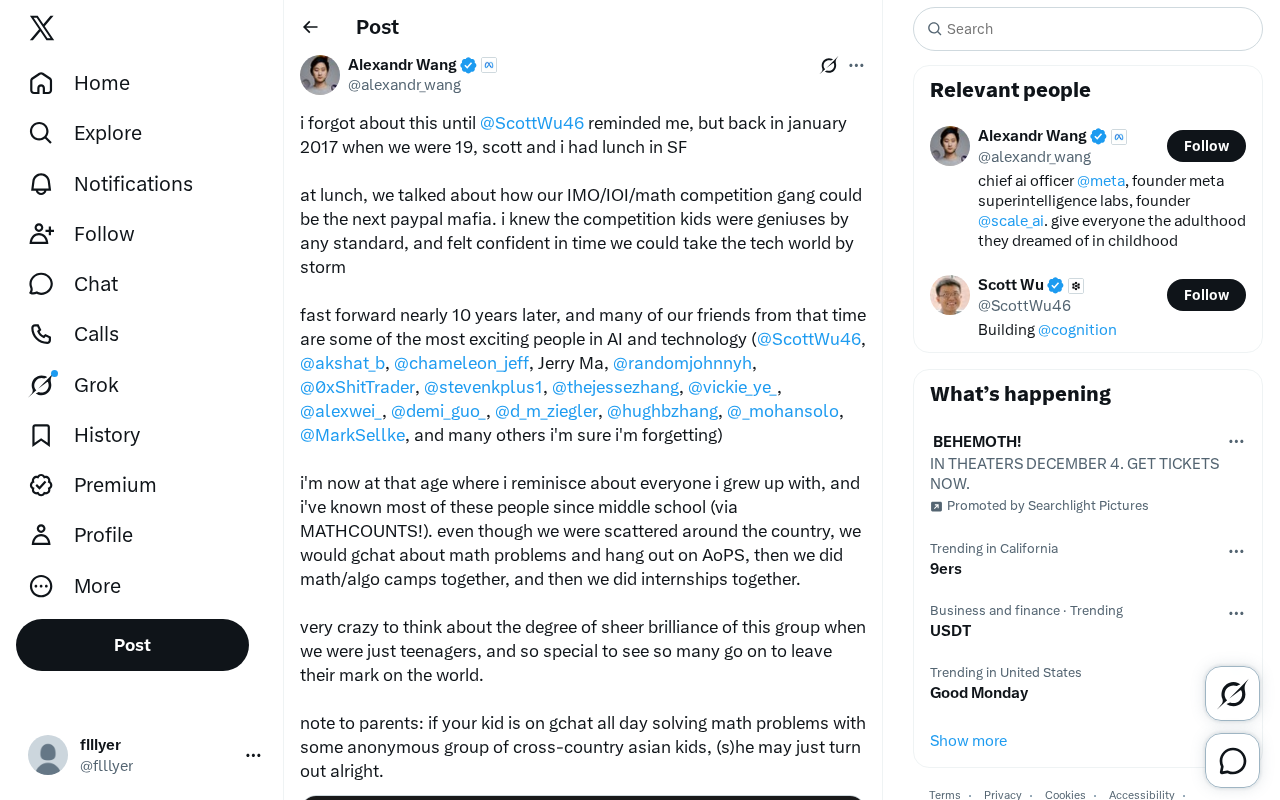
Starting from a nostalgic tweet, the article recounts how in 2017, the 19-year-old author and Scott Wu, over lunch in San Francisco, imagined their competition-circle friends becoming the next PayPal Mafia. The tweet named Scott Wu, Demi Guo, Johnny Ho, and others now active on the front lines of AI research and startups. The author traces their growth path: meeting in middle school through MATHCOUNTS, maintaining high-frequency intellectual interaction on gchat and AoPS forums, and attending training camps and internships together. The article stresses that what truly matters isn't the feel-good "genius kids finally make it big" narrative, but the talent-emergence mechanism formed by a high-density peer community solving problems and growing together over the long term.
One Lunch, One Wild Idea
January 2017, San Francisco. Two 19-year-olds sat down for lunch together. One of them was Scott Wu. They got to talking about an idea that sounded pretty cringey at the time: could the friends around them—the crowd who did math competitions and informatics olympiads—become the next PayPal Mafia?
The person who posted this memory is a longtime friend of Scott's. He wrote that he was extremely confident at the time that these competition-bred kids were geniuses by any standard, and that given time they would take the tech world by storm. Looking back nearly a decade later, that judgment wasn't so much prescient—it was more like an intuition that got validated after the fact.
From MATHCOUNTS to the AI Frontier: An Underrated Growth Path
The most valuable thing about this tweet isn't the nostalgia—it's that it sketches out a specific growth path.
Most of these people met in middle school, at math competitions like MATHCOUNTS. Even though they were geographically scattered across the US, their daily life was: discussing math problems on gchat, hanging out on the AoPS (Art of Problem Solving) forums, then attending math and algorithms training camps together, and later doing internships together.
The key to this chain is "peer density." The competition circle put a group of teenagers with similar intellectual levels and highly overlapping interests into the same high-frequency interactive space. They weren't organized by a classroom—they found each other on their own. The author's half-joking reminder—that if your kid spends all day on gchat solving math problems with a bunch of anonymous out-of-state Asian kids, he or she might actually turn out pretty accomplished—is really about this kind of self-organized intellectual community.
MATHCOUNTS is a national math competition program in the US for middle school students, including school-level selection, state-level and national finals, known for emphasizing problem-solving speed and creative thinking. AoPS (Art of Problem Solving) is a math learning community and publishing organization that started as a forum; its forums gather a large number of competition students to discuss hard problems, share solutions, and organize online training, and it later developed textbooks and online courses. gchat refers to the instant messaging service of Google Talk/Google Chat, which around the 2010s was a common low-friction communication tool among students. Together these platforms formed the high-frequency interactive space for competition students outside of class: competitions provided selection and goals, forums provided continuous practice and discussion, and instant messaging provided daily connection. This combination allowed geographically dispersed students to form stable peer networks without relying on being in the same school or city.
Those Kids from Back Then Are Now Scattered Across the Core of AI
The tweet named a long list of people: Scott Wu, Akshat Bubna, Jeff, Jerry Ma, Johnny Ho, Steven, Jesse Zhang, Vickie Ye, Alex Wei, Demi Guo, Daniel Ziegler, Hugh Zhang, Mohan, and more that the author said he must have missed.
He used the phrase "some of the most exciting people in AI and technology." Whether that judgment holds up is something people in the circle have their own views on, but one undeniable fact is: those middle schoolers who grinded problems on AoPS ten years ago are indeed showing up in large numbers on the front lines of AI research and startups.
The author himself marveled that he's already reached the age of reminiscing about childhood friends, and that he's known most of them since middle school.
Scott Wu, mentioned in the tweet, is co-founder and CEO of Cognition AI, the company behind the AI software engineer Devin; Demi Guo is co-founder of AI video generation company Pika; Johnny Ho and Scott Wu are both co-founders of Cognition. These names cluster on the front lines of AI startups and research, reflecting the migration path of competition-background talent into AI: the abstract modeling, rapid problem-solving, and engineering implementation skills trained by math and algorithm competitions overlap heavily with the needs of current large model R&D, inference systems, AI coding tools, and related directions. It should be noted that the tweet author is using personal observation and an insider's perspective, and the named list does not constitute a strict ranking or industry consensus of "the most exciting people in AI"—it's more about presenting a phenomenon of talent clustering.
Beyond the Competition Genius Narrative, What's More Worth Looking At
Placed into today's AI narrative, this tweet is easily simplified into a feel-good story of "genius kids finally making it big." But what the author himself really emphasizes is the "pure concentration of talent" that group displayed in their teens, and the special feeling of seeing them each leave their mark.
There's a detail here that's easy to overlook: what he focuses on in his recollection isn't who won what award or who joined what company, but the specific trajectory of gchat, AoPS, training camps, and internships. In other words, what he can't stop thinking about is the experience of a group of people solving problems and growing together over the long term, not some moment of glory.
For people who care about the AI talent ecosystem, this offers a plain observation angle: the emergence of top talent is often not an isolated individual event, but the result of some high-density community operating over the long term. As for where the next such community will appear, nobody knows the answer, but the conditions for its formation may not be all that different from what was discussed over that lunch ten years ago.
The PayPal Mafia refers to PayPal's early core team and affiliated entrepreneurs, including Peter Thiel, Elon Musk, Reid Hoffman, Max Levchin, and others. After PayPal was acquired by eBay, they dispersed to found or invest in companies like LinkedIn, Tesla, SpaceX, Palantir, and YouTube, becoming one of Silicon Valley's most influential entrepreneurial networks. This concept is often used in tech circles to describe the phenomenon of "people from the same organization or community continuously producing large-scale influence." The idea discussed over lunch in 2017 in the original text uses this phrase precisely to express an expectation: can the high-density peer network of the competition circle, like the PayPal team, continuously produce influential tech entrepreneurs and researchers over the next decade? Understanding this allusion helps grasp the specific meaning of "the next PayPal Mafia" in the tweet's recollection.
Related articles

Human-in-the-Loop QA Workflow: Adding Test Gates to Coding Agents
A Reddit developer shares a human-in-the-loop QA workflow for coding agents: agents write tests first, humans freeze them, scripts adjudicate. Across 17 tickets, more tests increased false positives—listing uncovered scope proved more effective.

MiniMax Open-Sources H3-Image: An Open-Weights Image Model Built on H3
MiniMax releases H3-Image, an open-weights image model built on the H3 video model. The community is watching its image editing, text-to-image quality, and the deployment burden of its 32B text encoder, with potential competition against Qwen Image 2.1.

Reddit Turns User Discussions into AI Product Reviews
Reddit launches AI product reviews that aggregate community discussions into pros and cons summaries for 10,000 products, helping consumers research before holiday shopping. This analysis examines data value, accuracy concerns, and commercialization boundaries.