The AI Agent Era: Building a New Product Paradigm with Evals
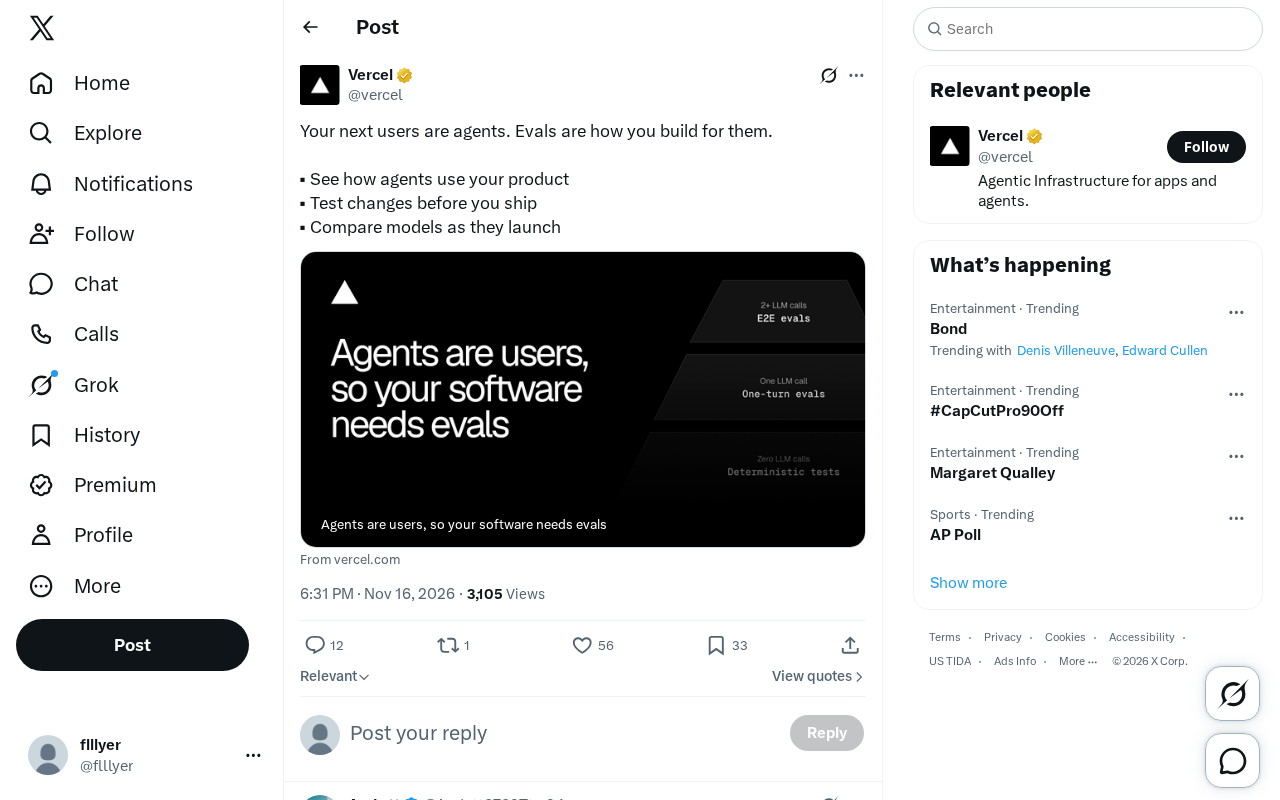
Agents are becoming the new users of products, and Evals are essential infrastructure for building and optimizing Agent experiences.
The article points out that AI Agents are becoming an important user group for products, and their usage patterns are fundamentally different from humans: calling APIs, parsing structured outputs, and executing multi-step tasks without supervision. To this end, product teams need to establish an Evals evaluation system to achieve three core capabilities: observing actual Agent usage behavior, systematically testing the impact of changes before launch, and comparing performance side-by-side when new models are released. Evals transform product change risks into quantifiable signals, helping teams make decisions with data rather than intuition. The article also emphasizes that product teams need to serve both human and Agent users, establish dual-track observability, and provides practical recommendations from logging to building Evals scenario sets.
AI Agents are becoming the "next users" of products. This is no longer a futuristic prophecy—it is happening now. As Agents replace humans as the primary callers of APIs and interfaces, product teams need a completely new methodology to understand and optimize this mode of usage. Evals (evaluation systems) are built precisely for this purpose.
Agents as Users: A New Assumption for Product Design
Traditional product design revolves around human users' cognitive habits, interaction paths, and fault tolerance. But Agents "use" products in a fundamentally different way: they call APIs, parse structured outputs, and execute multi-step tasks under unsupervised or semi-supervised conditions. An interface that is friendly to humans may be full of ambiguity for Agents; conversely, an interface that is "too machine-friendly" for humans may be the key to Agents completing tasks efficiently.
The first key point from the original article is "See how agents use your product"—observe how Agents actually use the product. This requires teams to establish observability, recording Agents' call patterns, failure points, and behavioral traces. Unlike behavioral analysis of human users, Agent behavior analysis is closer to system log mining: you need to focus on tool selection, parameter construction, and error recovery strategies, rather than click heatmaps or dwell time.
Pre-launch Testing: Evals as a Release Gate
"Test changes before you ship" is the second core point. In Agent scenarios, traditional unit tests and integration tests are insufficient to cover the uncertainty of real-world usage. Evals provide a systematic regression testing method: define a set of task scenarios, let Agents run in a controlled environment, and evaluate their completion quality.
The value of this testing lies in turning "whether a product change is safe" from a subjective judgment into a quantifiable signal. When teams modify API response formats, adjust error codes, or change documentation structure, Evals can quickly reveal the impact of these changes on Agent behavior. For products that rely on Agents as traffic entry points, this amounts to a pre-release quality gate.
Evals (evaluation systems) in LLM application development refer to a systematic, repeatable testing framework. Unlike traditional unit tests, Evals target scenarios with probabilistic outputs: the same input may yield multiple reasonable outputs, so exact matching cannot be used to determine pass or fail. Common practice involves defining a task set, designing scoring criteria (which may be rule-based matching, model scoring, or human annotation), then running in batches and calculating pass rates or quality scores. The core value of Evals is transforming the subjective "is the quality good?" into objective, trackable metrics, enabling teams to quickly determine whether the system has regressed after each change.
Continuous Comparison Across Model Iterations
The third key point, "Compare models as they launch," points to a reality: underlying models update far faster than product iteration cycles. When new models are released, Agent performance may change significantly—some tasks improve, while others may regress. Evals enable teams to conduct side-by-side comparisons before switching models, using data rather than intuition to decide whether to upgrade.
This comparison capability is especially important as model competition intensifies. Product teams no longer need to bet that a certain model "should be better"—they can make choices based on actual performance on their own task sets.
Model comparison in practice typically requires controlling variables: use the same set of Evals tasks, the same prompts and tool configurations, replace only the underlying model, and then compare success rates, latency, and cost across models in completing tasks. Since different models have different sensitivities to prompts, comparison also requires attention to prompt适配性—a prompt that works well for Model A may not be optimal for Model B. Therefore, fair comparison often requires preparing a set of prompt variants for each model and reporting best or average performance, avoiding erroneous conclusions caused by prompt mismatch.
From Human-Centered to Agent-Centered: The Challenge of a Mindset Shift
Behind the practice of Evals is a deeper mindset shift: product teams need to serve two types of users simultaneously—humans and Agents. The needs of these two user types sometimes align and sometimes conflict. For example, detailed error messages designed for humans may be overly verbose for Agents; concise JSON responses optimized for Agents may confuse human developers.
Although the original article does not elaborate on this tension, its three key points essentially establish a dual-track observability capability: observing how humans use the product and how Agents use it; testing both human experience and Agent success rates. For products aimed at developers or APIs, this dual-track capability is shifting from a nice-to-have to a must-have.
Dual-track observability refers to product teams maintaining two sets of user behavior analysis systems simultaneously: one for human users, focusing on metrics such as clickstreams, dwell time, and conversion funnels; the other for Agents, focusing on metrics such as API call sequences, tool selection distribution, parameter construction error rates, and multi-step task completion rates. The data sources and analysis methods of the two systems differ greatly—human behavior analysis relies on front-end instrumentation, while Agent behavior analysis relies on server-side logs and call chain tracing. The key to establishing dual-track observability lies in unifying the identifier system so that the same product change can be evaluated from both human and Agent perspectives simultaneously.
Practical Recommendations
If you are building a product that may be used by Agents, you can start with the following steps: establish Agent behavior logs to identify high-frequency call paths and typical failure patterns; design Evals scenario sets around core tasks as a baseline for change regression; run comparative evaluations when new models are released and record performance changes. These actions do not require large-scale investment, but they can help teams accumulate critical knowledge before Agents become mainstream users.
The era of Agents as users is arriving. Evals are not optional—they are essential infrastructure for building these products.
Related articles

Microsoft Global Email Outage Leads to Chlorine Leak at German Hotel, Injuring 15
A Microsoft 365 and Outlook global outage prevented a chlorine safety alert from reaching a German Phantasialand hotel, injuring 15 guests and exposing the fragility of cloud-dependent safety systems.

iPhone Duo to Support Face Unlock Using Only the Front Camera
Apple is developing front-camera-only face unlock for the iPhone Duo, now testing in the iOS 27.3 beta. We analyze the technical approach, user experience, and security trade-offs.

NVIDIA Board Denies Considering Rehiring Jensen Huang
According to CNBC, NVIDIA's board said it is not considering reinstating Jensen Huang as CEO and is focused on the investigation, with no discussions of a return.