The AI Deautomation Myth: High-Exposure Occupations Don't Necessarily Have Worse Working Conditions
Study finds higher AI exposure correlates with better, not worse, working conditions—exposure ≠ automation benefit.
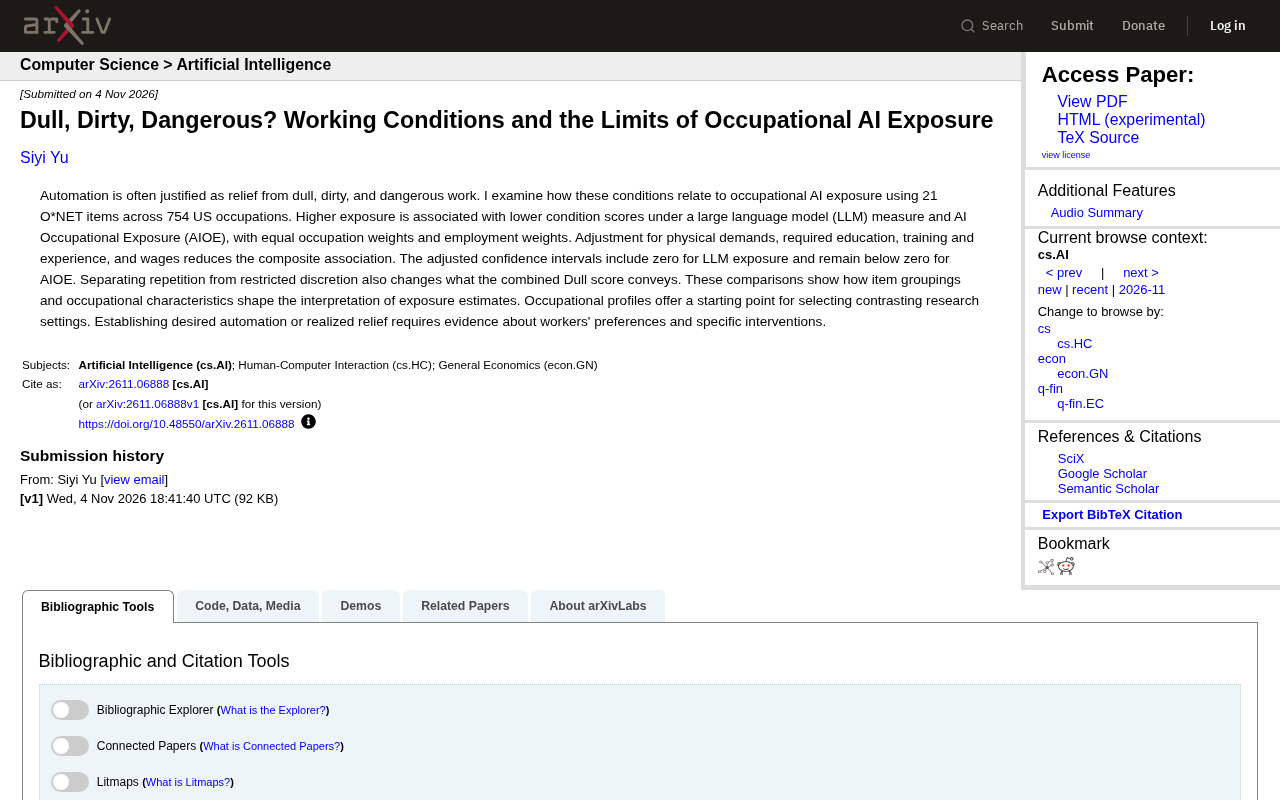
Based on 754 U.S. occupations and 21 O*NET work-condition items, the study tested associations between LLM exposure and the AIOE index on the one hand and working conditions on the other. Contrary to the popular "AI replaces dull, dirty, dangerous jobs first" narrative, higher exposure correlates with lower composite condition scores. After controlling for physical demands, education, training, and wages, the LLM association loses significance and the AIOE effect narrows sharply, suggesting physical and human capital factors explain much of the link. The authors stress that exposure measures capability-task overlap, not welfare improvement.
Introduction
Automation is often promoted as liberating humans from "dull, dirty, and dangerous" work. But a study covering 754 U.S. occupations and 21 O*NET work-condition items delivers a counterintuitive answer: under both LLM exposure and AI Occupational Exposure (AIOE) measures, occupations with higher AI exposure actually score lower on working conditions. This finding challenges the narrative that "AI will replace the bad jobs first," and suggests that exposure metrics themselves are not equivalent to automation benefits.
What Is the "Dull, Dirty, Dangerous" Framework?
"Dull, Dirty, Dangerous" (3D) is a long-standing classification framework in industrial automation, referring to three categories of work: repetitive and boring, environmentally hazardous, and physically risky. Policymakers and the media often invoke it to justify AI and robotics—replacing human labor with technology to improve workers' circumstances.
However, this framework has long remained at a qualitative level. This study operationalizes it into 21 O*NET work-condition items covering physical demands, repetitiveness, autonomy, environmental exposure, and other dimensions, providing the first systematic test at the occupational level of the statistical association between "AI exposure" and "working conditions."
O*NET (Occupational Information Network) is an occupational information database funded by the U.S. Department of Labor, systematically cataloging structured descriptions of tasks, skills, knowledge, work activities, and working conditions for hundreds of occupations. Researchers often use its items as quantifiable proxy variables for occupational characteristics—for example, using items like "physical demands," "environmental exposure," and "autonomy" to characterize working conditions. The database's strength lies in its broad coverage and standardized coding, facilitating cross-occupational comparison; its limitation is that the items derive from expert assessments and survey aggregation, which may not fully reflect frontline workers' subjective experience. Understanding this helps explain why the same O*NET items can yield different statistical conclusions under different grouping methods.
Core Finding: Higher Exposure, Lower Condition Scores
The study uses two exposure measures: LLM exposure based on large language models, and the existing AI Occupational Exposure (AIOE) index. Under both equal-occupation weighting and employment weighting, results are consistent—occupations with higher exposure have lower composite working-condition scores.
In other words, the occupations covered by AI capabilities are, on average, not the "hardest and most grueling" jobs. This directly undermines the intuitive expectation that "AI will take over bad jobs first."
The Association Weakens Markedly After Adjusting for Confounders
Researchers further controlled for physical demands, required education level, training and experience requirements, and wages. After adjustment, the composite association shrinks significantly: the confidence interval for LLM exposure crosses zero and is no longer statistically significant; the AIOE confidence interval remains below zero, but the effect size has narrowed substantially.
This indicates that much of the association between working conditions and AI exposure can be explained by occupations' physical characteristics and human capital requirements. Reading "high AI exposure" directly as "poor working conditions" is an oversimplification.
LLM exposure and AIOE are two distinct measurement approaches. LLM exposure is typically based on semantic matching between large language model capabilities and occupational task descriptions, assessing what proportion of tasks in an occupation can be "reached" by current models; AIOE (AI Occupational Exposure), proposed by Felten et al., constructs an index by mapping AI capability scores to occupational ability requirements. Both measure "the degree of overlap between technological capabilities and tasks," not "the probability of actually being automated." High exposure only means tasks fall within model capabilities; whether they are actually replaced also depends on cost, regulation, organizational inertia, and social acceptance. Therefore, reading exposure directly as automation pressure is itself a conceptual leap.
Statistically, "the confidence interval crossing zero" means that at conventional significance levels, the null hypothesis of "zero effect" cannot be rejected—i.e., the data are insufficient to support a stable association. But this does not prove the association is absent; it could be due to sample size, measurement error, or model specification. The narrowing of effect size suggests that even if the association genuinely exists, its magnitude is far smaller than the unadjusted surface results. The value of such confounder adjustment lies in distinguishing "direct associations" from "indirect associations mediated by third variables (such as physical demands and human capital)," the latter of which cannot serve as evidence that "AI targets bad jobs."
How Indicator Grouping Distorts Conclusions
The study also reveals a methodological trap: merging "repetitiveness" and "limited autonomy" into a single "Dull" score changes the meaning that indicator conveys. Occupations with high repetitiveness but reasonable autonomy, and those with both, become indistinguishable after merging, leading to biased interpretation of exposure estimates.
How items are grouped and how occupational characteristics are incorporated into models both substantially affect the interpretation of exposure estimates. This is especially important for institutions relying on such indices for policy judgments or investment decisions: indicators are not neutral—their construction embeds value judgments.
Implications for Research and Policy
Occupational Profiles as a Starting Point for Research
The authors note that occupational profiles can serve as a starting point for selecting comparative research scenarios. Rather than broadly discussing "which jobs AI will replace," it is better to focus on pairs of occupations with markedly different condition dimensions and observe the effects of specific interventions.
From "Exposure" to "Relief" Requires Evidence
The most critical point: exposure does not equal automation, and even less does it equal improvement in workers' circumstances. To confirm whether a given automation is "needed" and whether it truly brings "relief" requires two types of evidence—workers' own preferences, and empirical effects of specific interventions. Most current exposure research lacks precisely these two pieces.
This also means that "AI takes over the dirty, dull, and dangerous work" is currently more of a normative claim than an empirical fact. Without worker preference data, endorsing automation via the 3D framework risks circular reasoning.
Conclusion
This study does not deny that AI may improve certain working conditions, but it clearly reminds us: exposure metrics measure the overlap between technological capabilities and tasks, not welfare improvement. Conflating the two would base automation policy on untested assumptions. For AI practitioners, this is also a reminder—that model capabilities cover a certain class of tasks, and whether such tasks should be automated, are two questions that need to be answered separately.
One-line Summary
The study finds that occupations with higher AI exposure actually have better working conditions, and exposure does not equal automation benefits.
Paragraph Summary
Based on 754 U.S. occupations and 21 O*NET work-condition items, the study examined the statistical association between LLM exposure and the AIOE index on the one hand and working conditions on the other. The results run counter to the popular narrative that "AI will replace dull, dirty, and dangerous jobs first": occupations with higher exposure actually score lower on composite working conditions. However, after controlling for physical demands, education level, training and experience, and wages, the LLM exposure association is no longer significant, and while the AIOE association remains negative, its effect size narrows substantially—indicating that the association is largely explained by occupations' physical characteristics and human capital requirements. The study also points out that merging repetitiveness and limited autonomy into a single "Dull" score distorts the meaning of exposure estimates. The authors emphasize that exposure measures the overlap between technological capabilities and tasks, not welfare improvement, and that confirming whether automation is "needed" still requires empirical evidence on worker preferences and intervention effects.
Related articles
 Tech Frontiers
MuJoCo: An Analysis of DeepMind's Open-Source General-Purpose Physics Simulator
An in-depth analysis of Google DeepMind's open-source physics simulator MuJoCo: high-performance C++ kernel, MJCF modeling format, contact solving principles, MJX GPU acceleration, and robot reinforcement learning use cases.
 Tech Frontiers
Claude API Quick Start: The Official Quickstarts Project Collection
Anthropic's official claude-quickstarts project collection helps developers quickly build deployable apps with the Claude API. Nearly 20k stars, Python-based, great for beginners and prototyping.
 Tech Frontiers
AI Agents Connecting Directly to APIs: Which Calls Can Be Safely Allowed?
AI agents can call any API, but the real challenge is deciding which calls can be safely allowed. This article analyzes allowance decisions from three dimensions—intent matching, least privilege, and controllable impact—and argues that the control layer should sit outside the agent, combined with audit traceability to build a trustworthy API call governance mechanism.