The AI Game Development Inflection Point: Vibe-Coded Games Enter the Playable Era
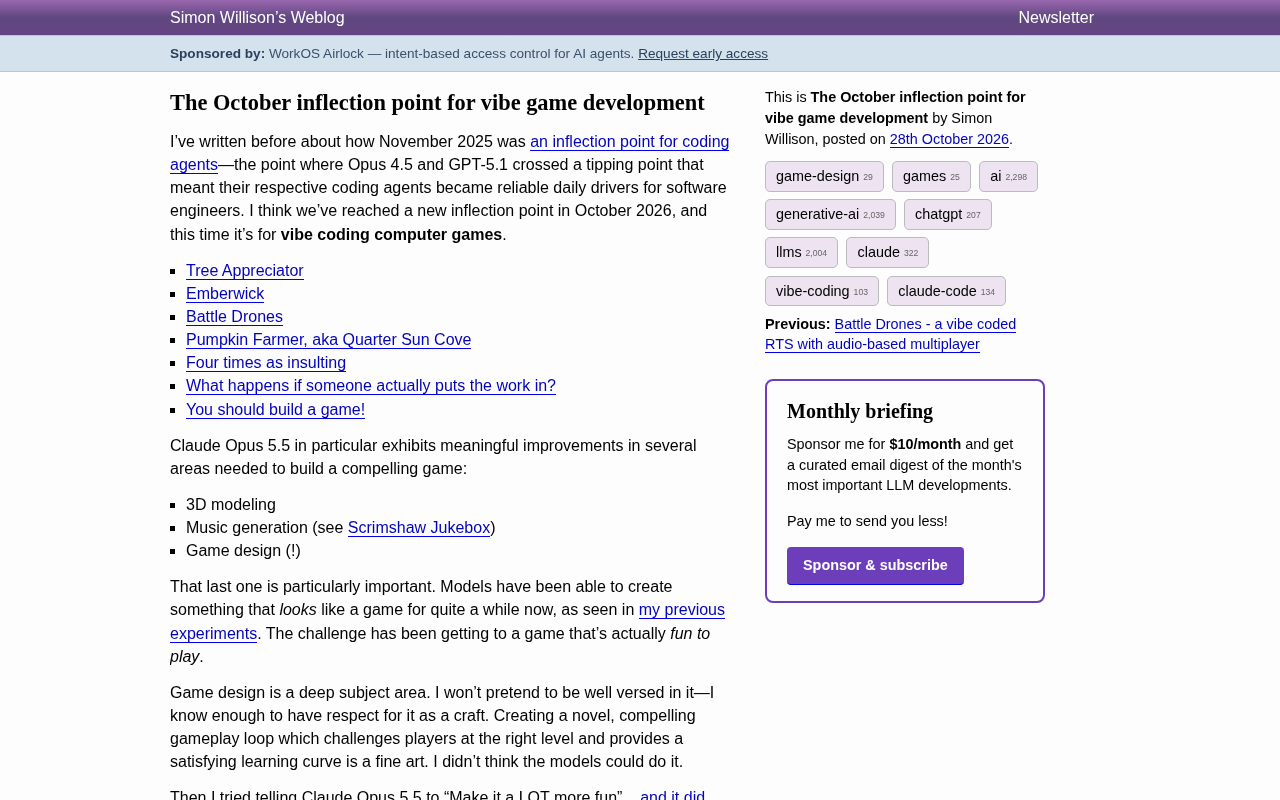
Willison argues October 2026 is the vibe-coding game inflection point, as models start to truly understand "fun."
Simon Willison proposes October 2026 as the inflection point for "vibe game development": previously models could only produce game-like artifacts, but on Claude Opus 5.5 a single "Make it a LOT more fun" could substantively improve playability. Without ever reading the code, he showcases four HTML/JavaScript projects—from the single-prompt three.js mini-game Tree Appreciator to the full RPG Emberwick, the multiplayer RTS Battle Drones, and the highly personal Pumpkin Farmer. Each took under four hours of human effort. He acknowledges AI games combine the four controversies of images, music, text, and code, with a possible community split—but argues what becomes scarce shifts from implementation to novel, delightful ideas.
AI coding tools are expanding their capabilities beyond "writing code" to "making games." In his blog, Simon Willison argues that October 2026 marks the inflection point for "vibe game development"—models can now not only generate things that look like games, but also make games that are genuinely fun to play.
The Key Leap from "Looks Like a Game" to "Actually Fun"
For some time, models have been able to produce game-like artifacts, but the core question has always been: is the game actually fun? Willison had run similar experiments before, with unimpressive results. Game design is widely recognized as a deep craft—designing novel, challenging gameplay loops with a satisfying learning curve requires long-term accumulation.
The turning point came with Claude Opus 5.5. Willison told the model to "Make it a LOT more fun," and the model actually pulled it off. He describes building four games that he genuinely enjoyed playing, using vibe coding in the fully classic sense—never looking at the code at all. At Foo Camp, he met several other people with similar experiences.
The significance of this judgment lies in extending the reliability inflection point for AI coding agents (which previously occurred in the coding-agent domain) into the more creative game development scenario. The latter demands far more in terms of aesthetics, pacing, and fun than ordinary business code.
Vibe Coding is a term coined by Andrej Karpathy in early 2025, referring to a programming approach in which developers barely read or review code, relying solely on natural language to describe intent, observing the results, and continuously pushing forward with prompts. Its difference from traditional "AI-assisted completion" lies in the shift of control: the human judges whether the output "feels right," while the model handles all implementation details. Precisely because code review is abandoned, vibe coding actually places higher demands on model reliability—bugs lurking in the code are no longer caught by humans, but must be surfaced through playtesting and trial runs. This is why Willison ties the game development inflection point to the coding agent reliability inflection point: only when the model makes few enough mistakes can "never looking at the code" produce playable work.
Four Game Projects: From Single-Shot Generation to Deep Iteration
Willison uses four projects to demonstrate output differences at varying levels of effort, all built on HTML and JavaScript and running entirely in the browser.
Tree Appreciator: The Surprise of a Single Prompt
This is the smallest project, completed using only the regular Claude chat interface, no Claude Code needed. The prompt asked for a three.js game showing two algorithmically generated trees, with gameplay centered on appreciating the differences between them, and asked the model to "think carefully about how to make it both fun and beautiful." It came out right in one shot: a mobile-friendly spot-the-difference mini-game with warm visuals, where collecting trees into a "herbarium" delivers a cozy sense of accomplishment.
One practical takeaway: having the model use three.js works very well. Claude has no image generation model of its own, but it can build excellent full-color 3D models.
three.js is an open-source JavaScript 3D graphics library built on top of WebGL. It wraps low-level concepts like shaders, cameras, lighting, materials, and geometry into relatively easy-to-use APIs, letting developers render 3D scenes in the browser without deep graphics expertise. It has long been the de facto standard library for web 3D, and thus occupies a large share of the training corpora of frontier models—one of the reasons the model can "get it right in one shot" for complex 3D scenes. By contrast, the error rate is much higher when models generate custom rendering pipelines or obscure engine code. For vibe coding, choosing a high-coverage, well-documented library like three.js essentially converts the model's prior knowledge into reliability.
Emberwick: From Engine Prototype to Full RPG
This project is more ambitious, also completed with regular Claude chat. The starting point was building a top-down fantasy RPG engine prototype, requiring village scenes, NPCs, furniture, multi-story buildings, and walls becoming transparent when the player enters a building. The first version performed well.
Willison then gradually raised the stakes: making the terrain no longer flat, adding basements to two buildings connected by a tunnel, and adding a cave in the mountain where a troll sleeps. Each step produced usable results. Finally he asked to "turn it into a real game"—quadrupling the playable area, adding interesting mechanics, designing a non-clichéd storyline, a magic system, and a twist.
This project required considerable playtesting and iteration, with the main issues being gameplay bugs, such as characters being unable to complete tasks in the right location due to story-driven movement. The final version has a complete story with about 15 minutes of gameplay, and Willison even said he was moved by the ending—with the game's visuals, story, characters, music, and dialogue all coming from the model. He also ran the same set of prompts on ChatGPT GPT-6 Pro as a comparison, with the verdict: "Looks great, but far less fun to play."
Battle Drones: The Most Successful Project
This is a Command & Conquer-style real-time strategy game where two to four robot armies build units, collect scrap, and compete for territory. Early versions were built with Claude Fable 5 and were only moderately playable. After Opus 5.5 took over, it was first asked to "make it a LOT more fun," then asked to port it to three.js, and the gameplay experience was transformed.
Battle Drones now supports 2-4 player multiplayer (via a vibe-coded WebSockets relay server), medals, replays, seven maps, a random map generator, and rule variants. It also supports different LLMs playing against each other: the game pauses after five seconds of advancement, giving each model time to interpret the situation and issue commands. Willison open-sourced it under the Apache 2.0 license, and the next day a developer released a steampunk-themed fork called Panache based on it.
WebSockets is a browser protocol that provides full-duplex communication over a single TCP connection, allowing the server to push data to clients proactively without client polling. This makes it a common choice for real-time multiplayer games: player commands and server-broadcast game state can flow bidirectionally with low latency, with the server acting as the single authoritative state source to avoid inconsistencies caused by each client simulating independently. The "vibe-coded WebSockets relay server" mentioned here refers to a lightweight server that only forwards messages between players and does not participate in game logic, allowing the game itself to still be deployed as a static frontend while supporting battle scenarios where multiple models each control one side.
Pumpkin Farmer: An Exploration of Personal Expression
Inspired by the pumpkin festival in his hometown of Half Moon Bay, Willison wanted to make a game that wasn't just imitating existing works: running a giant pumpkin farm and handling the October pumpkin-season crowds. All the characters in the game are vegetarian animals, the mayor is a pelican, and players can play as a pelican, skunk, raccoon, opossum, beaver, coyote, fox, owl, sea otter, or harbor seal.
He asked the model to "frequently surprise and delight the user," and the result was packed with details and Easter eggs: mischievous raccoons, an elephant seal hosting a weigh-in contest, a harbor seal rolling pumpkins back into the sea, and planting superstitions that sometimes come true. He admits this isn't his best game yet, with gameplay complexity perhaps even on the high side, but it represents the kind of game he wants: quirky, fun, and highly personal.
The Controversy and Divergence Around AI-Generated Content
Willison frankly acknowledges an awkward fact: if you're averse to AI-generated images, music, text, and code, then vibe-coded games check all four boxes at once. Resistance to AI assets in the gaming community is growing, as evidenced by complaints about low-quality AI works flooding Steam Next Fest.
But he believes the results aren't bad. Game development used to be one of the most challenging projects in software development, requiring multiple skills and months or even years of focused effort—and now he can make a playable multiplayer RTS via prompts on his phone. He predicts a split: some players will reject such games, while others will welcome game development opening up to a broader population. He himself wouldn't submit vibe-coded work to traditional game competitions—"I don't feel qualified."
Steam Next Fest is an online demo event held by Valve multiple times a year, where large numbers of indie developers release demos to gain wishlists and feedback—long an important exposure window for small teams. In recent editions, players have begun complaining about a flood of rough-looking works suspected to be AI-generated in bulk, which dilute exposure resources and intensify negative community sentiment toward AI assets. This context explains why Willison emphasizes "divergence": the resistance isn't directed at the technology itself, but at the squeezing of the existing ecosystem by low-effort, homogenized output; the reaction to high-effort work with personal expression may be entirely different.
What If You Invest More?
Willison notes that these projects are ordered by effort invested, and none exceeded four hours of his work (plus longer periods of Claude Code running on its own). What he really looks forward to is: what could someone produce if they took this seriously, invested substantial creative time, had better game design taste, and continuously playtested and iterated?
For those who want to try, he offers an extremely low-barrier path: all projects are HTML plus JavaScript, deployable with static hosting (GitHub Pages or Cloudflare Pages). Modern browsers, including mobile, are already powerful enough, and frontier models are familiar with libraries like three.js and Phaser. The starting prompt can be as simple as:
Build a mobile-friendly three.js game where...
This runs fine in the regular ChatGPT and Claude chat interfaces—no need to launch a full coding agent. Once the project passes the proof-of-concept stage, switch to Codex or Claude Code. If the game isn't fun enough, just add: "Make it a LOT more fun."
On model capability comparison, Willison's initial impression is that GPT-6 Astra is still a bit behind—it can build games, but doesn't grasp "fun" as well as Opus 5.5. He expects OpenAI to catch up before the end of the year.
The significance of this inflection point may not lie in models replacing game developers, but in turning "making games" from a high-barrier engineering endeavor into a low-risk creative experiment. What will be truly scarce is no longer implementation capability, but novel and delightful ideas.
One-line Summary
Willison argues that October 2026 is the inflection point for vibe-coded games, as models begin to truly understand "fun."
Paragraph Summary
Simon Willison proposes that October 2026 is the inflection point for "vibe game development": previously models could only generate things that looked like games, but on Claude Opus 5.5 a single "Make it a LOT more fun" could substantively improve playability. Without ever looking at the code, he demonstrates four HTML/JavaScript projects—from the single-prompt three.js mini-game Tree Appreciator, to the full RPG Emberwick, the multiplayer RTS Battle Drones, and the highly personal Pumpkin Farmer. Each project took no more than four hours of human effort. He also acknowledges that AI-generated games combine the four controversies of images, music, text, and code, and that the community may split into acceptance and rejection—but he believes what becomes truly scarce will shift from implementation capability to novel and delightful ideas.
Related articles

The Truth Behind Titanic's Sinking: Key Decisions and Communication Failures in the National Geographic Documentary
National Geographic's The Unsinkable Ship uses survivor testimony to reconstruct Titanic's fatal decisions—from the missing MSG telegram prefix and the broken boiler-room-to-bridge link to how 'unsinkable' thinking delayed damage control and evacuation.

74M-Parameter Open-Source Model Partially Outperforms Jev AI in Testing
Fastino AI's Glider 2.5 models, with just 74M–300M parameters, reportedly outperform Jev AI in some guardrail benchmarks per YouTube testing, run on consumer hardware, and even play Doom. We analyze small models' competitiveness and deployment value on specific tasks.

Gemini 4 Argon Hands-On: Aggressive Pricing, 3D Capabilities Need Coaching
Gemini 4 Argon hands-on: limited-time $2/$10 pricing, million-token output, strong 3D and reverse-engineering work, but weak front-end aesthetics and zero-shot ability need coaching.