The AI Production Pipeline Behind Great Videos: From Research to Agent Validation

Behind the AI video boom, a transferable four-step pipeline matters more than any single model.
The article starts from the explosion of AI videos on Douyin, arguing that the real competitive edge is not a specific model but a complete production process. Citing a Bilibili creator's course, it shows that general-purpose LLMs like DeepSeek can run AI video production without a VPN or paid membership. The process has four steps—researching professional workflows, organizing a skill checklist, configuring agents, and experimental validation—forming a validation-driven closed loop that can transfer to copywriting, data analysis, customer service, and more.
Why Is Everyone Suddenly Making AI Videos?
Recently, Douyin has been flooded with visually stunning AI videos. One of the driving forces behind this is a model that has sparked widespread discussion online (referred to in the source material as "OPUS 5.5"). According to a Bilibili creator in a course, after this model was released in mid-to-late September, overseas creators first produced viral videos a dozen seconds long, which were then widely reposted and adapted domestically. Combined with Douyin's topic-driven traffic mechanisms, this set off a creative wave.
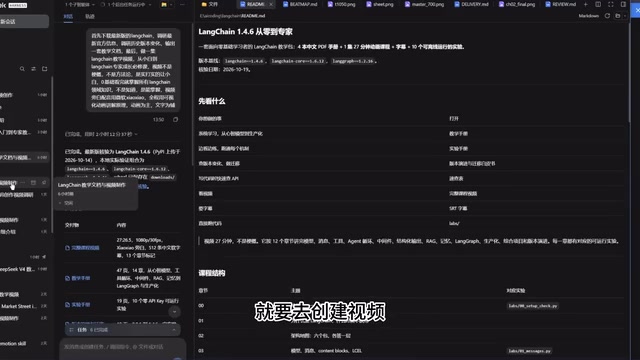
But one easily overlooked fact is: video creation is not something that any particular model does best. The creator made this clear right at the start of the course—what truly sets people apart is the complete production pipeline behind the work, not the "crushing superiority" of a single tool. This is exactly why this methodology can be transferred to other industries.
No VPN Needed: Running the Pipeline with General-Purpose LLMs
Many people assume that producing high-quality AI videos requires a paid membership and a specific model. In the course, the creator openly admitted that he "didn't pay for a membership" and used DeepSeekAd throughout for his explanations and demonstrations.

According to him, the model version used at the time was identified as "DeepSeek V4.1 Flash1017," launched on October 17. The creator noted that while the API may not have shown obvious changes on the surface, the improvements on the service and model sides were "quite good." He used this general-purpose model to demonstrate the full path from scratch to finished video, illustrating a key conclusion: if you don't want to use a VPN or touch a specific paid model, a general-purpose LLM can equally run a comparable video production pipeline.

What the course repeatedly emphasizes is "what the correct pipeline or approach should be," rather than fixating on which model to use. This is especially valuable for content creators—tools will iterate, but the process is a reusable asset.
The Four-Step Pipeline: Research → Organize → Configure → Validate
According to the framework presented by the creator in the course, a transferable AI video production process can be broken down into four stages. The clever part of this pipeline is that it is not video-specific but a general "professional process" that works just as well in any other industry.
Step 1: Research the Professional Workflow
Before starting to make videos, first figure out how true professionals in this field actually do it. The creator mentioned that he "researched a lot of things" and deliberately chose to focus on it after returning from vacation. The core of this step is to collect industry best practices, tool combinations, and common pitfalls, forming a cognitive map of the complete workflow—rather than opening software and randomly experimenting right away.
The term "Prompt Engineering" in this article refers to the method of designing the structure of input text, role settings, examples, and constraints to guide LLMs in stably producing results that meet expectations. Common techniques include few-shot examples (providing several input-output examples), chain-of-thought guidance (requiring the model to reason step by step), output format constraints (such as specifying a JSON structure), and system prompts that define role boundaries. In a video production pipeline, prompt engineering often determines the quality and consistency of outputs in stages such as storyboard scripts, scene descriptions, and subtitle copy, which is why it is listed separately as a skill that needs dedicated organization.
Step 2: Organize a Skill Checklist
The information gathered from research is fragmented and needs to be organized into a structured skill checklist: which stages require prompt engineering, which require asset processing, and which require tool orchestration. The creator sees this step as the key transition from "knowledge" to "executable capability."
Step 3: Configure Agents
Turn the organized skill checklist into concrete agent configurations—which model to use, what role to set, what constraints to give, and how to orchestrate multi-step tasks. The DeepSeek usage demonstrated in the course is exactly an example of this step: using a general-purpose model to handle specific nodes in the pipeline, rather than expecting a single model to do everything.
"Agent" here refers to a program unit that uses an LLM as its reasoning core and can autonomously plan steps and call external tools to complete multi-step tasks. Unlike single-turn Q&A, an agent typically includes role settings (system prompts), a list of available tools (such as search, code execution, and image generation interfaces), task orchestration logic, and termination conditions. The key to configuring an agent is mapping the skill checklist from the previous step to specific tools and constraints: clarifying which model handles each node, what the input/output formats are, and how to retry or degrade on failure. This also explains why a general-purpose model is sufficient—it plays the role of the "decision brain" for a particular node in the pipeline, not a universal tool that handles every stage.
Step 4: Experimental Validation
After configuration is complete, experimental validation is essential. The creator emphasized in the course that the entire process is a closed loop of "research → organize → configure → experimental validation," and that validation results feed back to correct the earlier stages. This also explains why he continued iterating during course preparation—the process is not designed in one go but is validation-driven.

Why This Method Can Transfer to Other Industries
The creator specifically noted in the title that it "can be transferred to other industries," and this is no exaggeration. The four steps are essentially a general paradigm from domain knowledge to automated execution: research corresponds to domain understanding, organization to knowledge structuring, configuration to tool orchestration, and validation to effectiveness evaluation.
Whether you work in video, copywriting, data analysis, or customer service automation, what you often lack is not a stronger model but this complete chain from cognition to implementation. The recurring expressions in the course such as "pipeline" and "approach" point precisely to this kind of process thinking.
A Few Reminders for Creators
First, trends will fade, but processes will settle. The traffic dividend around a particular topic is cyclical, but the method of research, organization, configuration, and validation can be used repeatedly.
Second, don't be misled by the narrative that "some model crushes everything." The creator explicitly stated that video creation is not something that any particular version does best; a general-purpose model combined with the right process can also produce good results.
Third, tool selection serves the process. The course used DeepSeek throughout for demonstrations, showing that the key to selection is matching the needs of pipeline nodes, not chasing parameter leaderboards.
The value of this four-step process lies in breaking down something that seems to depend on inspiration and luck—"making viral videos"—into an engineering problem that can be researched, organized, configured, and validated. For content creators, this may be more worth bookmarking than any specific model.
One-line Summary
Behind the AI video boom, a transferable four-step pipeline matters more than any single model.
Paragraph Summary
The article takes the explosion of AI videos on Douyin as its starting point and points out that the real competitive advantage is not a particular model but a complete production process. Citing course content from a Bilibili creator, the author explains that without a VPN or paid membership, general-purpose LLMs such as DeepSeek can also run AI video production. This process is broken down into four steps: researching the professional workflow, organizing a skill checklist, configuring agents, and experimental validation, forming a validation-driven closed loop. The article emphasizes that these four steps are essentially a general paradigm "from domain knowledge to automated execution" that can be transferred to copywriting, data analysis, customer service, and many other industries. It concludes with reminders: trends will fade while processes will settle, and tool selection should serve the needs of pipeline nodes rather than chasing parameter leaderboards or the narrative that "some model crushes everything."
Related articles

Private Key Set to 4? CA's Elementary Mistake Leaves TLS Exposed
CA eMudra set private keys to tiny values like 4, making TLS certificates brute-forceable. A Computerphile video demonstrates the full process from extracting public keys to forging certificates, and explores the fragility of the PKI trust chain.

How Gen Turns Data into Decisions with ChatGPT Work
In an OpenAI user case, business leader Gen shares how ChatGPT Work turns data into decisions: within hours of launch, teams can judge whether integrations and onboarding flows work, shifting decision iteration from hundreds of trial-and-error attempts to a fast feedback loop.

ChatGPT vs. Claude In-Depth Comparison: Strong at Coding but Weak at Research — How to Bridge the Gap?
A user considers switching from ChatGPT to Claude, finding Claude stronger at coding but shallower at research. We analyze the differences and share tips to make Claude's research deeper.