The Biggest Weakness of Chinese AI Models: They Need Frameworks to Work Well
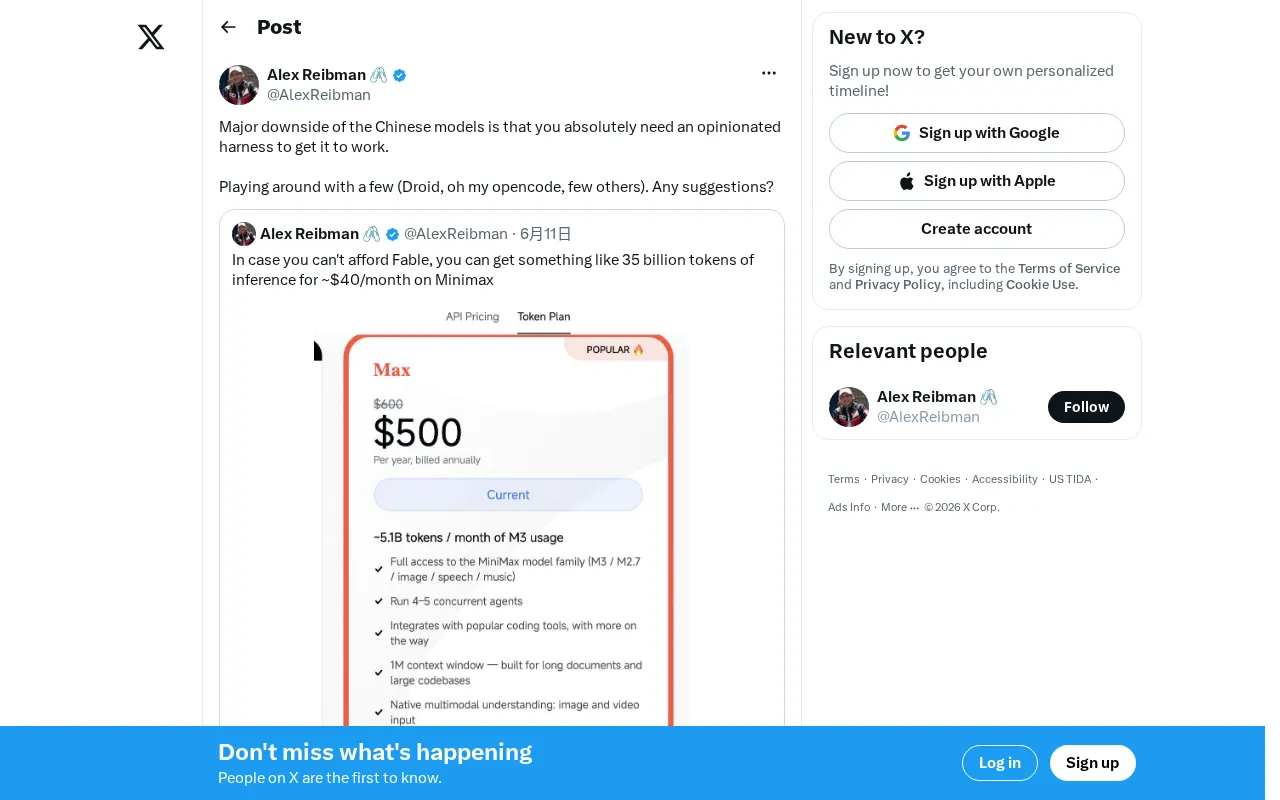
Chinese AI models need opinionated frameworks to bridge the gap between raw capability and usability.
A developer's observation that Chinese AI models like DeepSeek and Qwen require opinionated tool harnesses to work properly has sparked community discussion. The gap stems from differences in RLHF training focus, function calling protocol maturity, and system prompt sensitivity compared to models like Claude and GPT-4. While Chinese models excel in reasoning and cost-effectiveness, their developer experience and toolchain ecosystem are still catching up, making framework selection a critical decision for integration success.
Core Argument
Recently, a developer pointed out on Twitter a key issue with Chinese AI models (such as DeepSeekAd, Qwen, etc.) in practical use: You absolutely need an opinionated tool harness to make them work properly.

This tweet attracted widespread attention from the developer community. The author mentioned trying multiple tool frameworks, including Droid, OpenCode, and others, while soliciting more suggestions from the community.
What Is an "Opinionated Harness"?
In software engineering, an "opinionated" tool refers to a framework that has strong presets and constraints on how it should be used. In contrast, an "unopinionated" tool gives users more freedom but requires more configuration.
This pair of concepts originates from a classic design philosophy debate in software engineering. The most typical example comes from the web framework space: Ruby on Rails is the quintessential "opinionated" framework—it prescribes project structure, database naming conventions, routing conventions, and numerous other "Convention over Configuration" rules, allowing developers to build quickly as long as they follow these conventions. Express.js, on the other hand, is the quintessential "unopinionated" framework—it only provides basic HTTP handling capabilities, leaving project structure, middleware choices, ORM tools, and everything else entirely up to the developer. In the AI toolchain space, an opinionated harness comes with preset system prompt templates, output parsing rules, error retry strategies, context window management approaches, and more—developers just need to "fill in the blanks." This design is especially important when model behavior isn't stable enough—the framework's "opinions" are essentially crystallized community best practices, trading constraints for reliability.
For Chinese AI models, this means:
- Raw API calls are often insufficient: Directly using a model's API without additional prompt engineering and structural constraints can result in unstable output quality
- An additional orchestration layer is needed: A specially designed toolchain is required to standardize the model's input/output formats, tool calling methods, and context management
- Framework selection becomes a critical decision: Different harnesses constrain model behavior in different ways, directly impacting final results
Why Are Chinese Models More Framework-Dependent?
Differences in Training Objectives
Models like Claude and GPT-4 invested heavily during the RLHF phase to optimize the "out-of-the-box" experience—even when users give vague instructions, the model can produce structured, predictable output. Chinese models may be very strong in raw reasoning ability, but in terms of instruction-following consistency and output format standardization, they often need external frameworks to fill the gap.
RLHF (Reinforcement Learning from Human Feedback) is the core technical approach for aligning large language models today. The basic process includes three stages: first, supervised fine-tuning (SFT) teaches the model basic instruction-following ability; then a reward model is trained using preference ranking data from human annotators to learn what constitutes better output; finally, reinforcement learning algorithms like PPO (Proximal Policy Optimization) optimize the model's output policy toward what the reward model considers better. OpenAI and Anthropic have invested massive human and computational resources in this phase, particularly in fine-tuning for "robustness of instruction following" and "consistency of output format." This means that even when a user's prompt isn't precisely written, the model can infer user intent and provide a structured response. Chinese models have already reached very high levels in pre-training data scale and reasoning capability, but the fine polishing during the RLHF phase—particularly for tool-calling scenarios in the English developer ecosystem—still has room for improvement.
Maturity of Function Calling
In AI coding and Agent scenarios, tool-calling capability is crucial. Chinese models' tool-calling protocols and formats may not be fully compatible with the OpenAI ecosystem, requiring an adaptation layer to bridge the gap. This is a common pain point developers encounter when integrating DeepSeek or Qwen.
Function Calling is the key capability that enables large language models to evolve from "conversational assistants" to "intelligent Agents." OpenAI pioneered this feature in June 2023 in the GPT-3.5 and GPT-4 APIs: developers can define a set of function descriptions in JSON Schema format (including function names, parameter types, parameter descriptions, etc.) in API requests, and the model will determine whether to call a function during response generation, outputting the function name and parameter values in structured JSON format rather than natural language. This mechanism has become the infrastructure for building AI Agents, RAG systems, and automated workflows. OpenAI's Function Calling format has become the de facto industry standard, and Anthropic's Claude has adopted a similar but slightly different Tool Use protocol. While Chinese models like DeepSeek and Qwen also support tool calling, they may differ from the OpenAI standard in details such as protocol format, parallel call support, and nested call handling—requiring middleware adaptation layers for format conversion and error handling.
System Prompt Sensitivity
Some Chinese models respond to system prompts differently from other mainstream models. A well-designed harness can eliminate these differences through standardized prompt templates. System prompts are special instructions set by developers in API calls to define the model's role, behavioral boundaries, and output specifications. Different models allocate different weights to system prompts and follow them to varying degrees—some models strictly adhere to format requirements in system prompts, while others may gradually "forget" system prompt constraints over multiple conversation turns. A good harness dynamically injects and reinforces key instructions in every interaction, ensuring consistent model behavior.
Currently Available Tool Frameworks
The tweet author mentioned several options being tried:
- Droid: A terminal tool designed specifically for AI coding
- OpenCode: An open-source code generation framework
- Other community tools: Such as Aider, Continue, etc., which are also actively adapting to Chinese models
The core value of these frameworks lies in their preset best practices for interacting with models, including prompt formats, retry strategies, output parsing rules, and more—saving developers from having to figure everything out from scratch. Notably, most of these tools adopt an "adapter pattern" architectural design—using a unified abstract interface to shield differences between models, allowing developers to switch between different underlying models with the same code logic while the framework internally handles each model's specific format conversion and exception handling logic.
Implications for Developers
Framework Selection Advice
If you plan to use Chinese AI models (especially the DeepSeek and Qwen series) in your projects, don't expect the same "plug-and-play" experience as with Claude. Evaluating and selecting appropriate framework tools in advance will significantly reduce integration costs. Specifically, when making your selection, focus on these dimensions: the framework's adaptation depth for the target model (whether it has been optimized for specific models), community activity and update frequency (model APIs change frequently, and frameworks need to keep up), and whether it supports fallback strategies (whether it can automatically switch to alternative models when the primary model is unavailable).
A Signal of Ecosystem Maturity
This issue fundamentally reflects a developmental stage in the Chinese AI model ecosystem—the models themselves are already very capable, but the developer experience (DX) and toolchain surrounding the models are still catching up. With continued community investment, this gap is expected to narrow gradually.
Developer Experience (DX) is an important dimension for measuring the maturity of a technology platform or tool ecosystem, encompassing everything from API design, documentation quality, SDK completeness, and error message readability to community support. In the AI model space, the quality of DX directly determines a model's actual adoption rate. The reason OpenAI has been able to build such a strong ecosystem moat in the developer community is largely due to its sustained investment in DX: unified API formats, comprehensive documentation, rich SDKs (covering mainstream languages like Python, Node.js, Go), Playground debugging tools, and an active community forum. The DX gap for Chinese AI models isn't a capability issue but rather a time lag in ecosystem building—OpenAI has had five years of ecosystem accumulation since the GPT-3 API launch in 2020, while DeepSeek, Qwen, and other models have much shorter open API histories. The good news is that the Chinese AI community is rapidly closing this gap, with an increasing number of open-source tools and adaptation frameworks emerging.
Conclusion
Chinese AI models have already demonstrated strong competitiveness in cost-effectiveness and reasoning capability, but the distance between "usable" and "user-friendly" is often just one good framework away. For efficiency-minded developers, choosing the right harness may be more important than choosing the right model. This also reveals a deeper trend in the AI industry: as foundational model capabilities converge, the competitive focus is shifting from "whose model is stronger" to "whose ecosystem is more complete"—toolchains, developer experience, and community ecosystems will become the key variables determining market dynamics.
Related articles

Replit at Web Summit Lisbon: AI Coding Platform Accelerates European Expansion
Replit participated in Web Summit Lisbon 2026 Day 1 as Replit Live. This article examines its transition from an online IDE to an AI app-building platform and analyzes its European market opportunities and compliance challenges.

Codex Integrates with Zotero: Batch Literature Review and Deep-Read Tools Tested
Hands-on testing of two new Codex functions for Zotero: batch literature reviews by collection and screening key papers for deep reading. Covers comparison tables, citation verification, the three-layer method and experiment analysis, plus a complete workflow.

Codex + Obsidian + Zotero: An AI-Powered Automated Paper Reading Workflow
A Codex + Obsidian + Zotero paper management and retrieval workflow: Zotero manages references, Codex calls GPT for close reading and notes, Obsidian with DataView builds indexes, enabling Q&A with your paper library and quick literature review material — includes close-reading template and two Skill setup steps.