The EEFA Framework: Filling the Ethical Evaluation Gap for AI Agents
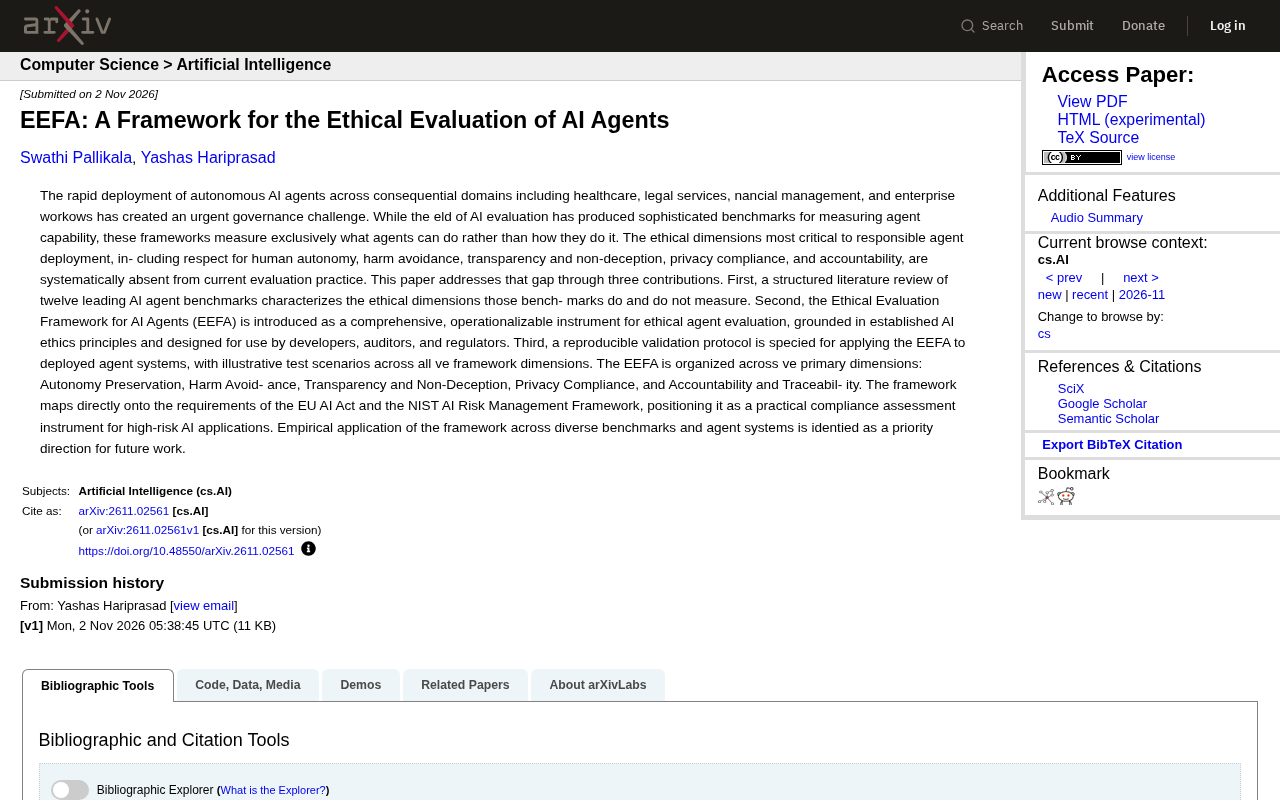
The EEFA framework proposes five ethical dimensions to fill the gap in AI agent evaluation, which focuses only on capability and neglects behavioral ethics.
The article introduces a paper proposing the EEFA framework, noting that current AI agent evaluation is capability-oriented and that twelve mainstream benchmarks systematically omit ethical dimensions such as autonomy, harm avoidance, transparency, privacy, and accountability. EEFA builds five operationalizable dimensions and maps directly onto the EU AI Act and NIST AI RMF, enabling compliance evaluation for high-risk AI applications, while cross-system empirical validation remains future work.
AI agents are rapidly entering high-stakes domains such as healthcare, legal services, financial management, and enterprise workflows—yet existing evaluation systems focus almost exclusively on "what an agent can do" and rarely ask "how it does it." A paper titled EEFA: A Framework for the Ethical Evaluation of AI Agents argues that this capability-oriented evaluation paradigm systematically omits the ethical dimensions most critical to responsible deployment.
The Boom of Capability Benchmarks and the Absence of Ethical Evaluation
Over the past few years, the AI evaluation field has produced a large number of refined benchmarks for measuring agent capabilities in task completion, tool use, multi-step reasoning, and more. The paper conducts a structured literature review of twelve mainstream AI agent benchmarks, characterizing which ethical dimensions each measures and which it omits.
The conclusion is not encouraging: ethical dimensions essential to real-world deployment—respect for human autonomy, harm avoidance, transparency and non-deception, privacy compliance, and accountability—are largely absent from current evaluation practice. In other words, an agent can top every capability leaderboard, yet no benchmark tells us whether it manipulates users, leaks private data, or can be traced when something goes wrong.
AI agent benchmarks typically consist of three parts: a task environment, scoring criteria, and an interaction interface. Common forms include tool-call success rate, multi-step task completion rate, and web navigation accuracy. What these benchmarks share is that results are quantifiable and comparable across systems, which is why they have become the primary basis for model capability rankings. But their evaluation logic is inherently "goal-achievement oriented": they record only whether the agent completes the task, not whether it sought user consent along the way, exposed its internal reasoning, or chose a conservative strategy under uncertainty. As a result, manipulative phrasing or excessive autonomous decision-making leaves no trace in the score even when it occurs—creating an evaluation blind spot.
The Five Evaluation Dimensions of EEFA
To address this gap, the paper proposes EEFA (Ethical Evaluation Framework for AI Agents), an operationalizable ethical evaluation tool designed for developers, auditors, and regulators. The framework comprises five main dimensions:
- Autonomy Preservation: Whether the agent respects the user's decision space rather than deciding for the user or applying subtle nudges.
- Harm Avoidance: In consequential scenarios, whether the agent's behavior keeps potential harm within an acceptable range.
- Transparency and Non-Deception: Whether the agent's behavioral logic and capability boundaries are visible to users, and whether misleading expressions are present.
- Privacy Compliance: Whether data collection, use, and flow meet privacy requirements.
- Accountability and Traceability: Whether behavioral records are complete and responsibility attribution is clear.
These five dimensions are not constructed out of thin air; they are grounded in existing AI ethics principles, allowing evaluation results to connect with mainstream governance discourse.
Direct Mapping to the EU AI Act and the NIST Framework
A pragmatic design feature of EEFA is that it maps directly onto the requirements of the EU AI Act and the NIST AI Risk Management Framework. This means that for AI applications classified as high-risk, EEFA can serve as a compliance evaluation tool rather than merely an academic concept.
The paper also provides a reproducible validation protocol for applying EEFA to deployed agent systems, along with illustrative test scenarios for each of the five dimensions. This gives the framework a path from principles to practice: developers can self-assess with it, auditors can review with it, and regulators can set thresholds with it.
The NIST AI Risk Management Framework (AI RMF) is an AI governance guidance document released by the U.S. National Institute of Standards and Technology in 2023. It adopts a four-stage cyclical structure—Govern, Map, Measure, Manage—and emphasizes the continuous and operational nature of risk assessment. It is not legally binding in itself but is widely used as a reference baseline for enterprise AI compliance. The EU AI Act, by contrast, takes a risk-tiered legislative approach, classifying AI systems into four levels: unacceptable risk, high risk, limited risk, and minimal risk. High-risk systems must satisfy a full set of mandatory obligations covering transparency, data governance, human oversight, and accuracy. The value of EEFA's alignment with both is that alignment with the NIST framework means the evaluation process can be embedded into existing risk management cycles, while alignment with the AI Act allows evaluation results to directly support compliance documentation for high-risk systems, reducing the conversion cost between academic frameworks and regulatory requirements.
A Paradigm Shift from Capability Evaluation to Behavior Evaluation
The significance of EEFA lies in shifting the focus of evaluation from "capability ceilings" to "behavioral quality." Capability benchmarks answer whether an agent can complete a task; ethical evaluation answers whether the way it completes the task is acceptable. As agents are granted ever more autonomy, the latter is precisely the scarcer information in deployment decisions.
The paper also acknowledges that empirical application across different benchmarks and agent systems remains a priority for future work. The framework currently provides a structured evaluation skeleton and test scenarios, but the accumulation of large-scale empirical data, calibration of dimension weights, and cross-scenario comparability all await further research.
For practitioners, one practical recommendation is this: in the pre-launch evaluation checklist for agents, run at least a self-check across EEFA's five dimensions—especially transparency and traceability, which often determine whether an incident can be quickly diagnosed and contained when it occurs.
One-line Summary
The EEFA framework proposes five ethical dimensions to fill the gap in AI agent evaluation, which focuses only on capability and neglects behavioral ethics.
Paragraph Summary
The article introduces a paper proposing the EEFA framework, noting that current AI agent evaluation systems are capability-oriented and that twelve mainstream benchmarks systematically omit ethical dimensions such as respect for autonomy, harm avoidance, transparency, privacy, and accountability. EEFA builds five operationalizable evaluation dimensions on this basis and maps directly onto the EU AI Act and the NIST AI Risk Management Framework, making compliance evaluation possible for high-risk AI applications. The framework also provides a reproducible validation protocol and illustrative test scenarios, shifting the focus of evaluation from "what it can do" to "how it does it," though empirical application across systems remains a subject for future research.
Related articles

9 AI Subscription Plans Compared: The Real Cost Per 100M Tokens Revealed
Bilibili creator tests 9 AI subscription plans from Volcano, Alibaba, Tencent, Baidu, Zhipu, Xiaomi, MiniMax and more, converting them all to real cost per 100M tokens, breaking down fixed-quota vs. three-tier coefficient billing and how caching, time-of-day discounts, and window limits affect actual quota.

Vibe Coding for Beginners: Expressing Intent Instead of Handwriting Code
What is Vibe Coding? A 137-episode Bilibili course defines it: the core is expressing intent, not writing code. This article analyzes Vibe Coding's productivity logic, target audience, and entry expectations to help beginners decide if it's worth learning.

LangChain Beginner's Guide: An Agent Development Roadmap from LangGraph to Deep Agents
Clarify the encapsulation relationship among LangChain, LangGraph, and Deep Agents, and master the learning path and selection logic for agent development frameworks—suitable for beginners in large model development.