The Energy Anxiety Behind Texas's AI Boom

Texas's AI data center boom may be turning due to energy policy shifts.
Based on MIT Technology Review's The Download, the article examines Texas as the fastest-growing US data center market at the center of the AI compute buildout. Its appeal comes from light regulation, low energy costs, abundant land, and fast-growing power supply. But an energy policy shift could end the boom, since data centers are power-intensive and depend on stable policy and supply. Texas's dual role as fastest-growing market and policy-sensitive zone concentrates this fragility, suggesting AI competition is shifting from models to energy and infrastructure.
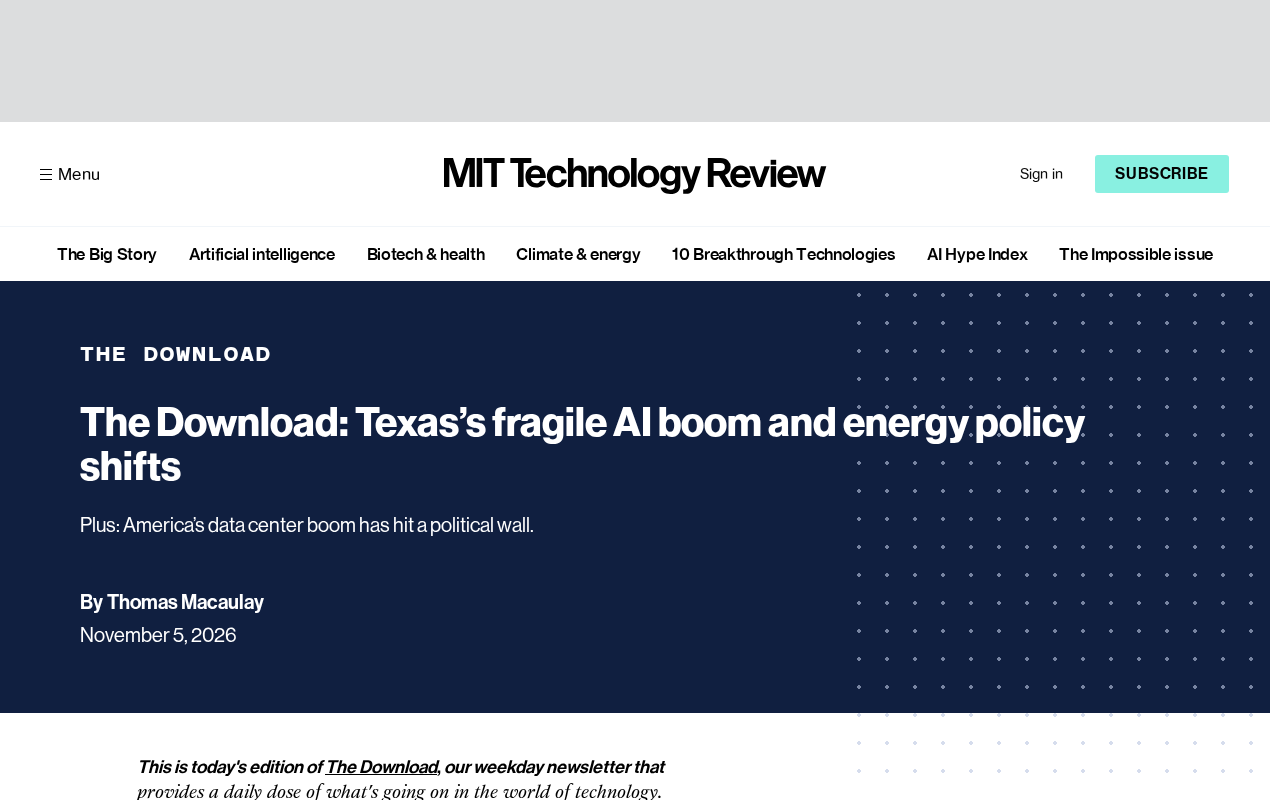
Texas is at the center of the AI data center construction wave in the United States. As the fastest-growing data center market in the country, it hosts the core compute infrastructure of major tech companies. However, the latest issue of MIT Technology Review's newsletter The Download notes that this boom may be facing a turning point — "Texas's status as the new epicenter of AI data center construction may already be a thing of the past."
Why Texas Became the "Epicenter" of AI Data Centers
Texas's appeal comes from multiple dimensions. A relatively light regulatory environment, lower energy costs, abundant land resources, and rapidly growing power supply capacity together make up the reasons major tech companies choose to locate here.
In terms of market growth rate, Texas is already the fastest-expanding data center region in the country. The scale of compute infrastructure that major tech companies have invested here makes it a key sample for observing the infrastructure layout of the AI industry. But it is precisely this rapid expansion that exposes the fragility of the boom: data centers are典型的 power-intensive facilities, and their growth is highly dependent on the stability of energy policy.
Why data centers are power-intensive facilities deserves specific explanation. A large AI training data center often requires continuous power supply of tens of megawatts or even hundreds of megawatts — equivalent to the electricity consumption of tens of thousands of households — and places extremely high demands on supply stability, since interrupted training runs can cause enormous losses in compute and cost. Compared with traditional cloud computing data centers, AI clusters have significantly higher power consumption per unit area due to the high power density of GPUs and cooling requirements, typically requiring additional infrastructure such as liquid cooling. This explains why the site-selection logic for data centers is highly dependent on the abundance and price of power supply: whoever can provide large-scale, stable, and cheap electricity can attract compute investment. Texas's low electricity prices and relatively fast grid interconnection process have therefore become core advantages — and once the price advantage narrows or interconnection queue times lengthen, its attractiveness quickly weakens.
Uncertainty Brought by the Energy Policy Shift
The The Download report directly links Texas's AI boom to an "energy policy shift." The core logic of this judgment is that the pace of data center expansion is essentially a function of power supply and the policy environment.
When energy policy shows signs of adjustment, data center construction plans that rely on large-scale power capacity expansion are the first to be affected. The report uses the strongly judgmental word "kaput" to describe the possible fate of Texas's AI construction boom, implying that the inhibitory effect of policy changes on industrial expansion should not be underestimated.
This fragility is not unique to Texas, but it is particularly concentrated there — because it simultaneously plays the dual role of "fastest-growing market" and "policy-sensitive zone."
The Electric Reliability Council of Texas (ERCOT) is key background for understanding this issue. ERCOT is the independent system operator that runs most of Texas's power grid, which is essentially isolated from the two major interconnected grids in the eastern and western United States, forming the so-called "Texas power island." This independence allows Texas to circumvent some jurisdiction of the Federal Energy Regulatory Commission (FERC), creating a relatively light, market-based wholesale electricity market — one of the reasons for its lower electricity prices and its appeal to data centers. But the cost is that ERCOT struggles to purchase emergency power from external grids during extreme weather or demand surges. The massive blackout caused by Winter Storm Uri in 2021 is a typical case — more than 4 million households lost power and hundreds of people died. As data centers bring continuously rising baseload demand, ERCOT's reserve margin and dispatch capacity face greater pressure. Therefore, the so-called "energy policy shift" includes not only adjustments by the state legislature to grid reliability, capacity markets, and large-load interconnection rules, but also a re-examination of data center power approval and electricity cost allocation mechanisms.
Implications for AI Infrastructure Layout
The Texas case reveals a broader issue: competition in the AI industry is shifting from the model capability layer to the energy and infrastructure layer. The speed of compute expansion increasingly depends on non-technical factors such as power supply and policy stability.
For readers following the direction of the AI industry, this means that when assessing AI development prospects, energy policy and infrastructure construction need to be included as core variables. Whether Texas's data center construction boom can continue will become an important bellwether for observing the pace of AI industry expansion.
The Download is a weekday newsletter product from MIT Technology Review, providing daily summaries of developments in the tech field. This issue discusses Texas AI data center construction alongside energy policy changes, signaling an industry signal worth tracking continuously.
The "compute-power" constraint is a structural bottleneck that has gradually emerged in the AI industry in recent years. As the parameter scale and training volume of large models continue to grow, the energy consumption of individual training runs and inference trends upward, and the share of electricity costs in total data center operating costs keeps rising. This produces several chain effects: first, tech companies are beginning to invest directly in or sign long-term power purchase agreements (PPAs), and even participate in the construction of nuclear and natural gas power projects; second, grid interconnection queues and the production capacity of equipment such as transformers and transmission lines have become new scarce resources; third, policy and regulation — including electricity cost allocation, environmental approval, and water use restrictions — have become the actual determinants of the pace of compute expansion. The value of the Texas case lies in the way it concentrates this shift from "chips-models" to "power-policy," providing a reference framework for assessing AI infrastructure prospects in other regions (such as Virginia, Arizona, and Ireland).
One-line Summary
Texas's AI data center boom may face a turning point due to an energy policy shift.
Paragraph Summary
Based on MIT Technology Review's The Download newsletter, the article discusses how Texas, as the fastest-growing data center market in the United States, is at the center of the AI compute construction wave. Its appeal comes from light regulation, lower energy costs, abundant land, and rapidly growing power supply. But the report notes that an energy policy shift could bring this boom to an end, because data centers are power-intensive facilities whose expansion is highly dependent on policy and the stability of power supply. Texas simultaneously plays the dual role of "fastest-growing market" and "policy-sensitive zone," which makes its fragility particularly concentrated. The article draws a broader implication: competition in the AI industry is shifting from model capabilities to energy and infrastructure, and assessing AI prospects requires incorporating energy policy and infrastructure as core variables.
Related articles
 Tech Frontiers
Coldframe: A Honeypot Disguised as a Supermarket Freezer Controller
Coldframe is a honeypot disguised as Danfoss AK-SM 800A and Dixell XWEB freezer controllers, built as a single Python file that detects CVE-2025-41450 attempts and is identified as real devices on Shodan.
 Tech Frontiers
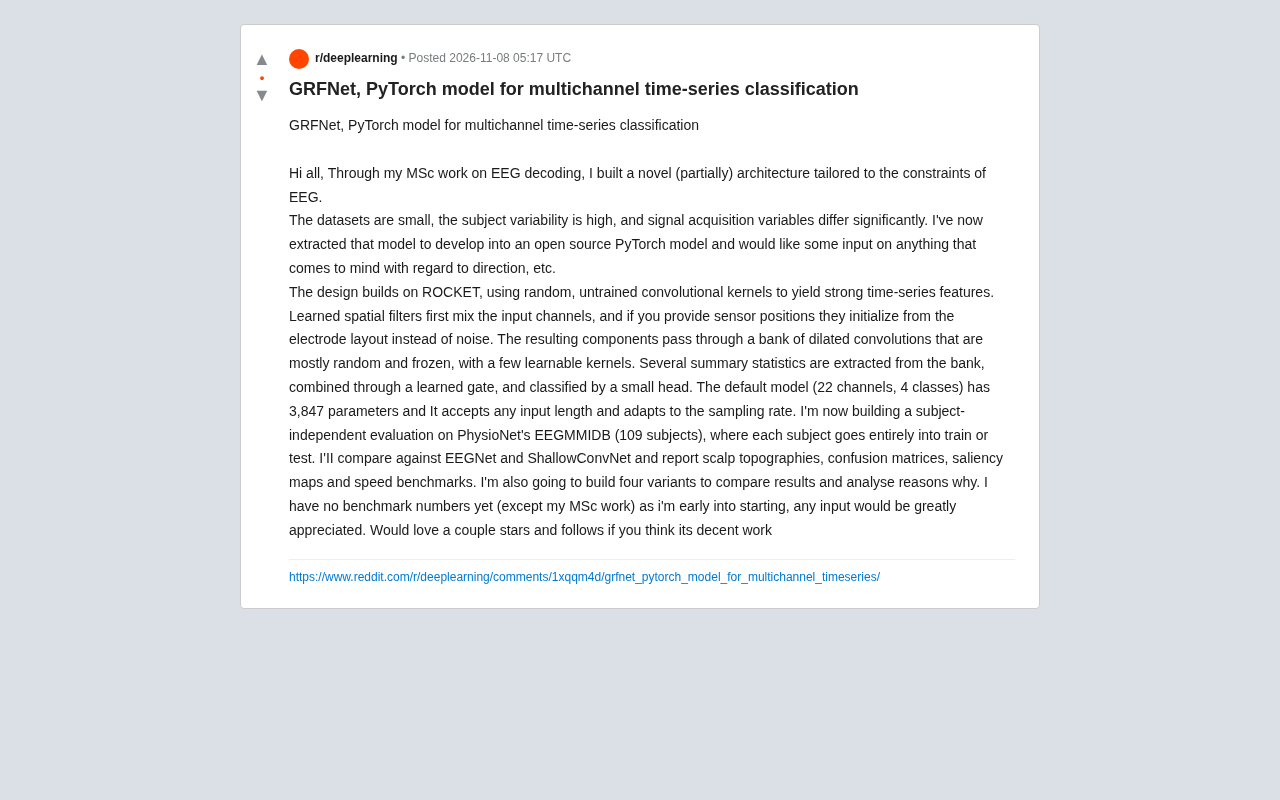
GRFNet: A Lightweight PyTorch Model Designed for Multichannel Time-Series Classification
GRFNet is a lightweight PyTorch model for multichannel time-series classification, originating from EEG decoding research. With only 3,847 parameters, it is based on the ROCKET architecture, combining random convolution kernels with learnable spatial filters, supports arbitrary input lengths, and will soon be evaluated on the PhysioNet dataset.
 Tech Frontiers
CUDA-Accelerated Rocket League Simulator: A Player-Made Hardcore Experiment
A Reddit post shows a "100% Accurate" Rocket League simulator accelerated with CUDA. We analyze its technical context, CUDA's value in game physics simulation, and the significance and limitations of such community projects.