The Essential Differences Between Product Thinking and Technical Thinking: A Must-Have Cognitive Course for AI Product Managers

Analyzing the core differences between product and technical thinking from a cognitive science perspective
Using the Müller-Lyer visual illusion and Kahneman's dual-system theory as entry points, this article examines the essential differences between product thinking and technical thinking from a cognitive science perspective. Through comparisons across the background dimension (growth paths) and thinking dimension (exhaustive logic vs. human nature insight), it reveals the roots of both thinking modes, helping AI product managers understand and bridge the cognitive gap with engineers.
As an AI product manager, understanding the differences between product thinking and technical thinking is a fundamental and critical skill. This not only affects your day-to-day collaboration efficiency with engineers but also determines whether you can design products that combine technical depth with great user experience.
This article takes a cognitive science perspective to systematically deconstruct the core differences between product thinking and technical thinking, helping you build a bridge across the cognitive gap.
Starting with Visual Illusions: The Cognitive Essence of Product vs. Technical Thinking
Have you ever seen the classic Müller-Lyer illusion? Two line segments of equal length appear different simply because the arrows at their ends point in different directions — we instinctively judge one as longer than the other. This simple example reveals a profound truth: There is often a significant gap between the conclusions our intuition provides and the real conclusions derived from rational analysis.
Cognitive Science Background: The Müller-Lyer illusion was first described by German sociologist Franz Carl Müller-Lyer in 1889 and remains one of the most widely studied visual illusions in cognitive science. It reveals a fundamental flaw in the human perceptual system: our brains don't objectively record reality but actively interpret information based on heuristic rules shaped by evolution. The implications for product design are profound — users rely on intuition almost entirely when using products, meaning usability design must align with intuition rather than requiring users to engage in effortful rational thinking.
Nobel laureate in Economics Daniel Kahneman proposed the famous dual-system theory in Thinking, Fast and Slow. Kahneman and Amos Tversky began systematically studying cognitive biases in human decision-making in the 1970s, eventually developing "Prospect Theory," which earned Kahneman the 2002 Nobel Prize in Economics. In his 2011 book Thinking, Fast and Slow, he distilled decades of research into the following framework:
- System 1 (Fast Thinking): Based on emotions, memory, and experience; operates autonomously with rapid responses. Like your first reaction when seeing the line segments.
- System 2 (Slow Thinking): Based on rational logic and deep analysis; requires deliberate activation and tends to remain in a "lazy" state. Like the thinking process when you stop to carefully measure the line segments.
The key insight is: Everyone's System 1 is structured differently, depending on their knowledge base and experiential background. For someone with a technical background, understanding an API interface is a System 1 intuitive response; but for a designer, this might require engaging System 2 for effortful comprehension. The reverse is also true — design principles are intuitive for designers but require deliberate thinking for engineers.
Understanding this is the first step toward bridging the cognitive gap between product and technology.
Deep Comparison of Product vs. Technical Thinking Across Three Dimensions
Background Dimension: Growth Paths Determine Thinking Foundations
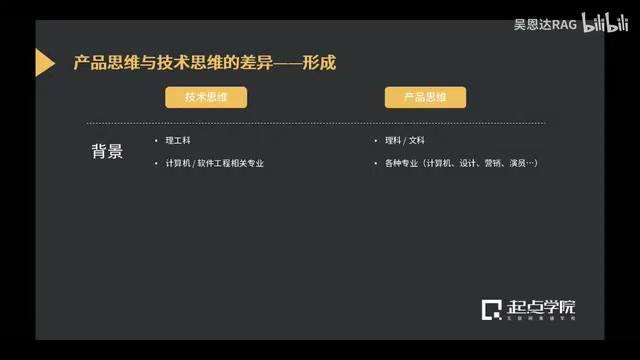
Those who hold technical thinking typically come from STEM backgrounds — studying science in high school, majoring in computer science or software engineering in college, with their entire learning trajectory shaped within an engineering mindset.
Product thinking, however, comes from extremely diverse sources. Some transitioned from technical roles, others from humanities backgrounds (linguistics, design), and some even switched from acting to product management. Product thinking is highly inclusive, which is both an advantage and means the cognitive foundations within the product manager community vary enormously.
Thinking Dimension: Exhaustive Logic vs. Human Nature Insight
This is the most fundamental distinction between product and technical thinking:
| Dimension | Technical Thinking | Product Thinking |
|---|---|---|
| Logic Characteristics | Extremely strong logic, purely rational | Strong logic, balanced between rational and emotional |
| Thinking Approach | Reasoning + exhaustive enumeration | Basic reasoning, difficult to enumerate exhaustively |
| Underlying Logic | Binary (0 and 1) | Finding optimal solutions from a human nature perspective |
In the world of computers, it's either 0 or 1 — there must be a definitive conclusion. So when a product manager proposes a requirement, engineers instinctively enumerate all edge cases and boundary conditions — "What if the user loses network connection?" "What if ten thousand people operate simultaneously?" This isn't being difficult; it's the natural expression of technical thinking.
The Root of Engineers' Exhaustive Thinking: This obsession with boundary conditions stems from foundational training in computer science. In software engineering, Boundary Value Analysis is one of the core methodologies for quality assurance — a large number of software failures occur precisely when input values are at extremes, such as empty strings, zero values, or maximum integer overflows. This training gives engineers an almost instinctive "defensive thinking" pattern. Understanding the root of this thinking mode helps product managers proactively include boundary condition specifications when writing requirement documents, significantly reducing communication friction.
Product managers, on the other hand, approach things more from user value and human experience, focusing on "what does the user need most in this scenario?"
Related articles
Deep Dive into AI Agent Skill Design: …
Deep Dive into AI Agent Skill Design: Engineering Practices from Anthropic and Perplexity
A deep dive into Skill design philosophy from Anthropic's Claude Code team and Perplexity's Agent team, covering the Tax Test, Gotchas Flywheel, progressive disclosure, and Eval-First practices for building high-quality AI Agent skill systems.
Deep Dive into OpenAI's Official GPT-5…
Deep Dive into OpenAI's Official GPT-5.6 Prompting Guide: The Shift from Manual to Automatic
A deep dive into OpenAI's official GPT-5.6 Sol prompting guide: conciseness-first, outcome-oriented design, autonomy boundaries, tool routing, and reasoning intensity tuning.
 Deep Dives
Deep Dive into How OpenClaw (Open-Source Crayfish) AI Agent Works
Deep analysis of OpenClaw AI Agent internals: System Prompt, tool calling, SubAgents, Skill system, memory, and Context Engineering explained.