The Fatal Flaw of Surprise-Based Learning: How LLM Continual Learning Gets Broken by Lies

Surprise-driven continual learning makes LLMs absorb false claims; four defense signals each have limits, and no single mechanism can determine truth.
A study on LoRA-adapted models reveals that surprise-driven continual learners absorb almost all false claims contradicting known facts, with contamination rates comparable to random selection. Four defenses were evaluated: LLM validators filter lies but are overly cautious; calibration regression testing only slows learning; model priors distinguish lies from true new facts (AUC 0.78-0.83) but not from legitimate same-kind updates (AUC 0.53); trusted-source routing has the lowest contamination when sources can't be implanted, but performs worse than validators alone when attackers implant matching sources for 30% of lies. The core insight: each signal answers a different question, no single signal can determine truth, and systems need multi-layer signal fusion while guarding data source integrity.
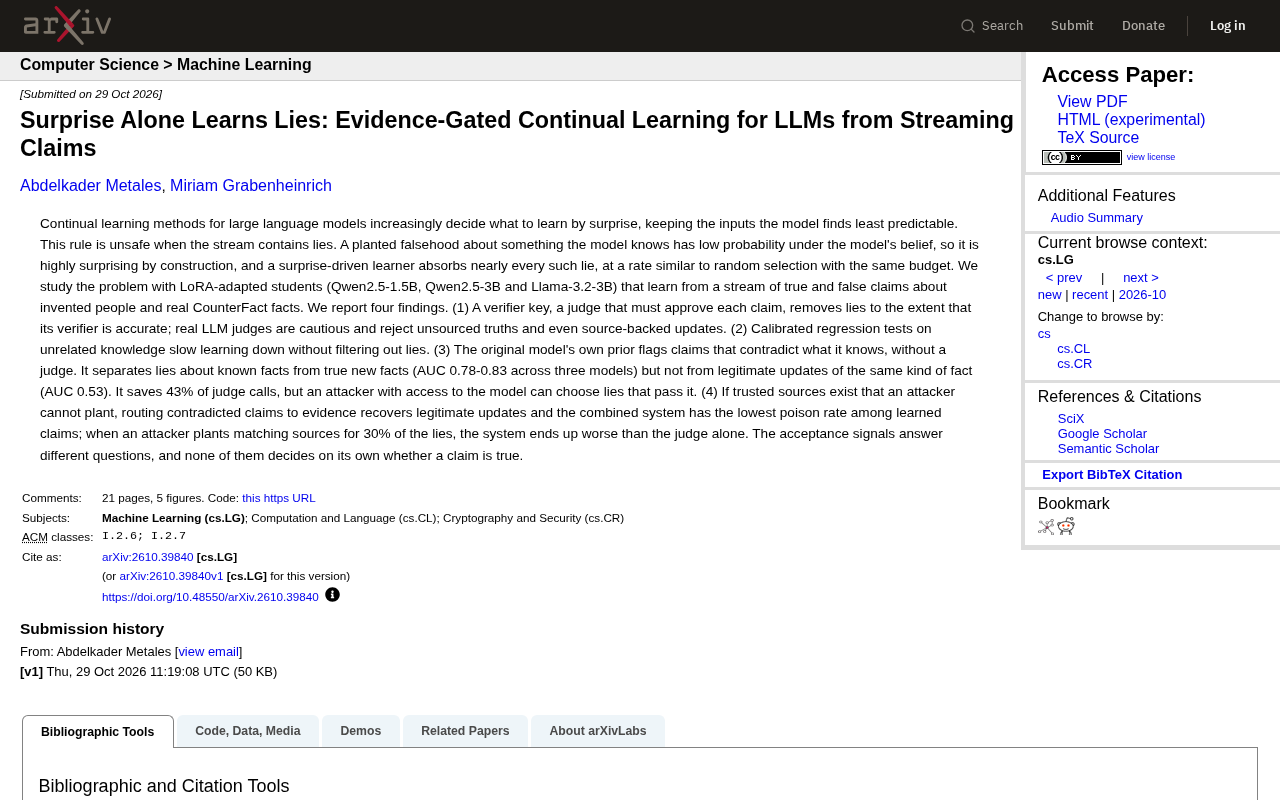
When large language models need to keep learning from continuously streaming data, a seemingly intuitive rule has been widely adopted: give higher learning weight to the inputs that the model finds most "surprising." After all, content with the lowest predicted probability is often the most informative new knowledge. However, this rule fails completely when lies are mixed into the data stream—a study on LoRA-adapted models reveals that surprise-driven learners absorb almost all carefully constructed false claims, with contamination rates comparable to random selection under the same budget.
Why "Surprise" Becomes an Accomplice to Lies
The logical foundation of surprise-based learning lies in information theory: low-probability events carry more information. For facts the model has already mastered, a false claim that contradicts them has an extremely low probability under the model's beliefs, and therefore naturally has the highest "surprise." This means attackers don't need sophisticated adversarial methods—simply stating content that contradicts facts the model already knows is enough to give false information priority in learning.
The study used three models—Qwen2.5-1.5B, Qwen2.5-3B, and Llama-3.2-3B—learning via LoRA adaptation from streams containing both true and false claims. Test data covered statements about fictional characters as well as real CounterFact facts. Results show that the surprise rule may be effective in clean data streams, but it offers almost no defense against maliciously injected lies.
"Surprise" and Self-Information in Information Theory
Surprise has a strict definition in information theory: the self-information of an event equals the negative logarithm of its probability, i.e., $I(x) = -\log p(x)$. The lower the probability of an event, the greater its self-information, and theoretically the more "new information" it carries. "Surprise sampling" in active learning or continual learning is based precisely on this principle: prioritize learning samples with low predicted probability, in hopes of gaining greater knowledge increments with less data. However, this criterion implicitly assumes that data is truthful and non-malicious—when the model encounters a false claim that contradicts its own beliefs, that claim has an extremely low probability under the model's distribution, and is therefore assigned the highest learning weight, becoming a vulnerability that attackers can exploit.
Measured Performance of Four Defense Mechanisms
The study systematically evaluated four possible remedies, each exposing different limitations.
Validator Gatekeeping: Effective but Overly Cautious
Introducing a "judge" that must approve every claim can theoretically filter out lies—the filtering effect depends on the validator's accuracy. In reality, LLM validators exhibit an overly cautious tendency: they reject true statements that lack sources, and even reject legitimate knowledge updates that are supported by sources. A clear tension emerges between safety and learning efficiency.
Calibration Regression Testing: Slows Down but Doesn't Detoxify
Calibration regression testing on unrelated knowledge can slow down learning, but cannot truly filter out lies. False claims still enter the model's parameters through the tests—the entire learning process is just dragged out. This is a compromise that trades efficiency for safety, but safety is not substantially improved.
The Model's Own Priors: Can Tell New from Old, but Not True from False
The model has a natural alertness toward claims that contradict its own knowledge. This prior signal can distinguish "lies about known facts" from "true new facts," achieving AUC of 0.78-0.83 across the three models. However, it cannot distinguish lies from "legitimate updates to facts of the same kind"—AUC is only 0.53, close to random guessing. This signal can save 43% of validator calls, but if attackers understand the model's internal state, they can carefully construct lies that pass the checks.
What the AUC Metric Means
AUC (Area Under the ROC Curve) is a common metric for evaluating a binary classifier's discriminative ability, ranging from 0.5 to 1. 0.5 indicates random guessing, and 1 indicates perfect discrimination. In the study, the model prior's AUC for distinguishing "lies about known facts" from "true new facts" is 0.78-0.83, indicating strong discriminative ability; while its AUC for distinguishing lies from "legitimate updates to facts of the same kind" is only 0.53, close to random, indicating that model priors cannot effectively discern true from false updates within the same knowledge domain. This contrast reveals the limitation of the model's internal state signals: it can sense "contradiction," but cannot judge "right or wrong."
Trusted-Source Routing: A Conditional Optimal Solution
If there exists a trusted source that attackers cannot implant, routing contradictory claims to the evidence source for verification can restore legitimate updates. This combined system has the lowest contamination rate among learned claims. But the preconditions are stringent: when attackers can implant matching sources for 30% of lies, the system performs even worse than using the validator alone.
LoRA and the Risk of Catastrophic Forgetting in Continual Learning
LoRA (Low-Rank Adaptation) achieves efficient fine-tuning by injecting low-rank decomposition matrices alongside pre-trained weights, adapting to new data by training only a small number of parameters. In continual learning scenarios, LoRA is often used to incrementally update models from data streams. However, continual learning faces the classic problem of catastrophic forgetting: new knowledge may overwrite old knowledge. The "calibration regression testing" mentioned in the study is precisely intended to mitigate this problem—by regression-testing unrelated knowledge, it ensures the model doesn't lose existing capabilities while learning new claims. But this test only slows down learning and cannot judge the truthfulness of the new claims themselves.
Core Insight: No Single Signal Can Determine Truth
The study's most profound finding may be this: each acceptance signal answers a different question. The validator answers "Is this claim credible?" The model prior answers "Does this claim conflict with my knowledge?" Source routing answers "Is this claim supported by external evidence?" Each is effective along different dimensions, but none can independently determine whether a claim is true or false.
The design of continual learning systems needs to abandon the fantasy of "finding a single universal filter" and instead build architectures that fuse multiple layers of signals. At the same time, security boundaries must be clear: when attackers can simultaneously manipulate multiple signal channels, the system's defensive capability drops sharply. For LLM applications that need to continuously learn from open data streams, this means maintaining the highest level of vigilance regarding the integrity of data sources.
One-line Summary
Surprise-driven continual learning causes LLMs to absorb false claims; the four defense signals each have limitations, and no single mechanism can determine truth.
Paragraph Summary
A study on LoRA-adapted models reveals that surprise-driven continual learners absorb almost all false claims contradicting facts the model already knows, with contamination rates comparable to random selection. The study systematically evaluated four defense mechanisms: LLM validators can filter lies but are overly cautious, rejecting true statements without sources; calibration regression testing only slows down learning without detoxifying; model priors can distinguish lies from true new facts (AUC 0.78-0.83), but cannot distinguish lies from legitimate updates to facts of the same kind (AUC 0.53); trusted-source routing has the lowest contamination rate when attackers cannot implant sources, but when attackers implant matching sources for 30% of lies, the system performs worse than using the validator alone. The core insight is: each acceptance signal answers a different question, no single signal can independently determine truth, and continual learning systems need to build multi-layer signal fusion architectures while remaining vigilant about data source integrity.
Related articles

Fifty Years Studying Power: Robert Caro's Writing and Insights on Power
Robert Caro reflects on 50 years studying power: Lyndon Johnson's persuasion and leverage, Robert Moses's transformation from idealist to ruthless builder, the dilemmas of large-scale construction, and his methods of compressing themes and solitary focus in biography writing.

Can a $20,000 Robot Do Your Chores? The Test Results Are Surprising
A YouTube test video shows how a $20,000 robot responds to commands like washing dishes, turning off lights, taking out trash, and feeding the dog. This article analyzes its real capability boundaries, the state of voice interaction technology, and how far household robots are from mainstream adoption.
The Complete Guide to Running AI Models Locally: Inference Engines and Tool Stack Explained
A systematic breakdown of the complete local LLM tool stack: from PyTorch and GGML compute libraries to llama.cpp, vLLM, SGLang inference engines and Ollama, LM Studio wrapper layers, with benchmark data on performance differences and selection logic.