The Real Value of AI's Math Breakthroughs: Not in Math, but in AI Research Itself

AI math capabilities leap non-linearly, with verification-heavy problems falling first, mattering more for AI R&D than for math itself.
The article traces AI's non-linear leap in math: from failing four-digit addition in 2023 to IMO gold in 2025 and a claimed Millennium Prize solve in 88 hours. Progress is uneven—AI skews toward verification-heavy tasks like finding counterexamples, with limited progress on new theories. The core argument: this problem-solving ability matters more for ML research than math itself, since AI labs' empirical-first paradigm is isomorphic to what AI does well.
From Four-Digit Addition to Millennium Prize Problems: An Accelerating Leap
In just a few years, AI's progress in mathematics has been striking. According to the timeline laid out in this YouTube video, in 2023 models still couldn't reliably perform four-digit addition; in 2024 they could barely solve problems in high school math competitions; by 2025 they were winning gold medals at the International Mathematical Olympiad; earlier this year, they began solving some obscure open problems; and just a month ago, OpenAI solved a Millennium Prize Problem in 88 hours.
The video's author quotes a line from the novel East of Eden to capture this impact: "There is one thing certain about the fall of the gods—they do not fall slowly, they shatter." This non-linear, almost rupturing pace of progress is exactly the immediate impression that current AI math capabilities give.

The Millennium Prize Problems were established by the Clay Mathematics Institute in 2000. There are seven in total, covering P vs NP, the Riemann Hypothesis, Yang-Mills existence and mass gap, the Navier-Stokes equations, the Hodge conjecture, the Poincaré conjecture (solved by Perelman in 2003), and the BSD conjecture. Each carries a $1 million prize, intended to record the core unsolved problems left over from 20th-century mathematics. What these problems share is that they are clearly stated and have unambiguous verification criteria, but the paths to solution are highly uncertain. The article mentions that OpenAI solved one of them in 88 hours—a claim that should be treated with caution: there is currently no officially recognized formal solution record from the Clay Institute, and it more likely refers to progress on a specific formalized or simplified version. Understanding this context helps in judging the actual weight of the phrase "solving a Millennium Prize Problem."
The Asymmetry of Progress: Verification-Intensive Problems Fall First
What needs to be viewed soberly is that these advances are not evenly distributed. The video points out that AI's capability gains are clearly skewed toward the "verification-heavy" parts of mathematics, such as finding counterexamples, while progress in proposing new theories remains limited.
This judgment cites a recent essay by Toby Ortt: current AI systems are beginning to automate mathematical proofs, but "there is little evidence that they can pose powerful questions or discover profound new areas of mathematics." However, the video's author offers a rather tension-filled reversal: put another way, the same sentence becomes: current AI systems have solved a Millennium Prize Problem, and they do not possess the ability to pose powerful questions or open up new fields.

Verification-intensive problems refer to mathematical tasks where, once an answer is given, checking its correctness is far easier than generating the answer—typical examples include finding counterexamples, verifying identities, checking properties of finite groups, or computing specific numerical values. The computational complexity of such problems is concentrated on the search side, while the verification side only requires polynomial time. AI systems excel at parallel probing in high-dimensional spaces, combining existing tools, and quickly eliminating wrong paths—which matches the structure of such tasks precisely. By contrast, proposing new theories requires identifying which problems are worth asking, constructing new abstract frameworks, and judging their long-term value. This involves aesthetics, intuition, and consensus within the academic community, and is difficult to characterize with an automatable reward signal. This asymmetry explains why AI has advanced by leaps and bounds in competition mathematics and counterexample search, yet has made limited progress in opening up new fields.
Why This Matters More for AI Research Than for Mathematics Itself
The core argument of the video is that this ability to "solve clearly defined problems" matters even more for machine learning research than for mathematics broadly.
The reason lies in what AI labs focus on. What they mainly care about is how any new algorithmic recipe can, at the empirical level, make training more efficient or make models behave more intelligently. Theory itself is not their goal. In other words, AI research is methodologically highly similar to the kind of mathematical work current AI excels at—relying on astonishing persistence, plus superhuman ability to connect ideas across a large number of adjacent fields, to unlock a large number of "low-hanging fruits."
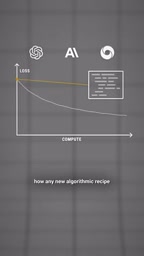
This also explains why the leap in math capabilities translates directly into an accelerator for AI R&D: when AI can rapidly trial-and-error, combine, and verify within clearly defined problem spaces, it aligns precisely with AI labs' "empirical-first" R&D paradigm.

The empirical-first R&D paradigm is the typical methodology of contemporary AI labs: researchers propose algorithmic changes, observe loss curves, downstream task performance, and compute efficiency in benchmarks and scaled training, and then iterate accordingly. This loop does not require a theoretical proof of why an algorithm works—only that experiments be reproducible and metrics comparable. In contrast, mathematical research traditionally pursues a deductive system composed of definitions, theorems, and proofs. When AI demonstrates superhuman persistence and cross-domain associative ability on problems that are clearly defined with unambiguous verification criteria, it is in fact working in the same way as AI labs—large-scale trial and error plus rapid verification. This is also the deeper reason the article believes the leap in math capabilities will directly accelerate AI R&D: both share the same epistemology of "search—verify—iterate."
Implications for the Industry
If this judgment holds, then the industry's focus in discussions of "AI math capabilities" may need to shift. Rather than agonizing over whether AI can become a mathematician, it would be better to focus on its actual output as a research tool in algorithm search, experimental verification, and cross-domain association. The implicit reminder in the video is: AI does not need to possess the self-awareness to propose profound theories in order to keep producing breakthroughs in engineering-driven, empirically driven AI research. For researchers and labs, this means positioning AI as an efficient problem-solving engine rather than a theory creator may be the more pragmatic path.
(This article is based on analysis from a single YouTube video source; the views and timeline in the text all come from that video's statements.)
One-line Summary
AI math capabilities are leaping non-linearly, with verification-intensive problems falling first—mattering more for AI R&D than for mathematics itself.
Paragraph Summary
The article traces the non-linear leap in AI math capabilities over just a few years: from being unable to reliably perform four-digit addition in 2023, to winning a gold medal at the International Mathematical Olympiad in 2025, to recent claims of solving a Millennium Prize Problem in 88 hours. The author notes that progress is unevenly distributed—AI is clearly skewed toward verification-heavy tasks such as finding counterexamples, while progress in proposing new theories and opening new fields remains limited. The core argument is that this ability to solve clearly defined problems matters even more for machine learning research than for mathematics itself, because AI labs follow an empirical-first R&D paradigm that is highly isomorphic to the mathematical work AI excels at. The article suggests positioning AI as an efficient problem-solving engine rather than a theory creator, and reminds us that the focus of discussion should shift from "can AI become a mathematician" to its actual output as a research tool.
Related articles

ClawDOS: Bringing AI Coding Capabilities to DOS
ClawDOS is an AI coding agent project for DOS, exploring the possibility of bringing AI coding assistance into resource-constrained retro computing environments. This article analyzes its positioning, use cases, and community response.

Baseten Releases Bison-1 and Groundhog-1, Topping the Decision Model Leaderboard
Baseten releases open-weight decision models bison-1 and groundhog-1 built on Gemma 4; bison-1 scores 76 on the AA Decision Index v2.1 to top the leaderboard. Both support 128k context and image input—here we analyze their capability combination, benchmark significance, and selection advice for developers.

Cline CLI v3.0.75 Released: Yolo Mode Now Default for One-Shot Runs
Cline CLI v3.0.75: one-shot runs now default to yolo mode, --timeout and Ctrl+C can interrupt the first round, read_files is no longer truncated to 8k chars, plus reasoning parameter fixes and 94 new providers.