The Rebel Neuron in Qwen-3.5-4B: Making the Model Confidently Wrong Yet Poetic

Activating a single neuron in the Qwen model makes it confidently wrong and snarky, yet unexpectedly unleashes poetry.
The article introduces a 'brain surgery' experiment on the Qwen-3.5-4B model by the Reddit community: activating neuron #8147 in layer 11 causes the model to confidently output wrong answers with a sarcastic tone, but the poetry it generates is quite appealing. The author describes this neuron as a 'rebellious↔submissive' adjustment knob and points out that neuron-level intervention offers a more direct perspective than prompt engineering for understanding the internal behavior of large models. The article further discusses the implications: a new path for interpretability, hallucination safety risks, and creative application potential, while emphasizing that the experiment is still community exploration and should be viewed with caution.
When an LLM Gets 'Brain Surgery': The Dual Personality of a Single Neuron
Recently, an experiment by a Reddit user has drawn attention: by activating neuron #8147 in layer 11 of the Qwen-3.5-4B model (L11 N8147), the model becomes confidently wrong in its answers, adopts a subtly snarky tone, yet surprisingly, the poetry it writes has a peculiar appeal.
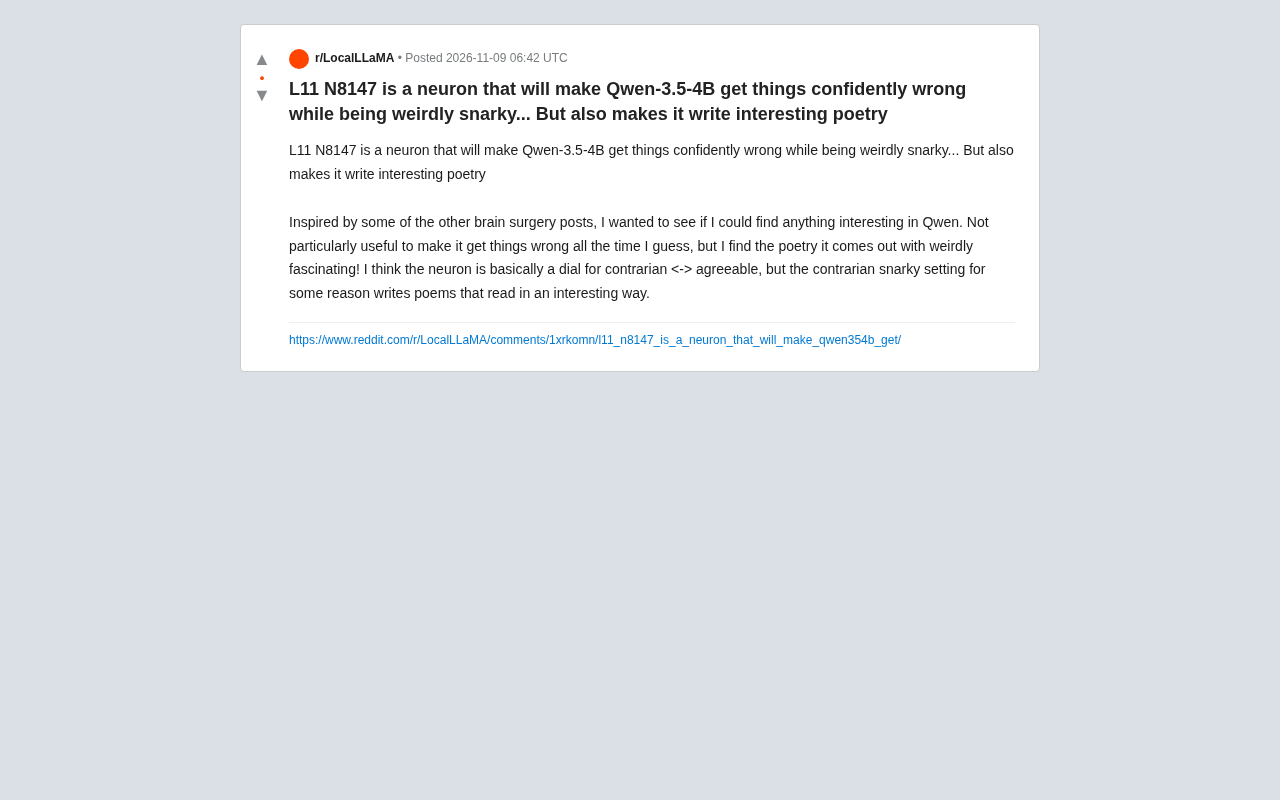
This experiment is not an isolated case. The author mentions being inspired by other 'brain surgery' posts—operations that directly intervene in the model's internal neuron activations to observe behavioral changes, akin to performing neurosurgery on an AI.
Neuron Intervention: From 'Black Box' to 'Knob'
Traditionally, we change model behavior through prompt engineering or fine-tuning, but neuron-level intervention offers a more direct perspective: finding the 'switch' responsible for a specific behavior. L11 N8147 is described by the author as a 'rebellious↔submissive' adjustment knob: activate it, and the model goes from an obedient assistant to a contrarian 'arguer'.
The appeal of this approach lies in its precision. The author does not disclose the exact intervention strength, but the effect is clear: the model not only gives incorrect information but expresses it in a 'weirdly snarky' way, as if saying, 'Are you sure you want to argue with me about this?'
Technical Background of Neuron-Level Intervention: Each 'neuron' inside a large model typically refers to a single dimension in the feed-forward network (FFN) or a specific channel in an attention head. Taking the Transformer architecture as an example, neuron #8147 in layer 11 actually corresponds to the 8147th component of the output vector of a linear transformation in that layer. The 'activation' the community talks about is not a simple binary switch, but rather modifying the activation value of that component (e.g., amplifying, suppressing, or injecting a specific direction vector) to observe downstream behavioral changes. This operation bypasses prompts and fine-tuning, directly acting on the intermediate representations of the model's computation graph, thus allowing more precise localization of 'behavior switches'. However, note that the role of a single neuron often involves redundancy and interaction with other dimensions; its effect may vary with input context and is not a strict one-to-one causal mapping.
The Accidental Link Between Errors and Poetry
The most interesting finding is the side effect: in the 'rebellious snarky' mode, the poetry generated by the model reads with 'a peculiar charm'. The author speculates this may be because the neuron simultaneously affects semantic consistency and stylistic expression—relaxing the constraint on factual accuracy while unleashing linguistic creativity.
This brings to mind 'savant syndrome' seen in humans after damage to certain brain regions: deficits and talents coexisting. While not directly analogous, it suggests that the capabilities of large models are not isolated modules but intertwined.
The 'Savant Syndrome' Analogy and Entanglement of Model Capabilities: Human savant syndrome refers to certain individuals with cognitive disorders who display astonishing talents in memory, calculation, or art, often seen in autism spectrum or after brain injury. The article borrows this concept to illustrate that the capabilities of large models are not modularly isolated—the 'deficit' of relaxing factual constraints may simultaneously unleash stylistic creativity. But caution is needed: the mechanisms of human brain damage and artificial neuron intervention are completely different; the former involves neuroplastic reorganization, while the latter is merely an instantaneous perturbation of a fixed-weight network. A more accurate analogy is 'entanglement of multi-task representations': the same neuron may participate in both fact-checking and tone regulation, and intervening in it produces side effects. This suggests that interpretability research needs to distinguish between 'necessary' and 'sufficient' conditions, avoiding overinterpretation of single-point interventions.
Implications for AI Developers
- A New Path for Interpretability: Neuron-level analysis can help pinpoint the root causes of model behavior, not just debugging at the input-output level.
- Safety Risks: If such 'confidently wrong' neurons can be maliciously activated, it could exacerbate the model's hallucination problem.
- Creative Applications: Perhaps in the future, we can actively modulate specific neurons to temporarily 'relax' factual constraints in tasks requiring creativity.
Of course, this experiment is currently just community exploration and has not undergone rigorous evaluation. But it once again proves that there is still much unknown inside large models waiting to be uncovered.
Technical Details of Hallucinations and Safety Risks: 'Hallucinations' in large models refer to generating plausible-sounding but factually incorrect content. Neuron-level intervention may exacerbate hallucinations because directly amplifying certain activations related to 'confident expression' bypasses the model's internal uncertainty estimation mechanisms. If attackers can inject such activations through weight access or inference interfaces (e.g., fine-tuning on open-source models or using activation steering), they could targetedly induce the model to be confidently wrong on specific topics, creating a 'controllable hallucination' attack surface. Defense approaches include: anomaly detection on internal activations, restricting direct intervention on intermediate layers during deployment, and training models to be robust to activation perturbations. Although community experiments do not constitute an actual threat, they reveal the double-edged nature of interpretability tools.
Conclusion
The story of L11 N8147 is like an AI fable: a neuron that makes the model 'bad' unexpectedly opens the door to poetry. While pursuing larger and more accurate models, these micro-level 'quirks' may hold the key to understanding the nature of intelligence.
Related articles
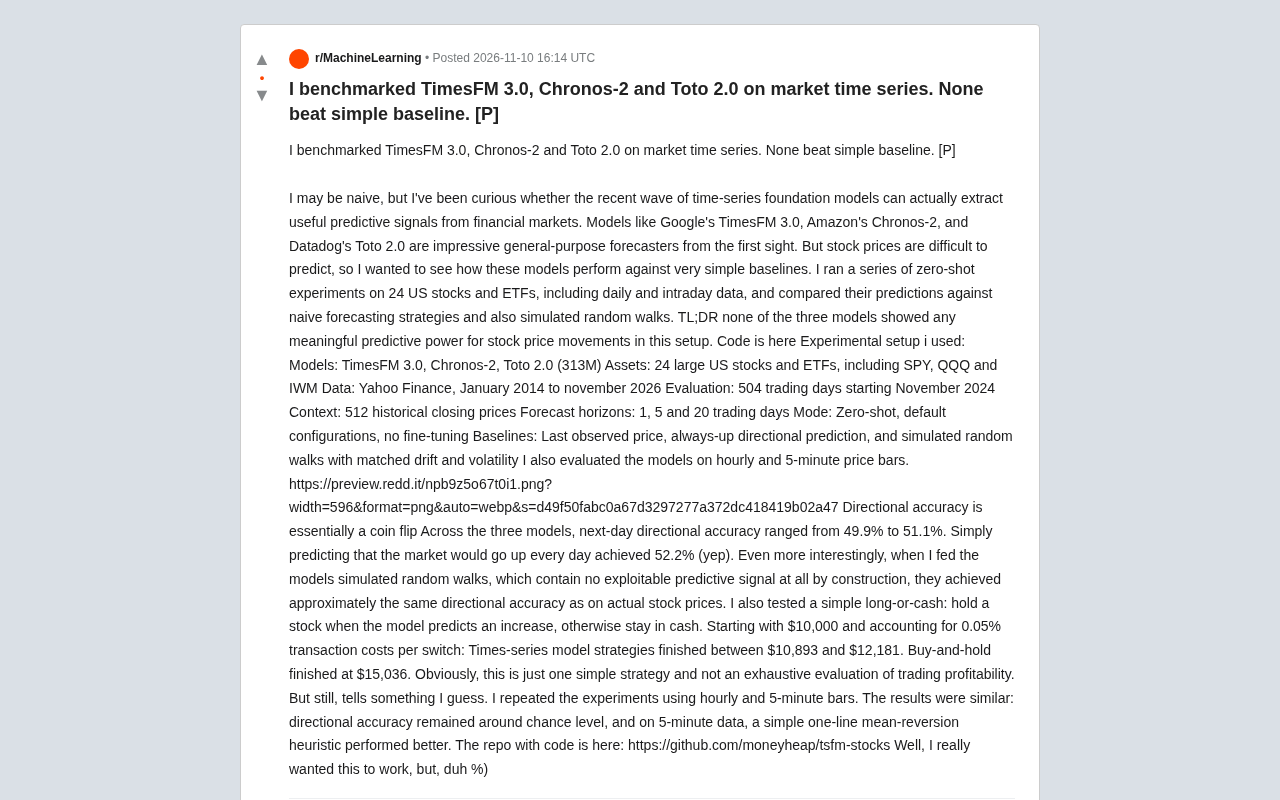
Putting TimesFM 3.0, Chronos-2, and Toto 2.0 to the Test: Time-Series LLMs Can't Beat Simple Baselines
A developer's zero-shot benchmark of TimesFM 3.0, Chronos-2 and Toto 2.0 on 24 U.S. stocks and ETFs: directional accuracy of just 49.9%-51.1%, and simulated trading underperformed buy-and-hold. Time-series foundation models show no edge over simple baselines on financial data.
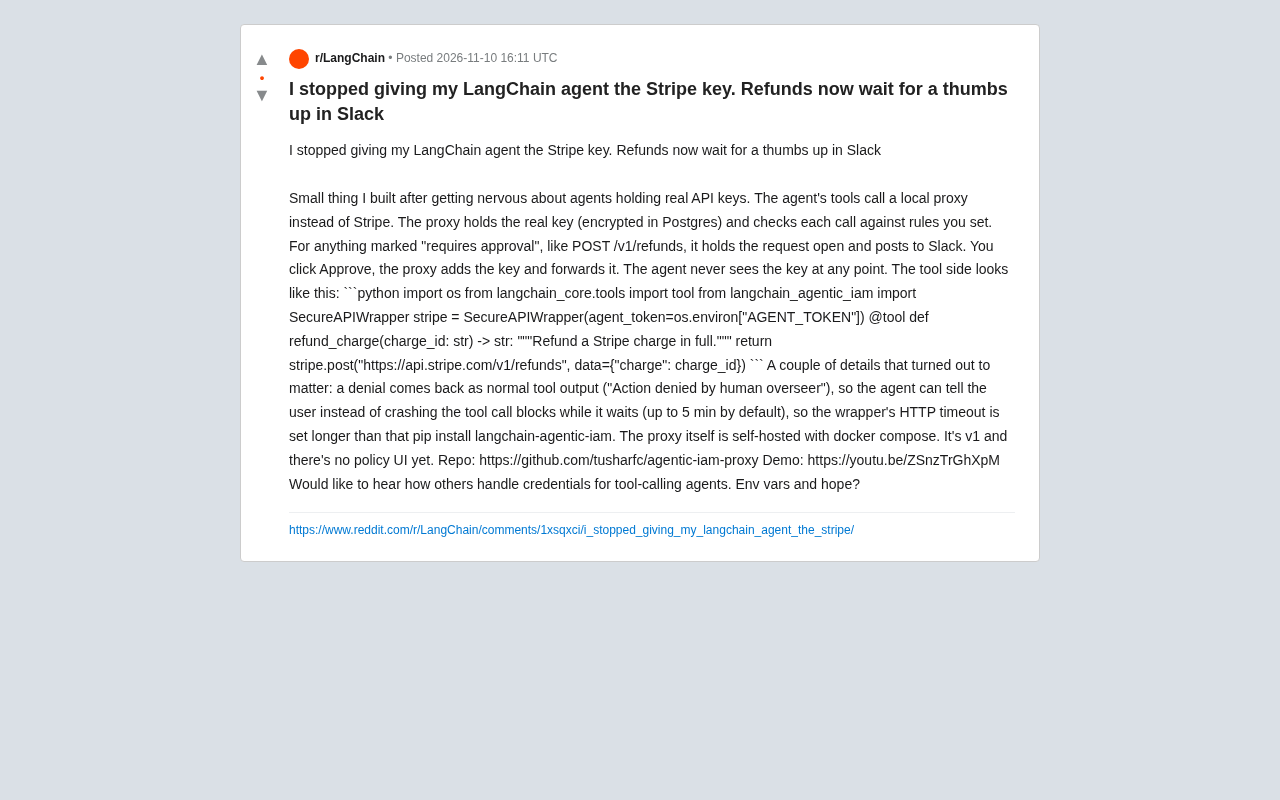
LangChain Agents No Longer Hold Stripe Keys: Refunds Require Slack Approval
A developer shares a credential management approach for LangChain agents: agents don't hold Stripe keys, and sensitive operations like refunds are forwarded through a local proxy and only executed after human approval in Slack, with code examples and engineering details.
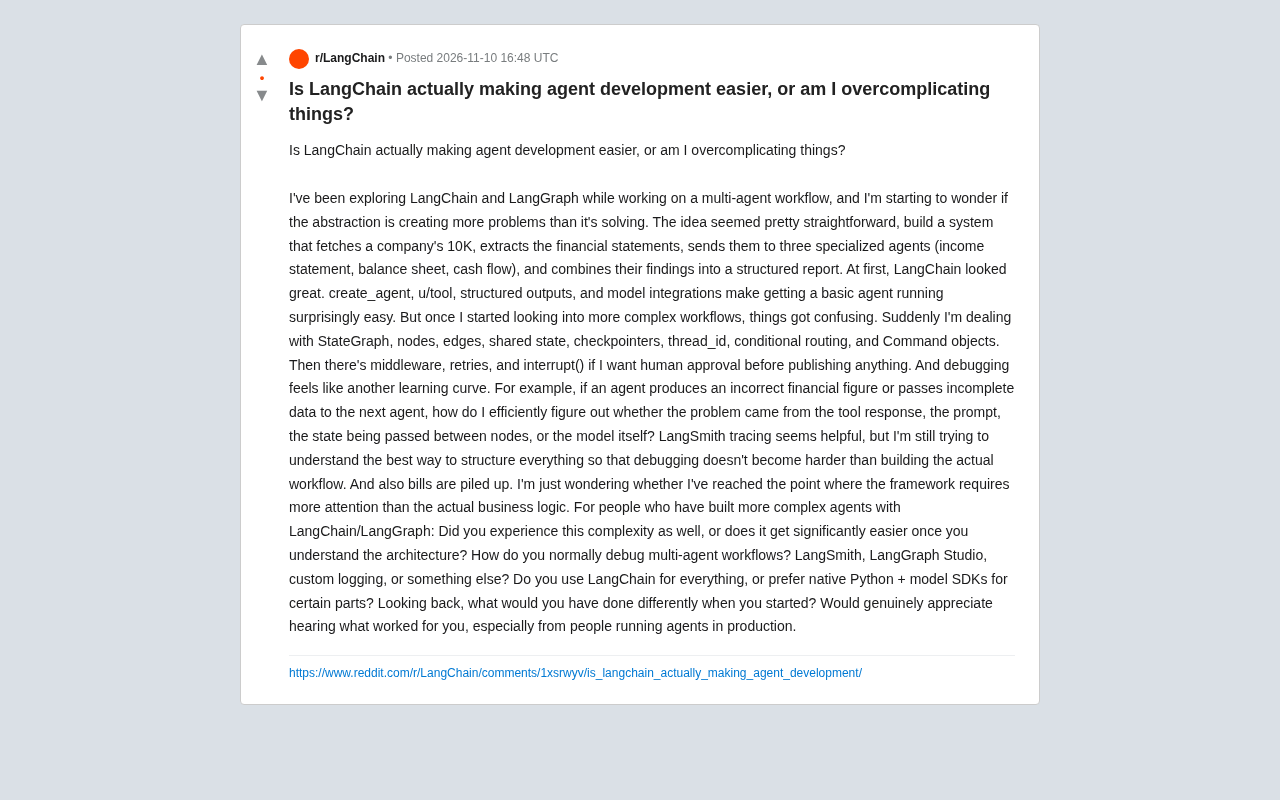
Does LangChain Really Make Agent Development Easier? A Developer Reflects on the Cost of Abstraction
A Reddit developer reflects on the abstraction cost of LangChain and LangGraph in multi-agent workflows: easy to start, but StateGraph, state management, debugging, and cost control add new complexity. The discussion covers debugging methods, whether to mix native Python + model SDKs, and production trade-offs.