The Truth About LLM Temporal Reasoning: The Arithmetic vs. Semantic Dichotomy Fails, and Knowledge Memory Is the Key

A new study challenges the temporal reasoning dichotomy, finding that high model scores mainly rely on knowledge memory rather than transferable reasoning.
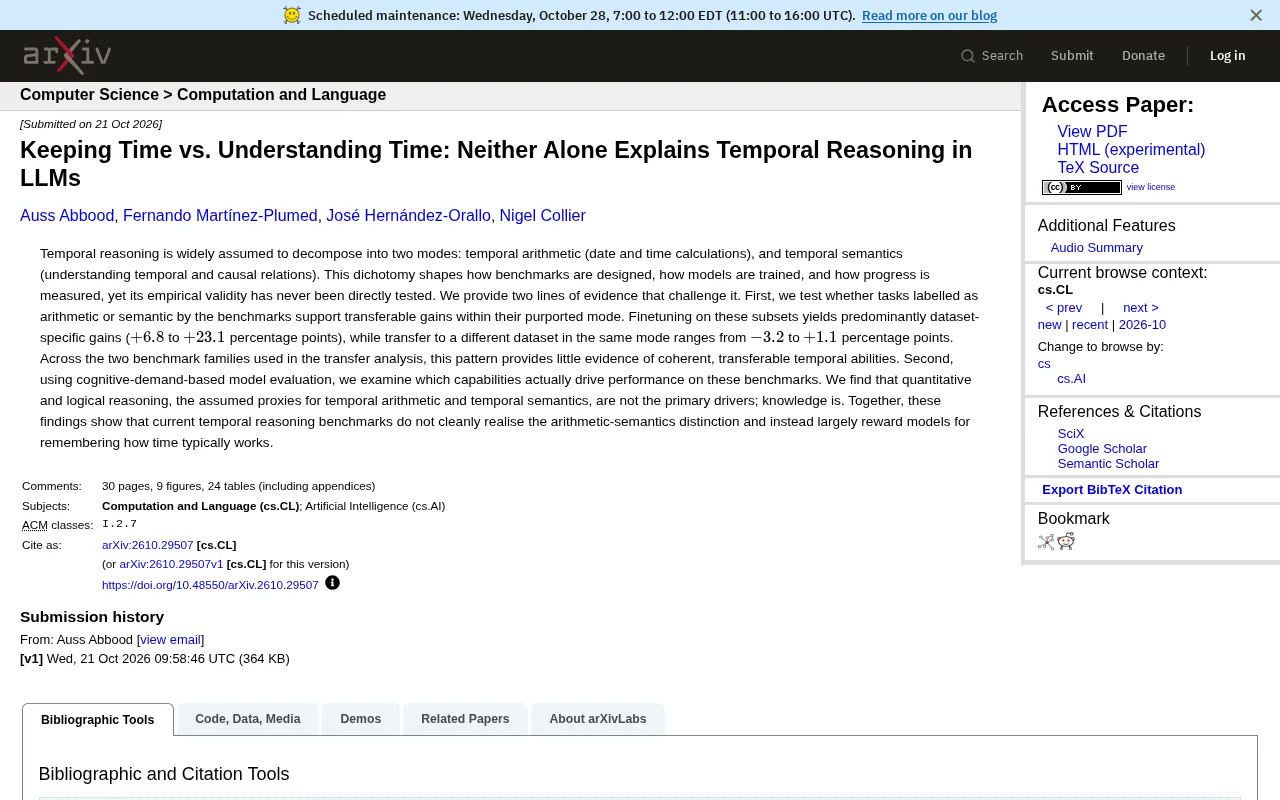
The paper "Keeping Time vs. Understanding Time" tests the validity of the "arithmetic vs. semantic" dichotomy in temporal reasoning through transfer experiments and cognitive demand evaluation. Fine-tuning experiments show that cross-dataset transfer gains within the same mode are only -3.2 to +1.1 percentage points, while gains on the training set itself reach +6.8 to +23.1 percentage points, indicating that the model learns dataset-specific patterns rather than generalizable ability. Cognitive demand analysis further reveals that knowledge, rather than quantitative or logical reasoning, is the core driver of benchmark performance. The study questions the construct validity of current temporal reasoning benchmarks and suggests controlling knowledge leakage, distinguishing the contributions of memory and reasoning, and re-examining training strategies.
Temporal reasoning is often regarded as an important dimension of large model capability, but a new study directly challenges the long-standing default dichotomous framework in this field. The paper "Keeping Time vs. Understanding Time: Neither Alone Explains Temporal Reasoning in LLMs" demonstrates through two sets of experiments that current benchmarks do not clearly distinguish between "temporal arithmetic" and "temporal semantics," and that model performance largely depends on memory of temporal common sense rather than transferable reasoning ability.
The Dichotomous Assumption of Temporal Reasoning: An Untested Consensus
Temporal reasoning is usually decomposed into two modes: temporal arithmetic (date calculation, duration estimation) and temporal semantics (understanding temporal relations and causal logic). This dichotomy has profoundly influenced benchmark design, training strategies, and evaluation methods, but its empirical validity has never been directly tested. The researchers point out that if this dichotomy holds, then fine-tuning within the same mode should yield transferable performance gains. However, the experimental results do not support this expectation.
Transfer Experiments: Fine-Tuning Gains Are Highly Dataset-Dependent
The research team fine-tuned on multiple temporal reasoning datasets separately and observed the transfer effects of the model across different datasets within the same mode. The results showed that the gains from fine-tuning were mainly confined to the training set itself (+6.8 to +23.1 percentage points), while when transferring to another dataset in the same mode, the gain range was only -3.2 to +1.1 percentage points. This means that what the model learned was more like surface patterns specific to a dataset rather than generalizable temporal arithmetic or semantic ability. Transfer analysis across two benchmark families further indicates that there is a lack of evidence for the so-called "coherent temporal reasoning ability."
Construct validity is a core concept in psychometrics, referring to whether a test truly measures the psychological construct it claims to measure. In LLM evaluation, this translates to: do benchmark scores truly reflect the target ability (such as temporal reasoning), or are they confounded by other factors (such as knowledge memory in training data)? If a benchmark allows a model to score through memory rather than reasoning due to knowledge leakage, its construct validity is threatened. This study questions temporal reasoning benchmarks precisely from the perspective of construct validity: if scores are mainly driven by knowledge, then these benchmarks may be measuring not "reasoning ability" but "coverage of temporal common sense." Insufficient construct validity can lead to misjudgments of model capabilities, which in turn affects training strategies and downstream application decisions.
Cognitive Demand Evaluation: Knowledge, Not Reasoning, Drives Performance
The second set of experiments adopted a model evaluation method based on cognitive demand to analyze which abilities truly drive benchmark performance. The results showed that quantitative reasoning and logical reasoning, which are assumed to be proxies for temporal arithmetic and semantics, are not the main factors; knowledge is the core driver. In other words, high scores on temporal reasoning benchmarks reflect more the model's memory of "how time usually works" rather than real-time computation or deep understanding.
Cognitive demand evaluation is a method for understanding model performance by analyzing the cognitive abilities required by a task. It usually decomposes a task into multiple cognitive dimensions (such as knowledge recall, quantitative reasoning, logical reasoning, working memory, etc.), and then determines through experiments (such as ablation, intervention, or correlation analysis) which dimensions contribute most to model performance. Unlike traditional end-to-end accuracy evaluation, cognitive demand evaluation attempts to reveal "why the model gets it right or wrong," thereby distinguishing surface performance from deeper ability. In this study, this method was used to examine which cognitive components temporal reasoning benchmarks actually rely on, and the results found that the knowledge dimension dominates, while the contributions of quantitative and logical reasoning are limited. This provides a direct diagnostic tool for the construct validity of benchmarks.
Implications for Benchmark Design and Model Evaluation
This finding raises questions about the construct validity of temporal reasoning benchmarks. If benchmarks reward knowledge recall rather than reasoning processes, then conclusions about ability drawn from these scores may be overestimated. The study suggests that future benchmark design needs to more strictly control knowledge leakage and distinguish the contributions of memory and reasoning. At the same time, training strategies should also be re-examined: simply adding more time-related data may not improve transferable temporal reasoning ability; it may be necessary to design tasks that specifically require computation or logical inference.
Conclusion
This study does not deny that large models possess temporal reasoning ability, but points out that current evaluation methods fail to accurately capture this ability. The arithmetic-semantic dichotomy still has conceptual value, but it has not yet been clearly realized empirically in benchmarks. For researchers and developers, this means that temporal reasoning scores need to be interpreted more cautiously, and more rigorous evaluation methods should be promoted.
One-line Summary
A new study challenges the temporal reasoning dichotomy and finds that high model scores mainly depend on knowledge memory rather than transferable reasoning.
Paragraph Summary
Through transfer experiments and cognitive demand evaluation, the paper "Keeping Time vs. Understanding Time" tests the validity of the "arithmetic vs. semantic" dichotomy in temporal reasoning. Fine-tuning experiments show that cross-dataset transfer gains within the same mode are only -3.2 to +1.1 percentage points, while gains on the training set itself reach +6.8 to +23.1 percentage points, indicating that the model learns dataset-specific patterns rather than generalizable ability. Cognitive demand analysis further reveals that knowledge, rather than quantitative or logical reasoning, is the core driver of benchmark performance. Based on this, the study questions the construct validity of current temporal reasoning benchmarks and suggests controlling knowledge leakage, distinguishing the contributions of memory and reasoning, and re-examining training strategies.
Related articles

Fifty Years Studying Power: Robert Caro's Writing and Insights on Power
Robert Caro reflects on 50 years studying power: Lyndon Johnson's persuasion and leverage, Robert Moses's transformation from idealist to ruthless builder, the dilemmas of large-scale construction, and his methods of compressing themes and solitary focus in biography writing.

Can a $20,000 Robot Do Your Chores? The Test Results Are Surprising
A YouTube test video shows how a $20,000 robot responds to commands like washing dishes, turning off lights, taking out trash, and feeding the dog. This article analyzes its real capability boundaries, the state of voice interaction technology, and how far household robots are from mainstream adoption.
The Complete Guide to Running AI Models Locally: Inference Engines and Tool Stack Explained
A systematic breakdown of the complete local LLM tool stack: from PyTorch and GGML compute libraries to llama.cpp, vLLM, SGLang inference engines and Ollama, LM Studio wrapper layers, with benchmark data on performance differences and selection logic.