The Underlying Logic of N8N Automation Workflows: Why Choose It Over RPA
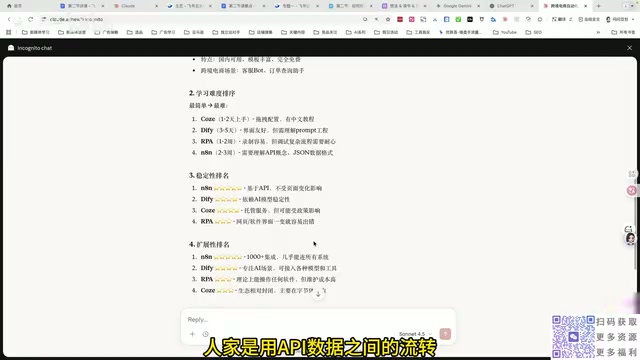
N8N achieves stable automation through API data flow and complements RPA; its essence is prompts plus the right large model.
Based on Bilibili creator Xiao Bei's N8N course, this article explores how cross-border e-commerce teams should choose among N8N, RPA, Dify, and Coze. Multi-model cross-validation shows N8N leads in stability and scalability while RPA is least stable. N8N flows data between nodes via APIs, while RPA simulates manual operations — the two are complementary, not opposing. On deployment, official cloud hosting is easiest; local deployment risks HTTPS certificate, intranet penetration, and upgrade-overwrite issues; cloud servers should avoid mainland China and Hong Kong nodes. The core breaks automation into three steps: what result you want, what the trigger is, and where the output goes — and stresses that automation ultimately comes down to prompts and the right model, testing business understanding rather than tool operation.
The Underlying Logic of N8N Automation Workflows: Why Choose It Over RPA
Automation tools keep proliferating — RPA, Coze, and Dify each have their strengths. So which one should a cross-border e-commerce team actually choose? In his hands-on N8N course on Bilibili, creator Xiao Bei offers his answer by "making AIs debate each other," and breaks down the underlying logic of automation workflows. This article is based on that course content, focusing on tool selection reasoning and the essence of automation.
Cross-Validation Across Multiple Models: Why N8N
Xiao Bei posed the selection question to several large models at once, with these preconditions: cross-border e-commerce business, no AI team at the company, zero-code foundation, and the goal of reducing costs and improving efficiency. He asked the AIs to compare N8N, RPA, Dify, and Coze across three dimensions: learning difficulty, stability, and scalability.
According to Xiao Bei's testing, several mainstream models reached highly consistent conclusions: N8N ranks first in both stability and scalability, while RPA has the worst stability — it breaks easily whenever a web page changes. The divergence lies in learning difficulty: some models rate N8N as moderately hard, while others say it has the highest barrier to entry. This disagreement actually shows that N8N is not a "foolproof" tool, but its learning cost buys stronger long-term maintainability.
Xiao Bei emphasizes that this multi-model cross-validation approach is itself a learning method: don't just use whatever someone recommends — first have AI do an objective comparison, then judge based on your own business scenario.
N8N vs. RPA: Not Opposites, but Complementary
The key to understanding N8N's positioning is clarifying its fundamental difference from RPA. N8N is about data flowing between nodes, communicating through API interfaces — once a workflow is built, changes to external interfaces won't affect its operation. RPA simulates manual operations: recognizing elements on screen to click, type, and drag — once a popup appears or an element changes, it needs readjustment.
But Xiao Bei doesn't see the two as mutually exclusive. In cross-border e-commerce scenarios, combining N8N with RPA is basically sufficient: software with APIs goes through N8N, software without APIs is covered by RPA — for example, certain internal company systems that only support manual operation interfaces. RPA's limitation is fragility; its strength is coverage. N8N's limitation is its dependence on APIs; its strength is stability and scalability.
As for Coze and Dify, Xiao Bei's assessment is: Coze leverages the ByteDance ecosystem and is already strong in China for combining Douyin, Xiaohongshu, and Feishu Bitable; Dify leans toward knowledge bases and RAG capabilities, suitable for building AI Agents based on enterprise private knowledge. The three have different positioning — the choice depends on your business focus.
Webhook: A mechanism where an external system initiates a call. In automation workflows, a Webhook is essentially a public URL reserved for your process — any third-party system (such as form submissions, payment success, message pushes) can send an HTTP request to that address to trigger the workflow in real time, without polling or manual intervention. Compared to scheduled triggers, Webhooks are event-driven, respond faster, and consume fewer resources, making them suitable for business scenarios requiring immediate response (such as automatically syncing inventory after an order status change). In N8N, the Webhook node can directly generate a receiving address and supports GET/POST and other methods — it's an important entry point for connecting external systems.
API (Application Programming Interface): A set of agreed communication rules between software programs, allowing one program to request data or functionality from another in a standardized way. In N8N, nodes call different services' APIs to read, write, and manipulate data — for example, calling the Feishu Bitable API to add records, or calling a translation API to convert text. API stability depends on the interface design of the service provider; as long as the interface doesn't change, the workflow is unaffected by front-end interface changes — this is the fundamental reason N8N is more stable than RPA. Understanding API request/response patterns (such as authentication methods and parameter formats) is a prerequisite for building reliable workflows.
Three Deployment Methods and Their Pitfalls
The course briefly outlines three deployment paths for N8N, focusing not on operational steps but on avoiding pitfalls.
Official cloud hosting is the most hassle-free choice — monthly payment, fully configured. Xiao Bei himself chose official hosting initially, for the reason of quick onboarding and not wanting to waste time on environment configuration.
Local deployment has the lowest cost but plenty of issues. The intranet environment uses HTTP rather than HTTPS, and some large model callbacks require security certificates — when misconfigured, it may seem to work, but problems only surface once you actually build workflows. Being unable to access the local network while traveling is another hard limitation, requiring additional intranet penetration — and penetration tools are either restricted or paid, which may not end up cheaper than cloud hosting.
Cloud server deployment has no technical barrier or maintenance burden, but Xiao Bei specifically warns: don't use mainland Chinese servers, and Hong Kong servers won't work either — stability cannot be guaranteed.
Another easily overlooked pitfall is credential migration. When switching from one platform to another, all previously configured credentials must be reinstalled, and as workflows multiply, migration costs grow higher and higher. Therefore, you should settle on a platform from the start. Local deployment users upgrading should also ask AI one more question: will the upgrade overwrite existing workflows? Xiao Bei himself fell into this trap and only later confirmed the container storage location to avoid losing nodes during upgrades.
Intranet penetration: When a locally deployed N8N needs to be accessed from the external network (such as remote operation while traveling, or receiving Webhook callbacks), since the local environment sits within a LAN without a public IP, external requests cannot reach it directly. Intranet penetration tools establish a tunnel between a public server and a local client, forwarding external requests to the local service to enable access. Common solutions include frp, ngrok, and Oray PeanutHull — some free tools have bandwidth and stability limitations, while paid versions add cost. For workflows that need stable 7×24 operation, intranet penetration reliability is often inferior to simply using a cloud server — this is the hidden cost Xiao Bei warns about when weighing local deployment.
The Underlying Logic of Automation in Five Minutes
This is the core of the entire lesson. Xiao Bei breaks automation into three steps: what result do I want to achieve, what is my initial idea (i.e., the trigger condition), and where does the final output go.
The first step is the result. Extracting links, translating, image recognition, scraping industry information, analyzing competitor sales — these are all the "what I want" part. The second step is the trigger — how you plan to start this process: manual click to run, scheduled trigger, a new row added to a spreadsheet, or invoked by an external system through a Webhook. The third step is the output — whether data ultimately flows back to a spreadsheet, a folder, or another destination.

Xiao Bei suggests beginners start with manual triggers, then gradually move to chat-based triggers, spreadsheet status triggers, and scheduled triggers. He uses Feishu Bitable field shortcuts as an analogy: reading tasks, cleaning data, extracting brand descriptions, tagging, sentiment analysis — each step is data flowing between nodes. Every N8N node works the same way: connecting to different APIs, consuming different quotas — the essence is always "whatever I want, I connect the corresponding node."
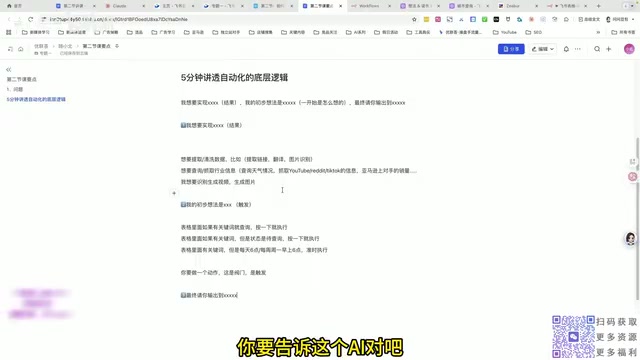
Once you understand this logic, the foundation for transferable learning ability is in place. Xiao Bei says bluntly that many people get stuck at the "idea" stage and can't categorize — it's not that the tool is hard, but that their expression ability hasn't caught up. The prerequisite for having AI write workflows for you is that you clearly articulate the three things: result, trigger, and output. He emphasizes that the course doesn't teach people to manually configure nodes one by one, but to command AI in natural language to generate workflows, then modify the generated results.
Trigger methods: The startup mechanism of an automation workflow, determining when and how the process runs. Common types include: manual trigger (click to run in the interface, suitable for debugging and low-frequency tasks), scheduled trigger (periodic execution via cron expressions, such as syncing data every day at midnight), event trigger (driven by external systems through Webhooks or new spreadsheet rows, with the strongest real-time responsiveness), and chat-based trigger (started through conversational commands, suitable for interactive scenarios). Choosing a trigger method requires weighing real-time responsiveness, resource consumption, and implementation complexity. Beginners starting with manual triggers can observe each node's input and output more clearly, then gradually switch to automatic triggers once the logic is stable — an effective path to reduce debugging difficulty.
Behind Automation Lies Prompts and Large Models
At the end of the course, Xiao Bei offers a judgment: behind all automation, the essence is prompts plus choosing the right large model. Prompts carry your understanding of the business; the model determines output quality. The same workflow template, built by different people, produces different results — the difference isn't in tool operation but in depth of business understanding. This is also why he spends so much time on logic rather than configuration — tools iterate, but learning ability is a long-term asset.
Related articles
 Tech Frontiers
MuJoCo: An Analysis of DeepMind's Open-Source General-Purpose Physics Simulator
An in-depth analysis of Google DeepMind's open-source physics simulator MuJoCo: high-performance C++ kernel, MJCF modeling format, contact solving principles, MJX GPU acceleration, and robot reinforcement learning use cases.
 Tech Frontiers
Claude API Quick Start: The Official Quickstarts Project Collection
Anthropic's official claude-quickstarts project collection helps developers quickly build deployable apps with the Claude API. Nearly 20k stars, Python-based, great for beginners and prototyping.
 Tech Frontiers
AI Agents Connecting Directly to APIs: Which Calls Can Be Safely Allowed?
AI agents can call any API, but the real challenge is deciding which calls can be safely allowed. This article analyzes allowance decisions from three dimensions—intent matching, least privilege, and controllable impact—and argues that the control layer should sit outside the agent, combined with audit traceability to build a trustworthy API call governance mechanism.