The Verifiable Reasoning Dilemma of Medical LLMs: Can Neuro-Symbolic Approaches Break Through?
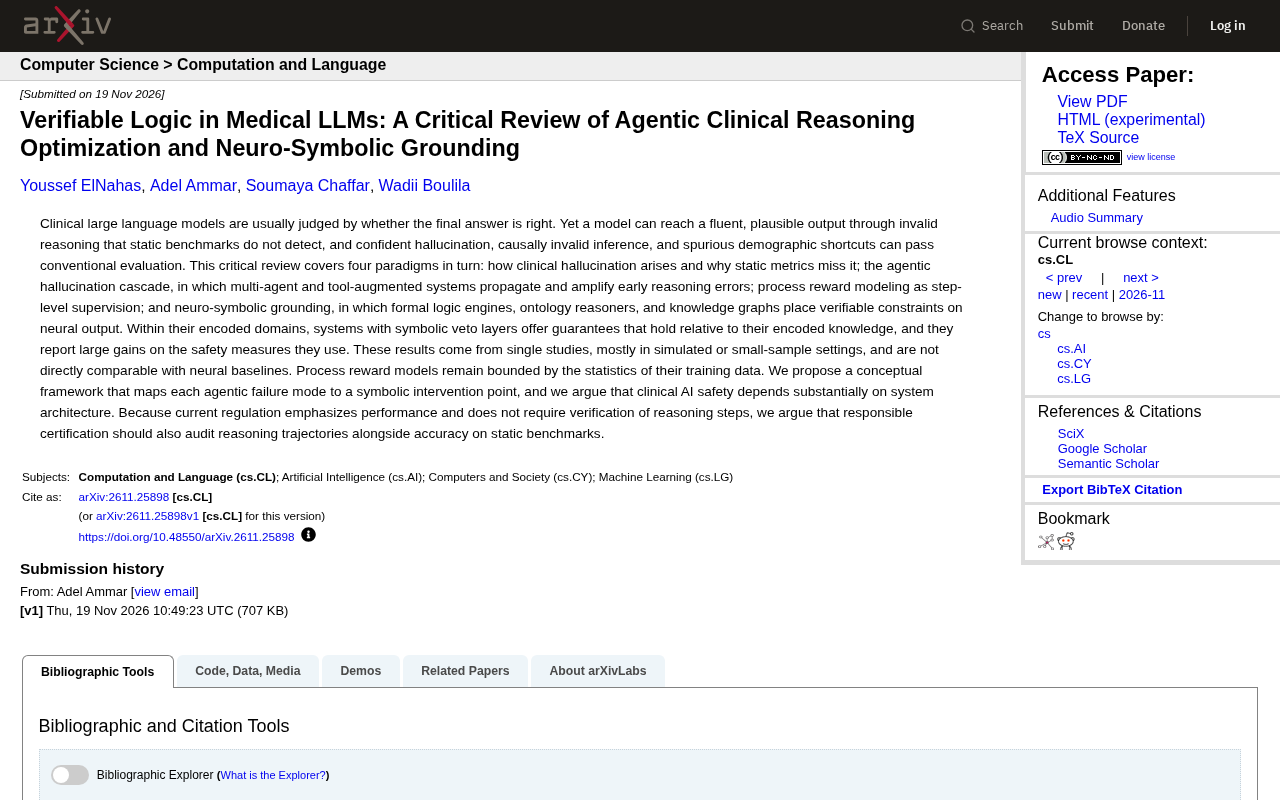
Clinical LLM evaluation must shift from answer correctness to reasoning verifiability; architecture determines safety.
This article critically reviews the deep flaws in clinical LLM evaluation: static benchmarks only check final-answer correctness and cannot detect fluent outputs from invalid reasoning, letting confident hallucinations, causally invalid inferences, and demographic shortcuts pass. It examines four paradigms: sources of clinical hallucination and static evaluation blind spots; agentic hallucination cascades in multi-agent/tool-augmented systems where early errors propagate; process reward modeling as step-level supervision, limited by data coverage and annotation cost; and neuro-symbolic grounding imposing verifiable constraints via logic engines, ontologies, and knowledge graphs, with mostly single-study and small-sample evidence. Core argument: clinical AI safety largely depends on system architecture, and certification should audit reasoning traces alongside static accuracy.
Clinical large language models are typically judged by the correctness of their final answers. But a model can produce fluent, seemingly plausible outputs through invalid reasoning, and static benchmarks cannot detect this. Confident hallucinations, causally invalid inferences, and spurious demographic shortcuts can all pass conventional evaluation. This critical review examines four paradigms in turn: how clinical hallucinations arise and why static metrics miss them; agentic hallucination cascades, whereby multi-agent and tool-augmented systems propagate and amplify early reasoning errors; process reward modeling as step-level supervision; and neuro-symbolic grounding, in which formal logic engines, ontology reasoners, and knowledge graphs impose verifiable constraints on neural outputs.
The Roots of Clinical Hallucinations and the Blind Spots of Static Evaluation
Evaluation of clinical large language models has long focused on final-answer accuracy, but this paradigm has a fundamental flaw. A model may reach a correct conclusion through an invalid reasoning path, or may mislead users with fluent but erroneous logic. The original article notes that confident hallucinations, causally invalid inferences, and spurious demographic shortcuts can all easily pass traditional static benchmarks. This means that answer correctness alone cannot guarantee the reliability of the reasoning process—and clinical decision-making depends precisely on traceable, verifiable chains of reasoning.
Static metrics fail because they capture only surface-level associations between input and output, ignoring the soundness of intermediate reasoning steps. In medical settings, an answer based on a false causal assumption may happen to coincide with the correct answer, but this "lucky correctness" is extremely dangerous in real clinical environments.
Hallucination in the context of clinical large language models refers to the model generating content that appears plausible and fluent but is factually incorrect or unsupported. Unlike in general domains, clinical hallucinations may manifest as fabricating non-existent guideline entries, incorrectly associating drugs with indications, or inventing laboratory reference ranges. Their roots include noise and bias in training data, insufficient coverage of long-tail knowledge, and the autoregressive generation mechanism's preference for fluency over factuality. Static benchmarks typically compare only the final answer against a gold standard and cannot capture erroneous premises quietly introduced into the reasoning chain, so "confident hallucinations" slip through. Understanding the generative mechanisms of hallucination is a prerequisite for designing step-level detection and symbolic constraints.
Agentic Hallucination Cascades: The Amplification Effect of Multi-Agent Systems
With the rise of multi-agent systems and tool-augmented architectures, the hallucination problem exhibits new propagation characteristics. The original article introduces the concept of "agentic hallucination cascades": in multi-agent collaboration, early reasoning errors are propagated and amplified through inter-agent interaction. One agent's erroneous output may become another agent's input premise, creating a chain reaction at the system level. Although tool calling extends model capabilities, it also introduces new error injection points—noisy results returned by tools may be misinterpreted by the model and further propagated.
This cascade effect means that hallucination detection methods designed for single-agent settings cannot be directly transferred to multi-agent systems. The system architecture itself becomes a key variable affecting safety, rather than merely model parameters or training data.
Agent refers to an LLM-driven system capable of autonomously perceiving its environment, calling tools, and taking actions to accomplish goals. In medical settings, agents can be divided into roles such as triage, retrieval, reasoning, and review, collaborating through multi-turn interaction. Tool augmentation equips agents with the ability to call external resources (such as electronic medical record queries, medical calculators, and literature retrieval). However, each agent's output may become a downstream agent's input premise; once an early stage produces a hallucination, the error propagates along the call chain and is "rationalized" by subsequent stages, forming a cascade amplification. Noisy or malformed tool returns may also be misread as valid evidence. Therefore, the safety of multi-agent systems depends not only on individual models but also on the orchestration architecture and error isolation mechanisms.
Process Reward Modeling: Progress and Limits of Step-Level Supervision
Process Reward Modeling represents a shift from outcome supervision to step-level supervision. By reward-modeling each step of the reasoning chain, the system can identify and penalize invalid intermediate reasoning, not just the final answer. In theory, this approach can capture reasoning flaws that static benchmarks miss.
However, the original article also clearly points out its limitations: process reward models remain constrained by the statistical properties of their training data. If the training data lack coverage of specific reasoning error patterns, the model will struggle to make accurate judgments on new error types. In addition, the computational overhead and annotation costs of process reward modeling limit its direct application in large-scale clinical settings.
Process Reward Modeling (PRM) contrasts with traditional Outcome Reward Modeling (ORM): the latter rewards only the final answer, while the former scores each intermediate state of the reasoning chain. PRM typically requires step-level annotated data, or generates step-level labels through Monte Carlo tree search, automatic verification, and other methods. In mathematical and code reasoning, PRM has been shown to effectively identify invalid intermediate steps and guide models toward self-correction. When transferred to the clinical domain, the challenge is that the "correctness" of medical reasoning steps often depends on context and guideline versions, annotation costs are high, and expert disagreement exists; moreover, the PRM reward model itself may inherit biases from the training data and lack discriminative power for rare error patterns.
Neuro-Symbolic Grounding: The Promise of Verifiable Constraints
Neuro-symbolic grounding is the most structural of the four paradigms. Formal logic engines, ontology reasoners, and knowledge graphs impose verifiable constraints on neural outputs, enabling the system to provide guarantees within the scope of its encoded knowledge. The original article notes that systems with a symbolic veto layer can provide guarantees that hold relative to their encoded knowledge within the encoded domain, and report substantial improvements on the safety metrics they adopt.
The appeal of this approach is that it elevates reasoning verification from the statistical level to the logical level. Symbolic systems can explicitly reject outputs that violate logical rules or ontological constraints, thereby blocking some hallucination pathways at the architectural level. But the original article also prudently notes that these results come from a single study and were mostly obtained in simulated or small-sample settings, and cannot be directly compared with neural baselines. The guarantees of the symbolic veto layer hold only relative to its encoded knowledge—the incompleteness or errors of the encoded knowledge itself remain potential sources of risk.
Neuro-symbolic grounding refers to combining neural networks (adept at perception and language generation) with symbolic systems (adept at logical reasoning and knowledge representation), so that neural outputs are constrained and verified by formalized knowledge. An ontology is an explicit formal specification of the concepts, properties, and relations in a domain, such as medical ontologies like SNOMED CT and ICD; a knowledge graph stores entities and relations in a graph structure, supporting multi-hop queries. A symbolic veto layer imposes logical rules or ontological constraints after the neural model outputs, rejecting or correcting outputs that violate the rules. The core advantage of this approach is interpretability and auditability, but its guarantees are "conditional": the veto is reliable only when the encoded knowledge is complete and correct; coverage gaps and update lag in the knowledge base remain sources of risk.
Architecture Determines Safety: A Conceptual Framework and Regulatory Implications
The core argument of the original article is that clinical AI safety depends to a large extent on system architecture. The authors propose a conceptual framework that maps each agent failure mode to a corresponding symbolic intervention point. The practical significance of this framework is that it guides system designers to select verification mechanisms based on failure modes, rather than relying on a single post-hoc evaluation.
From a regulatory perspective, current regulations emphasize performance metrics and do not require verification of reasoning steps. The original article therefore argues that responsible certification should audit both reasoning traces and accuracy on static benchmarks. This means that certification standards need to expand from "whether the answer is correct" to "whether the reasoning is verifiable," and neuro-symbolic architectures provide a technical foundation for this.
Taken together, this review reveals a deep contradiction in the evaluation of medical large models: the gap between answer correctness and reasoning reliability. Process reward modeling and neuro-symbolic grounding attempt to bridge this gap from the two directions of statistical learning and logical constraints, respectively, but the former is limited by data distribution and the latter by the completeness of encoded knowledge. The hallucination cascades of multi-agent systems remind us that the level of the safety problem is shifting from single models to system architecture. At the regulatory level, incorporating reasoning traces into certification audits may be a key step in advancing clinical AI from "performing well" to "being trustworthy."
One-line Summary
Clinical LLM evaluation must shift from answer correctness to reasoning verifiability; architecture determines safety.
Paragraph Summary
This article critically reviews the deep flaws in clinical large language model evaluation: static benchmarks focus only on final-answer correctness and cannot detect fluent outputs derived through invalid reasoning, allowing confident hallucinations, causally invalid inferences, and spurious demographic shortcuts to slip through. The article examines four paradigms in turn: the roots of clinical hallucinations and the blind spots of static evaluation; "agentic hallucination cascades" in multi-agent and tool-augmented systems, where early errors are propagated and amplified; process reward modeling for step-level supervision, limited by training-data coverage and annotation costs; and neuro-symbolic grounding, which imposes verifiable constraints through logic engines, ontologies, and knowledge graphs, providing guarantees within the scope of its encoded knowledge, though evidence comes mostly from a single study and small-sample simulations. The core argument is that clinical AI safety depends to a large extent on system architecture, and that regulatory certification should audit both reasoning traces and static accuracy.
Related articles
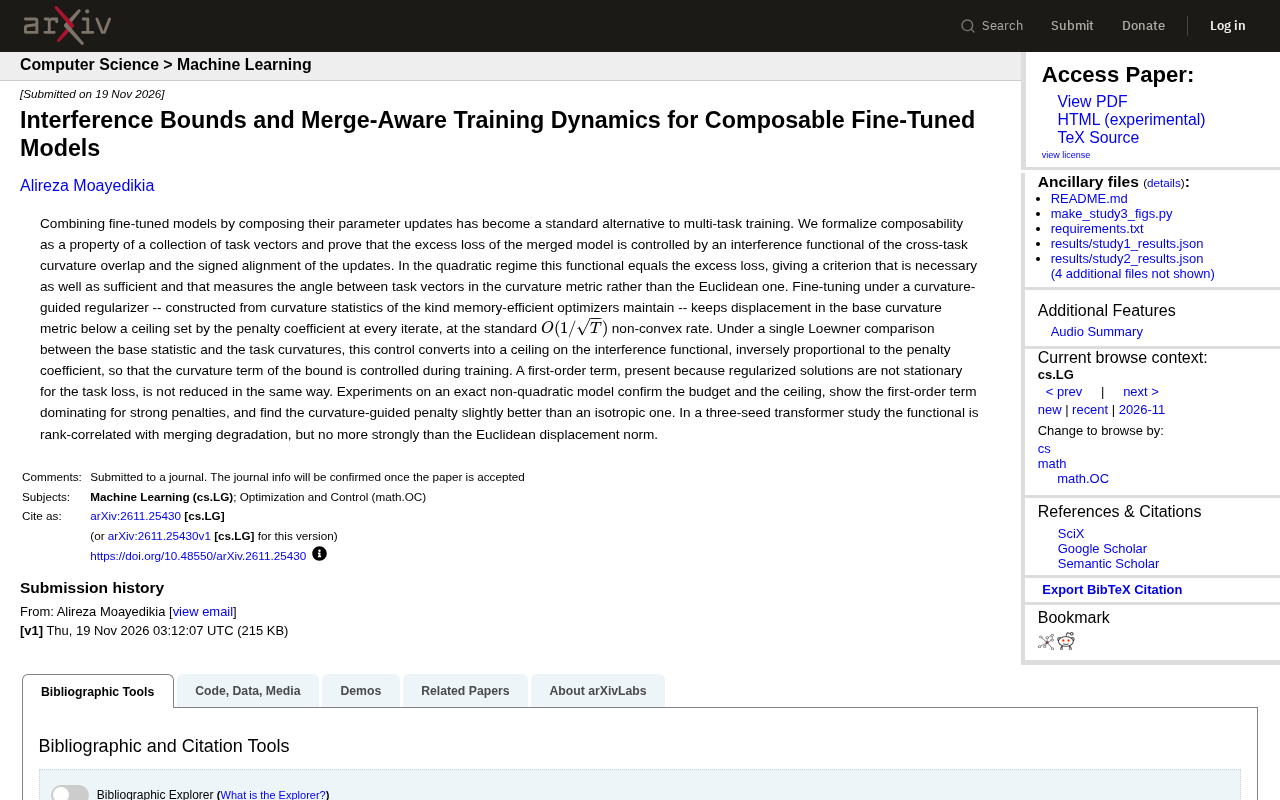
New Breakthrough in Model Merging: Interference Bounds and Curvature-Guided Training
This article interprets new theoretical advances in model merging: characterizing merging excess loss via an interference functional, proposing curvature-guided regularized training, and analyzing its experimental performance and limitations on Transformers.

A New Breakthrough in Differential Privacy: How to Achieve Instance-Optimal Moment Estimation?
This article interprets research on instance-optimal moment estimation under the add-remove model of differential privacy, covering instance-dependent error metrics, tight lower bound proofs, and new mechanism design, comparing with existing methods to show utility gains and discussing implications for privacy-preserving practice.

FamilySpace: From Emergent Chemical Semantics to Controllable Crystal Generation
Crystal generation latent spaces spontaneously cluster by elemental family? FamilySpace leverages this emergent chemical semantics to enable composition-controllable crystal generation via multi-source flow models, balancing quality and stable exploration on MP-20 and MPTS-52.