ThinkWorld: A VLA Framework that Reinforces Dynamic Chain Reasoning with World Imagination

ThinkWorld anchors world dynamics with dynamic chains and uses world imagination reinforcement to learn VLA from unannotated videos.
ThinkWorld is a learning framework for Vision-Language-Action (VLA) models that addresses the generalization bottleneck from scarce action-annotated robot data. It represents each action thought as a Chain-of-Dynamics (CoD)—discrete motion tokens capturing intermediate dynamics—as a cross-embodiment action representation. Training initializes CoD with annotated demonstrations, then reinforces CoDs whose predicted future states better match observations, enabling unannotated human videos to provide supervision through state transitions. Experiments validate human-to-robot skill transfer and generalization.
Vision-Language-Action (VLA) models have made significant progress in robotic manipulation, but their generalization ability remains limited by the diversity and coverage of action-annotated robot demonstration data. Human videos offer broader behavioral and environmental experience, yet learning from them involves a fundamental trade-off: scalable data volume and explicit action grounding are hard to achieve simultaneously. To address this, researchers propose ThinkWorld—a VLA learning framework that grounds action reasoning in world dynamics and reinforces reasoning through world-imagination-based reinforcement learning.
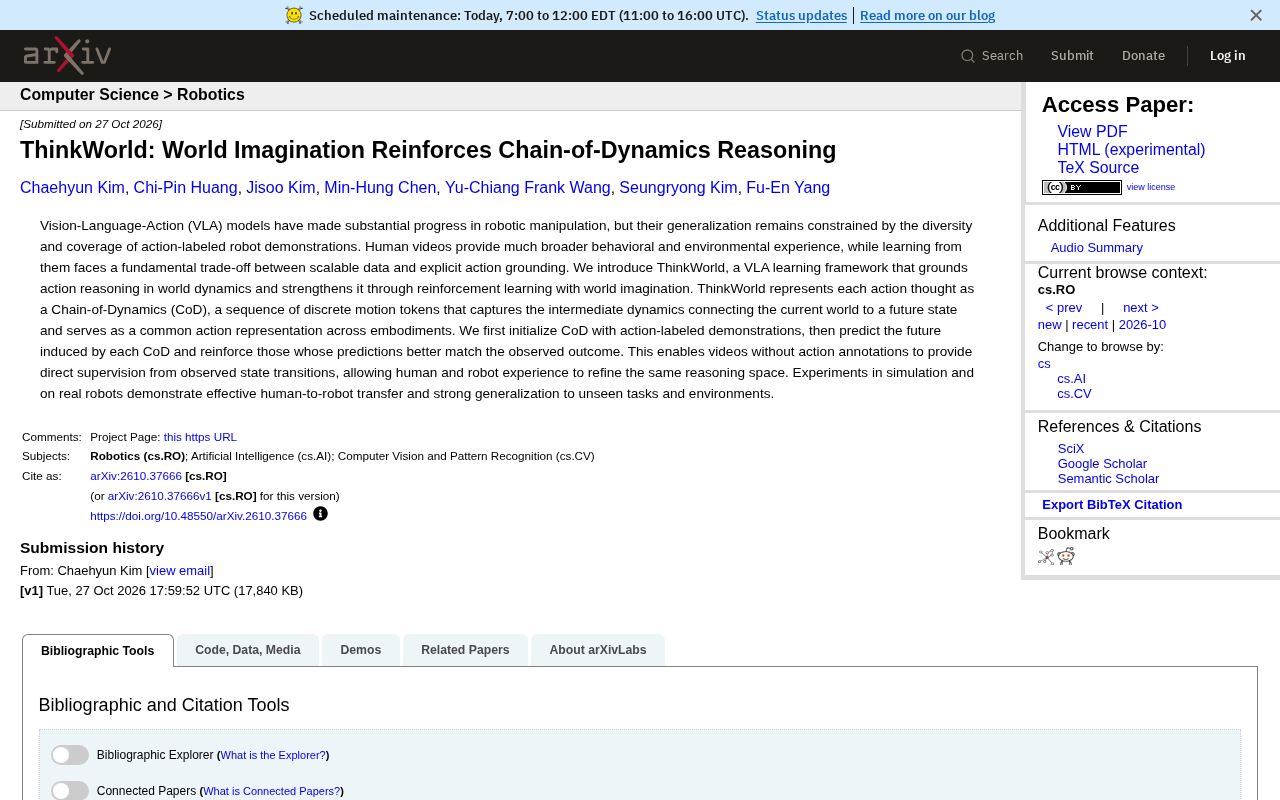
According to the RSS feed, ThinkWorld's core innovation lies in representing each action thought as a Chain-of-Dynamics (CoD), i.e., a sequence of discrete motion tokens that captures the intermediate dynamics from the current world to future states, serving as a universal action representation across embodiments. The framework first initializes CoD using action-annotated demonstrations, then predicts the future state induced by each CoD, and reinforces those CoDs whose predictions better match actual observations. This allows videos without action annotations to provide direct supervision through observed state transitions, thereby refining both human videos and robot experience within the same reasoning space.
Background: The Generalization Bottleneck of VLA Models
Current VLA models rely on large amounts of action-annotated robot demonstration data, but collecting such data is costly and limited in coverage. Human videos, while massive and rich in behavioral patterns, lack direct correspondence to robot actions. How to leverage unannotated videos while maintaining scalable action reasoning capability has become a key challenge for improving VLA generalization. ThinkWorld targets this pain point, attempting to bridge the gap between human videos and robot actions.
VLA models (Vision-Language-Action Models) are a class of robot learning architectures that unify visual perception, language understanding, and action generation. A typical approach uses pre-trained vision-language models (such as CLIP, LLaVA, etc.) as backbones, encoding image observations and task instructions into multimodal representations, then outputting robot control signals (joint positions, end-effector poses, or discrete action tokens) through an action decoder head. Their advantage lies in acquiring semantic generalization from large-scale image-text pre-training, but they are highly dependent on action supervision signals.
Action annotation refers to providing action labels corresponding to the robot control space for each frame in a video, typically requiring teleoperation collection or motion capture system recording. Such annotation is costly and not directly reusable across embodiments, which is precisely the core bottleneck limiting VLA data scale.
Core Method: Chain-of-Dynamics (CoD) and World-Imagination Reinforcement
ThinkWorld abstracts action reasoning as a Chain-of-Dynamics (CoD)—a sequence of discrete motion tokens describing intermediate dynamic changes from the current world state to future states. This representation does not depend on a specific embodiment, thus serving as a shared action language for humans and robots.
The training process consists of two steps: first, initialize CoD generation capability using action-annotated robot demonstration data; then, the model predicts the future state induced by each CoD, compares the prediction with actual observations, and uses reinforcement learning to increase the generation probability of CoDs with more accurate predictions. This "world imagination" mechanism enables videos without action annotations to provide supervision signals through state transitions, thereby incorporating human videos into training within the same reasoning space.
Cross-embodiment representation is an important research direction in robot learning, aiming to find an action abstraction not bound to a specific robotic arm structure, degrees of freedom, or camera configuration, so that data from different sources (human hand movements, different robot models, simulators) can share the same learning signal. Common approaches include mapping actions to end-effector trajectories, keypoint motions, or discretized motion primitives. ThinkWorld's CoD belongs to the discrete motion token route, and its cross-embodiment nature comes from "describing how the world state changes" rather than "describing how a specific joint rotates."
World models refer to predictive models that learn the transition rules of environmental states, predicting the observation or latent state at the next moment given the current state and action. The "world imagination" in ThinkWorld uses such predictive capability as a judge: a candidate CoD is considered more reasonable action reasoning if it can induce state predictions consistent with actual video observations. This idea of replacing action labels with prediction consistency essentially substitutes state transition supervision for action supervision.
The article's mention of "reinforcing those CoDs whose predictions better match actual observations" is typically implemented via policy optimization in reinforcement learning, for example, using the negative prediction error as reward and employing REINFORCE or preference optimization objectives to increase the generation probability of high-reward sequences. Unlike supervised learning, which requires correct labels for each token, such methods only need a comparable score for the entire sequence, making them naturally suited for videos without action annotations—the video itself provides "what the result is," and the model only needs to judge whether its imagined intermediate dynamics can lead to that result.
Experimental Validation: Human-to-Robot Transfer and Generalization
Experiments in simulation environments and on real robots show that ThinkWorld can effectively achieve skill transfer from human videos to robots and exhibits strong generalization to unseen tasks and environments. This result supports the idea of grounding action reasoning in world dynamics and improving reasoning quality through imagination reinforcement.
Significance and Outlook
ThinkWorld provides a unified framework where human and robot experience mutually reinforce each other within the same dynamic chain reasoning space. Through world imagination reinforcement, the model can learn from a broader range of unannotated videos, potentially alleviating VLA models' dependence on action-annotated data and advancing robotic manipulation toward greater generality.
One-line Summary
ThinkWorld anchors world dynamics with dynamic chains and uses world imagination reinforcement to learn VLA from unannotated videos.
Paragraph Summary
ThinkWorld is a learning framework for Vision-Language-Action (VLA) models, aimed at alleviating the generalization bottleneck caused by scarce action-annotated robot data. Its core is representing each action thought as a Chain-of-Dynamics (CoD)—a sequence of discrete motion tokens describing intermediate dynamics from the current world state to future states, serving as a universal cross-embodiment action representation. During training, CoD is first initialized with action-annotated demonstrations, then the model predicts the future state induced by each CoD, and reinforcement learning is used to boost CoDs whose predictions better match actual observations. This "world imagination" mechanism enables human videos without action annotations to provide direct supervision through state transitions, allowing human videos and robot experience to mutually reinforce within the same reasoning space. Simulation and real-robot experiments validate skill transfer from humans to robots and generalization to unseen tasks and environments.
Related articles

Only 40% of Statistics Cited by AI Are Traceable: A Credibility Crisis Emerges
A Hacker News discussion notes that only 40% of statistics cited by AI can be traced to specific studies. This article analyzes the causes, the impact on content creators and users, and practical ways to reduce risk.

Simantic: A Firmware Emulation Platform Built for AI Agents
Simantic, a YC F26 project launched on Hacker News, provides firmware emulation for AI agents, letting them interact with low-level hardware software in virtual environments and lowering the barrier to embedded testing.

Analyzing Databricks' Serverless Cost Control Strategy
Databricks' serverless computing usage grew over 3x in a year. Its cost control approach emphasizes granular attribution, policy-driven budgets, and automated governance. This article analyzes the core ideas to inform enterprise serverless cost management.