TikTok Quietly Launches Standalone TikTok Shop App

TikTok launches a standalone Shop app, spinning e-commerce out of the main app with an independent shopping loop.
TikTok has quietly launched a standalone TikTok Shop app, packaging personalized recommendations, livestream and short-video shopping, app-exclusive discounts, in-app checkout, order tracking, and customer support into a complete e-commerce loop. The move aims to ease the structural conflict between content consumption and product transactions in the main app. App-exclusive discounts are seen as a price lever to drive user migration, but they also create cross-app pricing challenges for sellers. The quiet launch suggests early validation; launch regions, user scale, and timeline are undisclosed. Success hinges on cold start: why users should download a second app, plus recommendation quality, discount strength, and account/order integration with the main app.
TikTok is pulling its e-commerce ambitions "out" of the main app. According to rss sources, TikTok has quietly launched a standalone TikTok Shop app, separating the shopping experience from the short-video feed and creating an independent entry point centered on product recommendations and transactions.
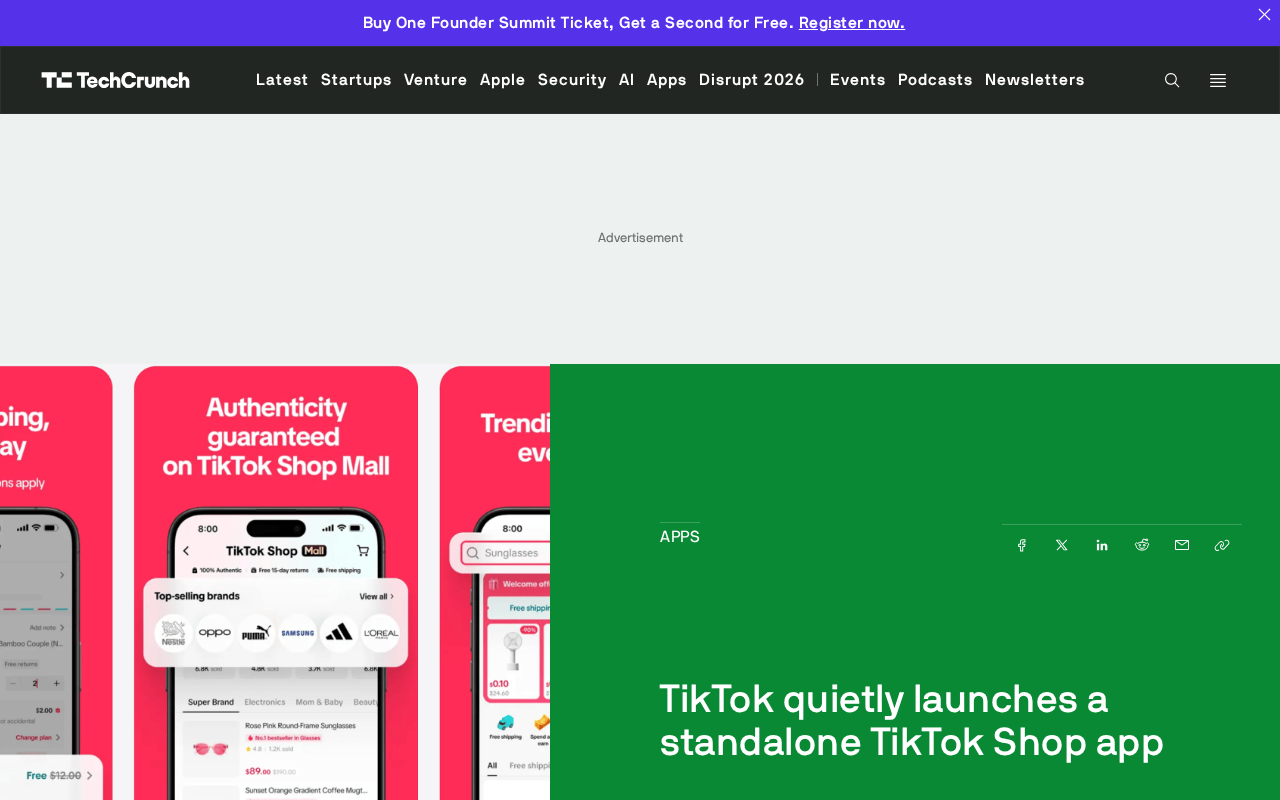
What's inside the standalone app
According to the original material, this standalone app offers personalized product recommendations, shopping via livestreams and short videos, app-exclusive discounts, in-app checkout, order tracking, and customer support. In other words, TikTok has packaged the e-commerce capabilities already proven in the main app—recommendations, content-driven sales, ordering, and after-sales service—into a complete closed loop.
You might not have noticed the "app-exclusive discounts" item. It means TikTok is using price leverage to steer users into the standalone app, rather than simply replicating the main app's shopping entry point. For the standalone app to succeed, it must offer reasons the main app cannot.
Why spin Shop out
Short-video platforms doing e-commerce have long faced a structural contradiction: content consumption and product transactions compete for the same screen time. When users are interrupted by products while scrolling videos, the experience suffers; and when shopping needs are buried in the feed, the conversion path isn't short enough.
A standalone app is one solution. It separates the intent to "browse" from the intent to "buy," letting users with clear shopping intent enter a purer transaction scenario while returning the main app to content consumption. This mirrors the logic of e-commerce platforms launching standalone apps—transaction scenarios require independent user mindset and more complete functional support.
Judging from the feature list in the material, what TikTok wants to build is not a traffic-routing tool but an e-commerce product with a full chain of recommendations, content, transactions, and after-sales service.
Content e-commerce vs. shelf e-commerce is the background framework for understanding this split. Content e-commerce refers to stimulating unplanned purchases through short videos, livestreams, and other content—typically feed-driven sales on Douyin and TikTok. Shelf e-commerce refers to users actively searching, browsing products, and placing orders with clear intent—typically Taobao and Amazon. The user mindset and product logic differ greatly: the former relies on recommendation algorithms and content consumption time, while the latter relies on product catalogs, search, and transaction-path efficiency. TikTok's main app has long been content-e-commerce-oriented, with shopping entry points embedded in the feed—short conversion paths but weak intent. The standalone Shop app attempts to add shelf e-commerce capabilities, letting users complete a "browse-to-buy" loop in a product-centric scenario. This combination of "content seeding + shelf harvesting" is also a direction domestic e-commerce platforms have generally explored in recent years.
What the quiet launch signals
The word "quietly" is worth noting. The material mentions no grand launch announcement or marketing push. This low profile may reflect several considerations: first, validating the product form on a small scale to avoid excessive backlash among main-app users; second, the independence of the e-commerce business involves complex coordination with sellers and brands, requiring gradual progress; third, the regulatory environment keeps an eye on e-commerce expansion by large platforms, and a low profile can reduce public friction.
The material itself does not provide the launch regions, user scale, or timeline, and the absence of this information also confirms that this release is at an early stage.
Cold start is the core challenge facing the standalone app. For platform products, cold start refers to how to simultaneously solve "why users come" and "why products exist" in the early stage when user scale and supply ecosystem are lacking. The TikTok Shop standalone app needs to persuade users to download a second app, while the main app already provides a shopping entry point, so it must offer differentiated reasons—stronger recommendations, lower exclusive prices, or a more complete transaction experience. Meanwhile, sellers also need incentives to list and operate on the standalone app. The cold-start phase is typically accompanied by small-scale testing, targeted invitations, and subsidy strategies, which aligns with the "quiet launch" description. Whether the cold start succeeds determines whether the standalone app gains an independent growth curve or becomes redundant duplication of the main app.
Impact on sellers and content creators
If the standalone app gradually rolls out, sellers' operational focus may diverge: the main app continues to handle content seeding and traffic acquisition, while the standalone app takes on conversion and repeat purchases. Livestream and short-video commerce gain dedicated entry points in the standalone app, meaning content creators' product tagging is no longer just an accessory feature within the feed.
App-exclusive discounts give sellers a new promotional tool, but may also complicate price system management—how to price the same product between the main app and the standalone app will become a new operational issue.
Cross-app pricing management is a common operational challenge for sellers operating across multiple entry points. When the same product appears in both the main app feed and the standalone Shop app, sellers need to decide whether prices are consistent, whether discounts are universal, and how inventory is allocated. If the standalone app offers exclusive discounts while the main app does not, it may trigger user price comparisons and channel conflicts; if they are completely identical, the exclusive discounts lose their appeal. In addition, whether account systems, order data, and after-sales processes can be integrated directly affects sellers' operational efficiency. For content creators, product tagging shifting from an accessory feature of the feed to a dedicated entry point in a standalone app means the distribution logic and commission settlement for commerce content may be redivided. Although these operational details are not within the scope of the material, they are issues that must be resolved when the standalone app scales.
Questions to watch
Whether the standalone app can succeed depends on whether it can solve the cold-start problem: why should users download a second app. The feature list in the material is a enumeration of necessary conditions, not sufficient ones. The quality of personalized recommendations, the strength of exclusive discounts, and the degree of account and order integration with the main app will all determine whether this split is a strategic upgrade or a dispersion of resources.
Only one thing can be confirmed at present: TikTok is no longer satisfied with treating e-commerce as an add-on feature of a content platform, but is serious about building an independent shopping product.
One-line Summary
TikTok launches a standalone Shop app, spinning e-commerce out of the main app and carrying the shopping loop through an independent entry point.
Paragraph Summary
TikTok has quietly launched a standalone TikTok Shop app, packaging personalized recommendations, livestream and short-video shopping, app-exclusive discounts, in-app checkout, order tracking, and customer support into a complete e-commerce loop. The move aims to ease the structural contradiction in the main app where content consumption and product transactions compete for screen time, allowing shopping intent to enter a purer transaction scenario. App-exclusive discounts are seen as a means of using price leverage to guide user migration, but they also create cross-app pricing management challenges for sellers. The quiet launch suggests the product is at an early validation stage, and the material does not disclose launch regions, user scale, or timeline. The standalone app's success depends on cold start: why users should download a second app, and the quality of recommendations, strength of exclusive discounts, and degree of account and order integration with the main app.
Related articles
 Tech Frontiers
Coldframe: A Honeypot Disguised as a Supermarket Freezer Controller
Coldframe is a honeypot disguised as Danfoss AK-SM 800A and Dixell XWEB freezer controllers, built as a single Python file that detects CVE-2025-41450 attempts and is identified as real devices on Shodan.
 Tech Frontiers
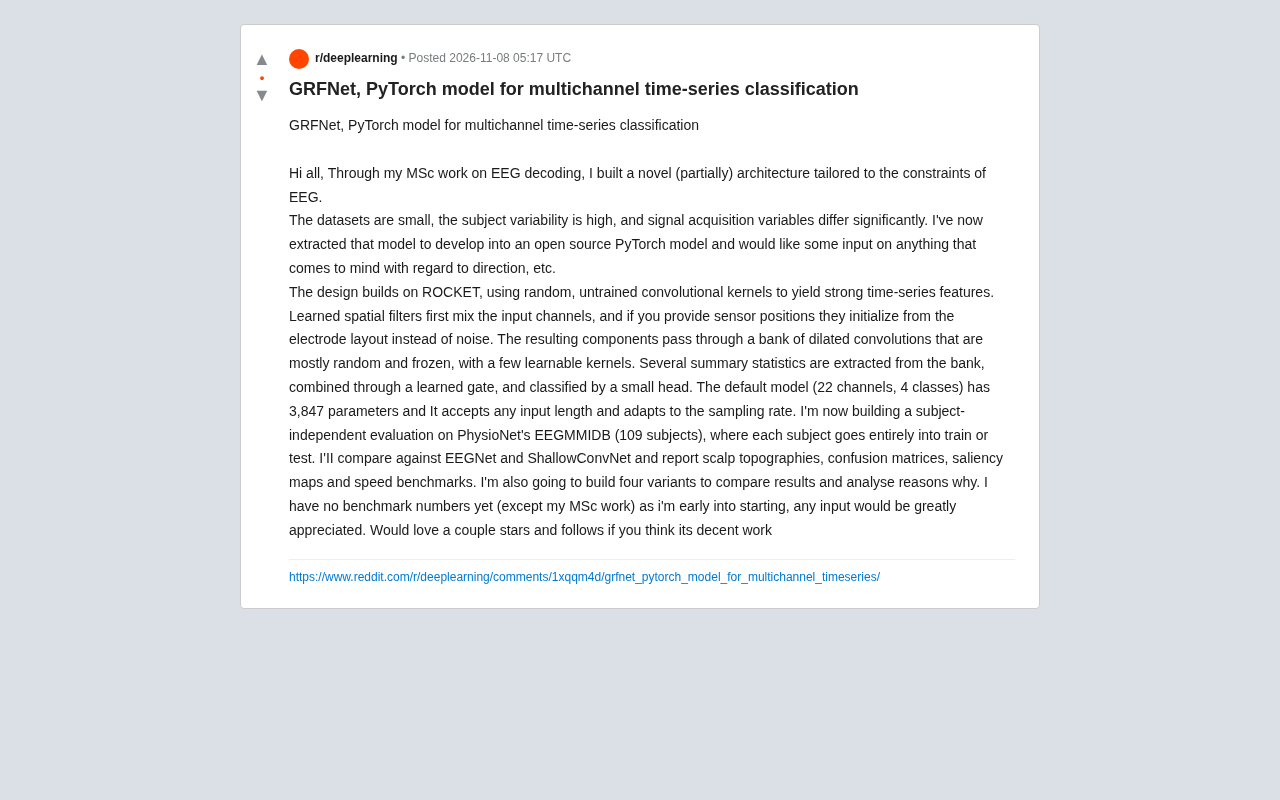
GRFNet: A Lightweight PyTorch Model Designed for Multichannel Time-Series Classification
GRFNet is a lightweight PyTorch model for multichannel time-series classification, originating from EEG decoding research. With only 3,847 parameters, it is based on the ROCKET architecture, combining random convolution kernels with learnable spatial filters, supports arbitrary input lengths, and will soon be evaluated on the PhysioNet dataset.
 Tech Frontiers
CUDA-Accelerated Rocket League Simulator: A Player-Made Hardcore Experiment
A Reddit post shows a "100% Accurate" Rocket League simulator accelerated with CUDA. We analyze its technical context, CUDA's value in game physics simulation, and the significance and limitations of such community projects.