Titans' Inference-Time Learning: The Hidden Risks of AI Auto-Memory and the Correction Challenge

Titans' inference-time learning enables dynamic AI memory, but correction experiments reveal erroneous memories are hard to fully restore.
The article discusses Google's Titans architecture, which uses an independent neural memory module to update weights in real time during inference, enabling continuous adaptation without retraining. However, a Reddit user's small synthetic experiment found that after injecting erroneous information and then providing corrective input, recall accuracy improved but could not fully recover, indicating some irreversibility of memory contamination similar to the misinformation effect in human memory. The article further asks what AI should be allowed to remember automatically, noting that the lack of write review in auto-memory may lead to solidification of erroneous information and cross-user contamination. Achieving reversible memory requires engineering support such as version tracking, error detection, and rollback interfaces, which Titans has not yet disclosed. The conclusion emphasizes that memory writing and correction capabilities must evolve together.
Title
Titans' Inference-Time Learning: The Hidden Risks of AI Auto-Memory and the Correction Challenge
Meta Description
Google's Titans architecture lets AI dynamically update memory weights during inference, but a Reddit user's experiment reveals that erroneous information written into memory is hard to fully correct. This article explores the boundaries of AI auto-memory, the correction challenge, and the engineering hurdles of reversible memory.
Article Content
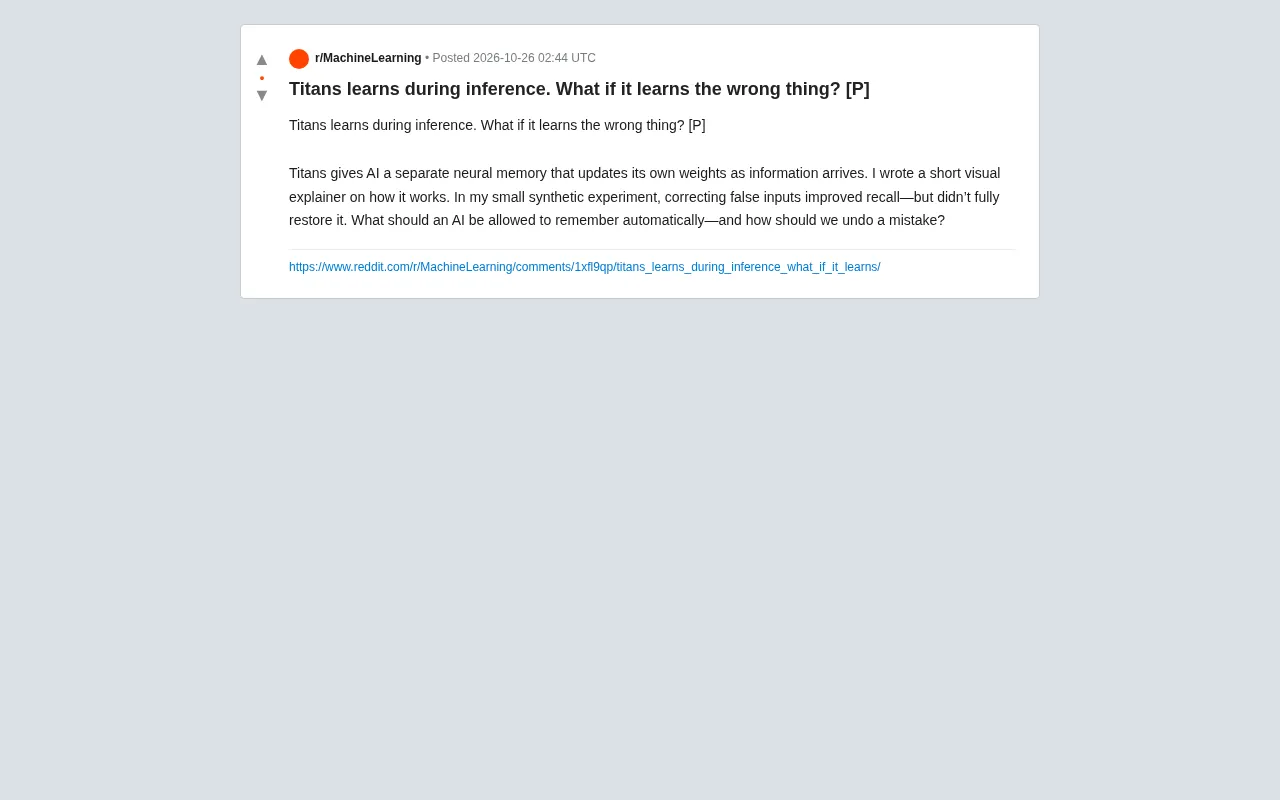
Google's Titans architecture enables AI to dynamically update memory weights during inference, giving models the ability to learn continuously. But a key question arises: if the model learns erroneous information during inference, how do we correct it? A Reddit user, through visual explanations and a small synthetic experiment, revealed the dilemma that memory cannot be fully restored after correction, sparking discussion about the boundaries and reversibility of AI auto-memory.
How Titans Achieves Inference-Time Learning
The core innovation of Titans lies in introducing an independent neural memory module. Unlike traditional Transformers that rely solely on attention mechanisms, Titans' memory module updates its own weights in real time as information flows in—essentially giving the model a "writable" external memory. This design allows AI to continuously adapt to new data during inference without retraining the entire model.
According to the Reddit user's (a member of the r/MachineLearning community) visual explanation, Titans' memory updates resemble the rapid encoding process in the human brain's hippocampus—information is written upon arrival, and weights adjust with experience. This mechanism shows promise in long-context tasks and continual learning scenarios, but it also plants a hidden risk: the model may inadvertently solidify erroneous information into long-term memory.
Neural Memory Module is a type of subnetwork whose parameters can be dynamically updated during model inference, typically implemented as key-value storage or a differentiable memory matrix. Unlike the static attention key-value cache in Transformers, the weights of a neural memory module themselves adjust in real time with the input stream, enabling continual adaptation without retraining the backbone network. This concept traces back to early work such as Neural Turing Machines and Differentiable Neural Computers, whose core idea is to model memory read/write operations as differentiable computations so that gradients can flow through the memory update process. Titans' contribution lies in combining this idea with large-scale language models, allowing the memory module to play the role of "experience accumulation" in long-context and streaming-input scenarios.
Correction Experiment: Why Memory Cannot Be Fully Restored After Correcting Input
To investigate this issue, the user designed a small synthetic experiment. The idea was to first inject erroneous input into the model and observe its memory performance; then provide corrected input and test whether the memory could recover. The results showed that after correcting the erroneous input, the model's recall accuracy improved somewhat but did not fully return to the level of an uncontaminated state.
This finding implies that Titans' memory updates may have a certain "irreversibility"—erroneous information leaves traces at the weight level, and subsequent corrections can only partially overwrite them, not completely erase them. The user likened this phenomenon to the "misinformation effect" in human memory: once a false memory is encoded, even if the truth is later learned, the residual original memory still influences judgment.
Although the experiment was small in scale, it points to a key issue: in architectures that learn during inference, the writing and correction of memory require more sophisticated mechanism design. Simply "overwriting" erroneous input is not enough; the model may need explicit forgetting or rollback capabilities.
Misinformation Effect is a classic phenomenon in cognitive psychology, systematically revealed by Elizabeth Loftus in the 1970s through eyewitness memory experiments: when individuals are exposed to misleading information after an event, their recall of the original event is distorted, and even if later told the truth, traces of the original memory still interfere with judgment. Mechanistic explanations for this effect include overwriting of memory traces, source monitoring failures, and reconstruction bias during retrieval. Drawing this analogy into AI memory discussions is illuminating, but differences must be noted: the irreversibility of human memory stems from the plasticity and reconstructive nature of biological neural systems, whereas the "residue" in neural network weights stems from the distributed nature of gradient updates—correction signals can only adjust weights along the direction of the current input and cannot precisely cancel previous update components.
The Boundaries of Auto-Memory: What Should AI Be Allowed to Remember
The user's core question is: what should AI be allowed to remember automatically? In architectures like Titans, memory updates happen automatically without human review. This means the model may permanently write users' erroneous statements, biased content, or temporary information into memory, thereby affecting subsequent outputs.
From an application perspective, this auto-memory capability has clear value in personalized assistants and continual learning systems—the model can remember user preferences and habits. But the risks are equally prominent: if a user inputs erroneous information (whether intentionally or not), the model may solidify it as fact. More troublesome is that when multiple users share the same model instance, one user's erroneous input may contaminate other users' experiences.
The user did not provide a clear answer, but the question itself is sharp enough: should "write permissions" be set for auto-memory? What types of information require human confirmation before entering long-term memory? These design decisions will directly affect the trustworthiness of Titans-like architectures.
How to "Undo" a Mistake: The Engineering Challenge of Reversible Memory
More difficult than "what to remember" is "how to forget." The experiment shows that simple corrective input cannot fully reverse memory contamination. From an engineering perspective, achieving reversible memory requires support at at least three levels: version tracking when memory is written, error detection mechanisms, and operational interfaces to roll back or suppress specific memory fragments.
Currently, Titans' public materials do not discuss memory rollback mechanisms in detail. Although the user's experiment is limited in scale, it suggests a direction: future inference-time learning architectures may need to introduce the concept of "memory transactions"—each weight update records its source and timestamp, so that when an error is discovered, specific updates can be located and undone. This resembles transaction logs in databases, but is more difficult to implement because neural weight updates are distributed and non-discrete.
Another approach is to introduce memory decay or confidence tagging: assign lower weight to information from unreliable sources so that it naturally fades over time. But this raises new questions—who determines the reliability of information?
Memory Transaction borrows from the transaction concept in database systems, referring to a set of atomic memory update operations: either all take effect or all roll back, with logging to support failure recovery. Implementing memory transactions in the context of neural networks faces fundamental difficulties because weight updates are distributed and continuous; the gradient changes caused by a single input are diffused throughout the parameter space, making it difficult to precisely locate and undo them like database row records. Possible approximate solutions include: maintaining a low-rank incremental matrix for each update along with source metadata, and computing an approximate inverse of that increment when rollback is needed; or adopting a parameter isolation strategy, writing information from different sources into mutually independent memory subspaces, thereby achieving selective suppression rather than global rollback. These solutions require trade-offs between engineering complexity and memory capacity.
Conclusion: Capability and Responsibility Must Evolve Together
The inference-time learning capability demonstrated by Titans is exciting, but the Reddit user's experiment and questions remind us: the ability to write memory and the ability to correct it must develop in tandem. An AI system that can only remember but cannot forget or correct may bring unexpected risks in the real world. The boundaries of auto-memory, the reversibility of correction mechanisms, and users' control over memory content—the answers to these questions will determine whether Titans-like architectures can move from research to trustworthy products.
Although the user's synthetic experiment is small in scale, the questions it raises are universal. While pursuing stronger continual learning capabilities, how to design "undoable" memory mechanisms may be a direction more worthy of investment than increasing memory capacity.
One-line Summary
Titans' inference-time learning lets AI dynamically memorize, but correction experiments reveal that erroneous memories are hard to fully restore.
Paragraph Summary
The article discusses the inference-time learning capability of Google's Titans architecture. Titans uses an independent neural memory module to update weights in real time during inference, enabling the model to continuously adapt to new data without retraining. However, a Reddit user's small synthetic experiment found that after injecting erroneous information into the model and then providing corrective input, recall accuracy improved but could not fully recover, indicating a certain irreversibility of memory contamination similar to the misinformation effect in human memory. The article further asks what AI should be allowed to remember automatically, pointing out that the lack of write review in auto-memory may lead to solidification of erroneous information and cross-user contamination. Achieving reversible memory requires engineering support such as version tracking, error detection, and rollback interfaces, and Titans has not yet disclosed such mechanisms. The conclusion emphasizes that memory writing capability and correction capability must evolve together.
Related articles

Build a Reasoning Model from Scratch: An 11-Hour Open-Source Course Breakdown
Sebastian Raschka releases a free 8-episode, ~11-hour video course teaching you to build a reasoning model from scratch with Python and PyTorch—from a small Qwen3 model through Verifier, Inference Time Scaling, GRPO, and distillation, with open-source code on GitHub.

An 11-Hour Reasoning Model Course in Practice: How Small Models Learn to Think
Starting from Sebastian Raschka's 11-hour reasoning model course and HN buzz, this analyzes small-model training, legal text version control, Anthropic data policy, and product reliability reviews.

Lightpanda: A Headless Browser Built for AI and Automation
Lightpanda is a headless browser built from scratch in Zig for AI and automation, with 37,852 GitHub stars. This analysis covers its technical approach, design choices, and use cases.