TogetherAI SDK 2.0.94 Patch Update: Dependency Upgrades
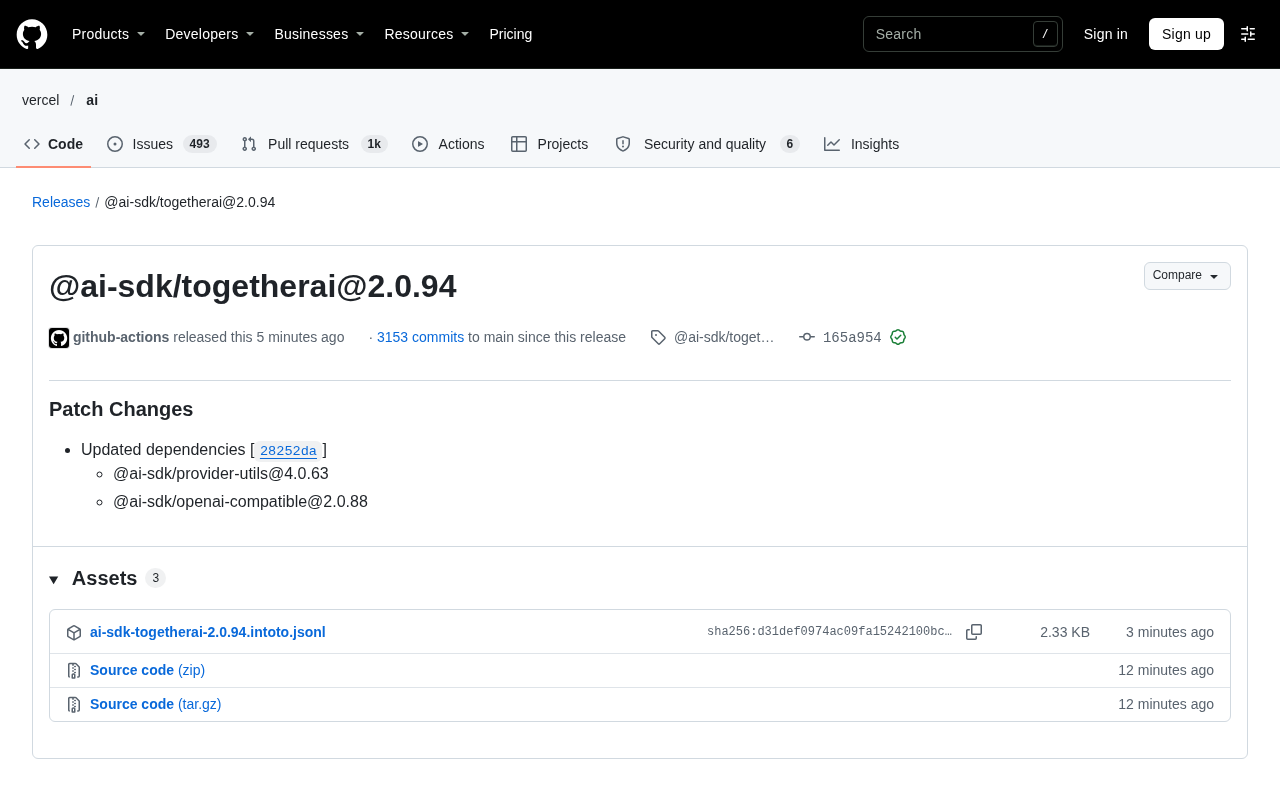
@ai-sdk/togetherai releases patch version 2.0.94, only synchronizing upgrades of two ecosystem dependency packages.
The TogetherAI adapter package @ai-sdk/togetherai in the Vercel AI SDK ecosystem has released version 2.0.94, a typical patch-level update whose only change is upgrading @ai-sdk/provider-utils to 4.0.63 and @ai-sdk/openai-compatible to 2.0.88, with no new public APIs or features. The article notes that developers should pay attention to such patch updates because dependency syncs often carry underlying behavior fixes, type adjustments, or edge case handling changes. This update also reflects the AI SDK's layered modular design: provider-utils serves as the common foundation layer shared by all providers, openai-compatible encapsulates the OpenAI-compatible protocol, and TogetherAI only needs to maintain a thin layer of adapter code. The release is automated by GitHub Actions and GPG-signed. The upgrade recommendation is a routine dependency update with low breaking risk, but integration tests should be run and related package versions aligned.
The TogetherAI adapter package in Vercel's AI SDK ecosystem has released version 2.0.94. This is a typical patch-level update, with the core content focused on synchronized upgrades of the dependency chain, introducing no new public APIs or feature capabilities.
Update Content: A Pure Dependency Sync
According to the release records on GitHub, the only change type listed for @ai-sdk/togetherai@2.0.94 is Patch Changes, and the specific content is updating the dependency versions of two packages within the same ecosystem:
@ai-sdk/provider-utilsupgraded to 4.0.63@ai-sdk/openai-compatibleupgraded to 2.0.88
These two packages handle provider general utility functions and OpenAI-compatible interface adaptation, respectively. TogetherAI's API is designed to be highly compatible with the OpenAI interface, so the version sync of the openai-compatible package directly affects the actual behavior of the TogetherAI provider.
Why a Patch Version Is Worth Noticing
Looking only at the version number, 2.0.94 may be just a few commits away from the previous version, but dependency package updates often imply underlying behavior fixes, type definition adjustments, or changes in edge case handling. For projects that pin dependency versions in production environments, such patch upgrades are usually safe, but it is still recommended to run integration tests after upgrading to confirm that TogetherAI's inference calls, streaming responses, and error handling paths have not changed unexpectedly.
Semantic versioning and the meaning of patch: Under the SemVer (Semantic Versioning) convention, an increment in the patch position of the version number MAJOR.MINOR.PATCH indicates a "backward-compatible bug fix" and theoretically contains no breaking changes or new features. However, note that SemVer constrains the compatibility of public APIs, not complete consistency of runtime behavior—underlying fixes may change output in certain edge cases (for example, how streaming chunks are merged, the structure of error objects, or the number of retries). Therefore, for production projects that pin dependencies, the risk of a patch upgrade is usually low but not zero, and integration testing remains a necessary verification step.
Lockfiles and transitive dependencies: The lockfile of npm/pnpm/yarn fixes the exact versions of the entire dependency tree. This release modifies the dependency declarations in @ai-sdk/togetherai's own package.json. If the project does not perform an update, the lockfile will still retain the old versions. Conversely, if multiple packages in the project depend on @ai-sdk/provider-utils at the same time, the package manager may hoist them to a single version, or multiple copies may appear because the version ranges do not overlap. The latter can lead to type incompatibility or failure of instanceof checks, which is precisely the technical reason the article recommends "version alignment."
Ecosystem Perspective: The Modular Layering of the AI SDK
This update happens to demonstrate the layered design of the Vercel AI SDK. provider-utils serves as the common foundation layer shared by all providers, while openai-compatible encapsulates a group of service providers compatible with the OpenAI protocol. TogetherAI, as one of them, only needs to maintain a thin layer of adapter code, and its underlying capabilities evolve together with the common packages.
The advantage of this structure is that fixes and optimizations can cover multiple providers at once; the cost is tighter version coupling, so compatibility of transitive dependencies must be considered during upgrades. According to the release records, this update was automatically published by GitHub Actions and verified with GPG signatures, consistent with the repository's usual release process.
The relationship between providers and the adapter layer: In the AI SDK, a provider refers to the implementation wrapper for a model service provider (such as TogetherAI, OpenAI, or Anthropic). It exposes unified calling interfaces such as generateText and streamText upward, and is responsible for constructing requests, parsing responses, and mapping errors downward. @ai-sdk/provider defines the specification and type contract for this set of providers, while @ai-sdk/provider-utils provides the utility functions repeatedly used when implementing the contract, such as parsing and assembling streaming data, fault-tolerant parsing of JSON responses, request retries, and timeout handling. Extracting such common logic into a shared package avoids repeated implementation by each provider and allows behavior fixes to take effect across all providers at once.
The OpenAI-compatible protocol: @ai-sdk/openai-compatible encapsulates the general adaptation logic for "communicating according to the OpenAI Chat Completions protocol," including request body field organization, parsing of the SSE streaming chunk format, and field mapping for tool calling and structured output. Many service providers (TogetherAI, Fireworks, Groq, and various self-hosted inference gateways) deliberately remain compatible with this protocol, so they do not need to implement a provider from scratch—they only need to make a small amount of differentiated adaptation on top of the compatibility layer, which is the meaning of "thin adapter code" mentioned in the article.
Upgrade Recommendations
Developers using @ai-sdk/togetherai can perform a routine dependency update. Since this involves only patch changes, the risk of breakage is low. If the project also directly depends on @ai-sdk/provider-utils or @ai-sdk/openai-compatible, it is recommended to align the versions to the values referenced in this release to avoid type conflicts caused by multiple versions coexisting.
One-line Summary
@ai-sdk/togetherai releases patch version 2.0.94, only synchronizing upgrades of two ecosystem dependency packages.
Paragraph Summary
The TogetherAI adapter package @ai-sdk/togetherai in the Vercel AI SDK ecosystem has released version 2.0.94, a typical patch-level update whose only change is upgrading the dependencies @ai-sdk/provider-utils to 4.0.63 and @ai-sdk/openai-compatible to 2.0.88, with no new public APIs or features introduced. The article notes that developers should pay attention to such patch updates because dependency syncs often carry underlying behavior fixes, type adjustments, or edge case handling changes. This update also reflects the layered modular design of the AI SDK: provider-utils serves as the common foundation layer shared by all providers, openai-compatible encapsulates the OpenAI-compatible protocol, and TogetherAI only needs to maintain a thin layer of adapter code. The release is automated by GitHub Actions and GPG-signed. The upgrade recommendation is a routine dependency update with low breaking risk, but integration tests should be run and related package versions aligned.
Related articles

DeepSeek Open-Sources DeepInfer: What Is an Inference Framework Actually For?
DeepSeek open-sources its inference framework DeepInfer under Apache 2.0, supporting DeepSeek V4.1 Flash offline inference. This article explains its request scheduling, FlashMLA/DeepGEMM compute optimization, DSPark speculative verification acceleration, and what it means for developers and ordinary users.

Open-Source AI Learning Agent: A Full Workflow Experience from Topology Graphs to Exam Generation
Explore an open-source AI learning agent: built on DeepSeek API, it constructs knowledge systems via topology graphs, with automatic document generation, notes, super documents, and exams. Learn about its Agent workflow and design highlights.

DeepSeek Whale Girl Open-Source MV Meme: AI Industry Coded Slang About Pivoting to Closed Source
Bilibili's DeepSeek Whale Girl rap MV uses fictional memes to tease the AI open-source vs. closed-source debate, with lyrics full of industry slang. This article explains the meme culture, the Whale Girl symbol, and the open/closed tension.