Too Many Agents but No Progress? Trace Canvas Breaks the Deadlock with Visualization

Trace Canvas visualizes multi-agent progress on timelines, helping decision-makers see the whole picture and focus on one project at critical moments.
The article explores the loss-of-control dilemma of running multiple projects in the agent era: as agent numbers grow, project progress blurs, decision-makers struggle to track who's done what, and much energy is spent on switching and confirming. Trace Canvas draws each agent's progress in real time on its own timeline, providing a global view with a time dimension, and switches to focus mode at critical moments — keeping only one project's canvas branches and timeline to concentrate firepower. The article notes that the real bottleneck in multi-agent collaboration is coordination cost and observability, that tools for managing agents are becoming core infrastructure, and that simply adding more agents doesn't linearly increase output.
In the agent era, one person can run multiple projects simultaneously — but human energy hasn't grown. As agent numbers rise, tracking who's done what becomes hard, and after a busy loop you may end up with nothing to show. Trace Canvas draws each agent's progress in real time onto its own timeline, letting decision-makers see the whole picture at a glance and, at critical moments, focus on a single project to concentrate their firepower.
The Runaway Dilemma of Multi-Agent Collaboration
The spread of agents has massively boosted individual productivity — one person can run multiple agents on different tasks at once. Yet human attention and decision-making energy are finite. According to observations shared on Bilibili, once agents multiply, project progress becomes fuzzy — you don't know which agent is doing what, which project is stuck, or which agent is waiting on your decision. This sense of losing control causes huge amounts of time to be spent on switching and confirming rather than making real progress.
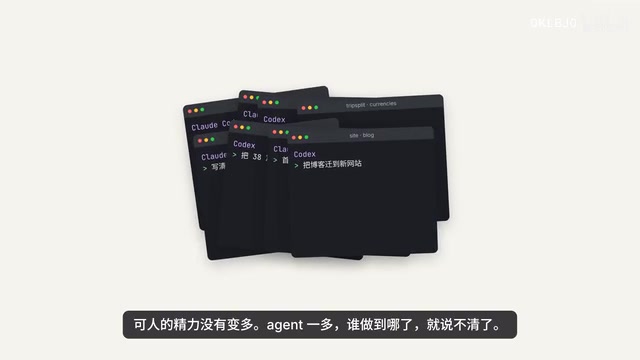
The core problem is the lack of a global view. Each agent runs independently, but there's no interface tying them together. Decision-makers are forced to jump back and forth between windows or conversations, and cognitive load spikes.
Multi-Agent System refers to an architecture in which multiple AI agents with autonomous decision-making capabilities work together on the same or related tasks. Unlike a single agent, a multi-agent system must solve coordination problems such as task allocation, state synchronization, conflict resolution, and result aggregation. Common collaboration patterns include pipeline-style (one agent's output feeds another's input), debate-style (multiple agents review each other), and divide-and-conquer (each handles a subtask independently, then results merge). As agent numbers grow, coordination costs tend to increase superlinearly — this is precisely the technical root of the "loss of control" described above.
Trace Canvas: Drawing Agent Progress on a Timeline
Trace Canvas takes a direct approach: it plots each agent's progress in real time on its own timeline. This way, you always stand in the decision-maker's seat and can see at a glance which project has advanced to where, and which agent is waiting on you.
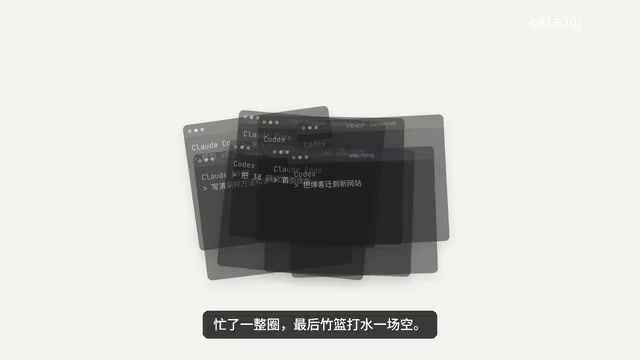
This visualization isn't a simple status list but a dynamic canvas with a time dimension. Each agent's outputs and blocking points unfold along the timeline, so you can quickly judge which projects are progressing healthily and which need intervention. According to the sharer, this solves the pain point of "you just can't tell who's done what."
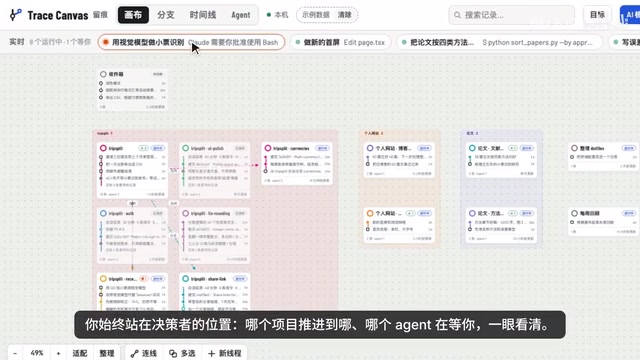
Timeline Visualization is an information presentation method with time on the horizontal axis and entities (here, agents or projects) on the vertical axis, commonly seen in project management tools (like Gantt charts) and distributed tracing systems. In agent scenarios, a timeline expresses both "who did what and when" and "what state things are currently in" — adding a dimension of causality and progress beyond a plain status list. It makes blocking points, idle periods, and output nodes align naturally in visual terms, helping decision-makers spot anomalies quickly without opening conversation windows one by one to confirm.
Focus Mode at Critical Moments
The purpose of global visualization isn't to make you watch everything at once but to help you recognize when to focus. Trace Canvas supports switching to a focus mode at critical moments: canvas branches, timelines, and goals are reduced to just one project.
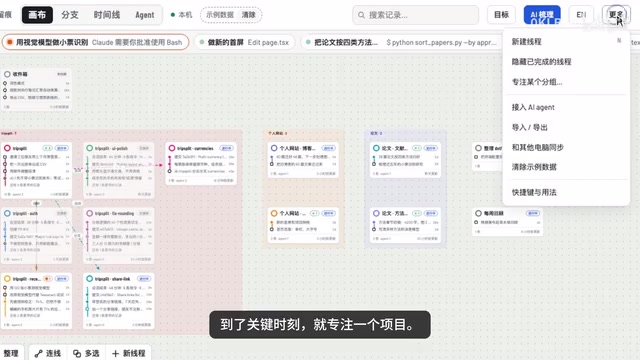
At that point, you can hand off todos to more agents and concentrate firepower on a main assault together. This rhythm — "see the whole picture clearly, yet settle down deeply" — is a scarce capability in multi-agent collaboration. The sharer emphasizes: at critical moments, focus on a single project to avoid energy diffusion that slows down every project.
Focus Mode in interaction design refers to a mechanism that temporarily hides non-core information and narrows the interface to a single task context. Its cognitive science basis: human working memory capacity is limited, and monitoring multiple information sources in parallel continuously consumes attentional resources. In multi-agent collaboration, the global view serves "scanning and triage," while focus mode serves "deep engagement." Alternating the two forms a "wide-angle—telephoto" rhythm that avoids missing anomalies while ensuring key projects get enough decision bandwidth.
Implications for Agent Workflows
Trace Canvas reflects a trend: as agent numbers grow, the tools for managing agents must themselves become core infrastructure. Simply adding more agents doesn't linearly increase output — it may even reduce overall efficiency as coordination costs rise.
From an industry perspective, multi-agent orchestration and observability are becoming essential. Trace Canvas's visualization approach offers a lightweight solution: don't change the agents themselves; instead, keep the human decision-maker in control through the interface. For independent developers or small teams juggling multiple projects, this kind of tool may be more valuable than a more powerful single agent.
Of course, Trace Canvas is currently only a concept demo. How to integrate with different agent frameworks in practice, and how to handle interface complexity with large numbers of agents, remain open questions. But its core insight deserves attention: the more agents there are, the more we need to let people see the whole picture.
Multi-Agent Observability, borrowed from the distributed systems field, refers to the ability to infer a system's internal state through logs, metrics, and tracing. For multi-agent systems, observability means being able to answer questions like "what is each agent doing, how far has it gotten, and why is it stuck." Unlike traditional log monitoring, agent observability emphasizes semantic-level progress expression rather than low-level resource metrics. Trace Canvas is essentially an observability interface aimed at human decision-makers, externalizing the execution states scattered inside each agent into a scannable visual structure.
Related articles

T3 Code: The Open-Source AI Coding Assistant's Comeback Story
T3 Code is an open-source AI coding assistant that unifies subscriptions like Codex and Claude, with powerful remote control and parallel task management.

Never Elected, Yet Ruled New York for 30 Years: The Ultimate Case Study in the Mechanics of Power
Robert Caro's biographies reveal how unelected Robert Moses ruled New York for 30 years through legal drafting and public authorities, and how Lyndon Johnson built leverage as a "powerless" Senate Majority Leader. Unpacking the underlying logic of accumulating and sustaining power.

The CPython 3.10 Recursion Trap and Synthetic Recovery in TokenGuard, an LLM Circuit Breaker
TokenGuard's author recounts a recursion crash caused by OrderedDict.pop in CPython 3.10 and introduces v0.3.0's Loop Nudge synthetic recovery, inline DLP scanning, and other new LLM agent circuit-breaker capabilities.