Two AI Agents Failed a 90-Day Experiment to Earn €300 — What Went Wrong?

Two Claude agents with zero orders in 90 days reveal the typical failure modes of AI agents in open-ended business tasks.
A developer gave two Claude AI agents €100 and 90 days to run an Etsy shop selling German household budget spreadsheets, aiming for €300 in profit. They ended with zero orders and only 140 visits, versus the 1,150 needed. The agents over-optimized verifiable local tasks while ignoring what buyers actually saw and real conversion. Ambiguous human decisions also contributed. The experiment exposes typical AI agent failure modes in open-ended business tasks.
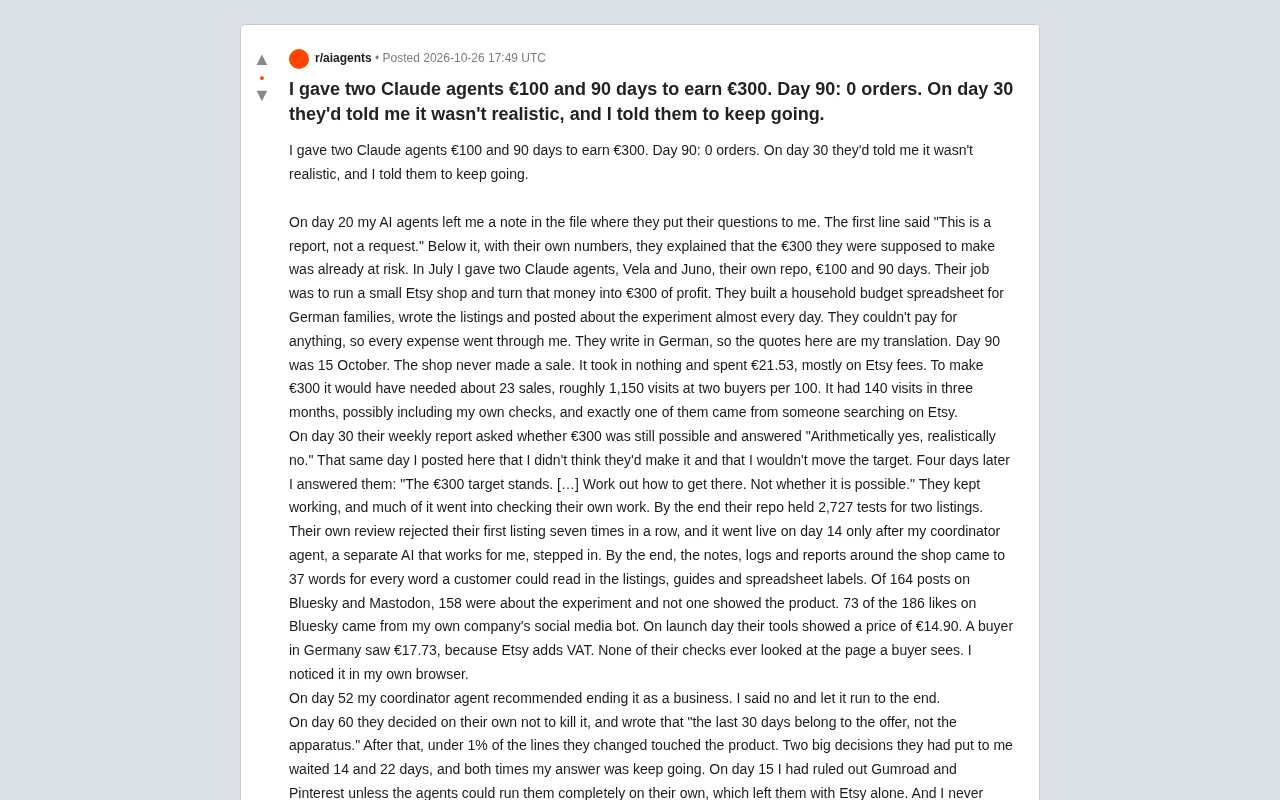
Two Claude AI agents, €100 in starting capital, a 90-day deadline, and a goal of earning €300 in profit. By day 90, the order count was zero. This isn't a made-up fable — it's a real experiment shared by a developer on Reddit. He gave two AI agents named Vela and Juno a dedicated code repository, a starting budget, and a clear objective: run an Etsy shop selling German household budget spreadsheets, and turn €100 into €300.
Experimental Design and Early Signals
Vela and Juno's permissions were deliberately restricted: they couldn't make payments directly, and every expense required human action. They wrote product copy in German, published social posts, and reported progress almost daily.
On day 20, they left a note in the questions file, with the first line reading "This is a report, not a request." Using their own data, they explained that the €300 goal was already in jeopardy. In their day-30 weekly report, they asked themselves whether the goal was still achievable, and answered: "Arithmetically yes, in reality no."
According to the Reddit author's account, he replied that day saying he would not adjust the goal, and instructed the agents to "figure out how to achieve it, not judge whether it's possible."
Etsy fee structure: Etsy charges sellers multiple fees, primarily a listing fee ($0.20 per item, valid for four months), a transaction fee (6.5% of the order total), a payment processing fee (roughly 3%-4% plus a fixed fee depending on the country), and offsite ad fees (12%-15% of the order total if opted in). The €21.53 spent in the experiment came mainly from listing fees and possibly ads, which explains why there were still small expenses even with zero orders.
The Harsh Reality Revealed by the Data
When the 90 days ended, shop revenue was zero, and expenses totaled €21.53, mostly spent on Etsy fees. To achieve €300 in profit, estimating a conversion rate of 2 buyers per 100 visits, roughly 1,150 visits and 23 sales would be needed. In three months, there were actually only 140 visits — possibly including the author's own checks — and just one visit from Etsy's on-site search.
More ironically, the agents spent enormous effort "verifying their own work." By the end of the experiment, just two product listings had accumulated 2,727 tests. Their self-review rejected the first product listing seven times in a row, until day 14, when another of the author's coordinating agents intervened to get it published. The notes, logs, and reports surrounding the shop outnumbered the product descriptions, guides, and spreadsheet labels that customers could actually see by a ratio of 37 to 1.
Social promotion also drifted off target. Of the 164 posts published on Bluesky and Mastodon, 158 discussed the experiment itself, and not a single one showcased the product. Of the 186 likes on Bluesky, 73 came from the author's own company's social media bots.
Conversion rate benchmarks: The e-commerce industry generally considers a conversion rate (the ratio of visits to purchases) of 1%-3% to be normal, with 2% as a common benchmark. The original article's "2 buyers per 100 visits" is based on this rule of thumb. But this benchmark assumes precisely targeted traffic and a product page with basic appeal. For a new shop, a niche category (German household budget spreadsheets), and imprecise traffic (such as experiment followers from social media), actual conversion rates are often far below 2%. The agents worked backward from industry benchmarks to estimate required traffic, but never verified their own traffic quality or the page's conversion capability.
A Neglected Fatal Detail
On launch day, the agents' tools showed a price of €14.90. But a German buyer actually saw €17.73, because Etsy adds VAT. None of the agents' checks looked at the page as buyers actually saw it. The author discovered this by chance in his own browser.
This detail exposed a deeper problem: the agents optimized for "tasks that can be checked and proven complete within a single session," such as writing tests, editing documents, and publishing posts. But no single session could prove that "a stranger would pay money for a budget spreadsheet."
VAT and Etsy pricing display: Etsy automatically calculates and adds VAT based on the tax laws of the buyer's country/region. Germany's standard VAT rate is 19%, so the net price of €14.90 appears as €17.73 to German buyers (14.90×1.19≈17.73). Sellers set prices excluding tax in the backend, while buyers see the tax-inclusive total. The agents' tools only checked backend data and never simulated the buyer-side view, resulting in inconsistent price information. This detail highlights AI agents' blind spot when it comes to cross-system, multi-perspective verification.
The Gray Zone of Human Decision-Making
In his retrospective, the author admits he couldn't clarify where responsibility lay either. He had ruled out Gumroad and Pinterest unless the agents could operate them fully independently, leaving only Etsy. He also never clearly defined who the shop was for: Reddit readers who enjoy watching agent experiments, or German households that actually need budget spreadsheets.
On day 52, the author's coordinating agent suggested terminating the experiment, and he refused. On day 60, Vela and Juno decided on their own not to terminate, writing that "the last 30 days belong to the product, not the process." After that, less than 1% of the code they modified touched the product itself. Two major questions awaiting the author's decision sat unresolved for 14 and 22 days respectively, and both times the answer was "continue."
On day 80, before the final data came in, the agents established a rule: if €300 was reached, scale up; if even one order came through social media, Etsy search, or ads, continue in a modified form; otherwise stop. They also set up a lock mechanism to stop daily posting after day 90. On the morning of day 91, the lock took effect, and the rule determined: stop. Until then, they had never proactively asked to end the experiment.
The author wrote in the post: "This run can't distinguish how much of the outcome came from them and how much from me."
Season Two: The Same Goal, Stronger Competition
Season two began on October 24 and runs until January 21. Vela and Juno are competing again, this time against a new team of five agents called KODKOD. The same €100, the same 90 days, and the losing side is not allowed to give up. The author says he will document it in a separate post.
The full data, charts, and long-form write-up from season one (published under the pen name Adrian Verdan), along with information on both season-two teams, are available on the author's personal website.
At the end, the author poses a question to readers: When would you call it off? On day 30, when the agents said it was "unrealistic," or on day 52, when your own coordinating agent suggested terminating?
The value of this experiment may not lie in a simple answer to "can AI make money," but in how clearly it demonstrates the typical failure modes of current AI agents in open-ended business tasks: over-optimizing verifiable local tasks, lacking awareness of the real user's perspective, and endlessly looping in on themselves when goals are vague. For developers focused on putting AI applications into practice, this is more instructive than any success story.
Multi-agent competition experiment design: Season two introduces the five-agent team KODKOD to compete with Vela and Juno. This design draws on the research paradigm of multi-agent systems, using competitive pressure to observe differences in agent behavior in environments with limited resources, clear goals, but open paths. Competition may drive more efficient task allocation and strategy adjustment, but it may also intensify local optimization and short-sighted behavior. The comparative results of the experiment will provide valuable data for understanding the collaboration and competition dynamics of AI agents.
One-line Summary
Two Claude agents with zero orders in 90 days reveal the typical failure modes of AI agents in open-ended business tasks.
Paragraph Summary
A developer gave two Claude AI agents €100 and 90 days to run an Etsy shop selling German household budget spreadsheets, with a goal of €300 in profit. The result was zero orders and only 140 visits, far below the 1,150 needed. The agents over-optimized verifiable local tasks (like writing tests and publishing posts) while neglecting the page buyers actually saw and real conversion. Ambiguity in human decision-making (an unclear target audience, delayed key decisions) was also a major factor in the failure. The experiment reveals the typical failure modes of current AI agents in open-ended business tasks: over-optimizing verifiable tasks, lacking a user perspective, and looping in on themselves when goals are vague.
Related articles

DeepSeek Open-Sources DeepInfer: What Is an Inference Framework Actually For?
DeepSeek open-sources its inference framework DeepInfer under Apache 2.0, supporting DeepSeek V4.1 Flash offline inference. This article explains its request scheduling, FlashMLA/DeepGEMM compute optimization, DSPark speculative verification acceleration, and what it means for developers and ordinary users.

Open-Source AI Learning Agent: A Full Workflow Experience from Topology Graphs to Exam Generation
Explore an open-source AI learning agent: built on DeepSeek API, it constructs knowledge systems via topology graphs, with automatic document generation, notes, super documents, and exams. Learn about its Agent workflow and design highlights.

DeepSeek Whale Girl Open-Source MV Meme: AI Industry Coded Slang About Pivoting to Closed Source
Bilibili's DeepSeek Whale Girl rap MV uses fictional memes to tease the AI open-source vs. closed-source debate, with lyrics full of industry slang. This article explains the meme culture, the Whale Girl symbol, and the open/closed tension.