Two Weeks with iPhone Duo: Why Early Adopters Aren't Buying In?

Two weeks after launch, some iPhone Duo early adopters are expressing dissatisfaction and taking action.
Just over two weeks after the iPhone Duo launched, some launch-day buyers are disappointed with the new-form-factor device and have begun taking action. The report compares it to an intimate relationship, noting that while two weeks may not be enough to judge a long-term relationship, it is enough for users to form a clear attitude toward a new phone. The original wording is measured, using "not everyone" rather than a blanket negative, indicating dissatisfaction is concentrated in a specific subset of users. The article analyzes that early dissatisfaction with new-form-factor devices typically stems from interaction learning costs, practicality discounts in daily use, and the adjustment between software ecosystem and hardware form factor; launch buyers have high expectations and experience a big gap, and negative voices are easily amplified on social platforms. For potential buyers, what's more valuable is tracking specific complaint points and where dissatisfied users go next — such as returns, resale, or changed opinions.
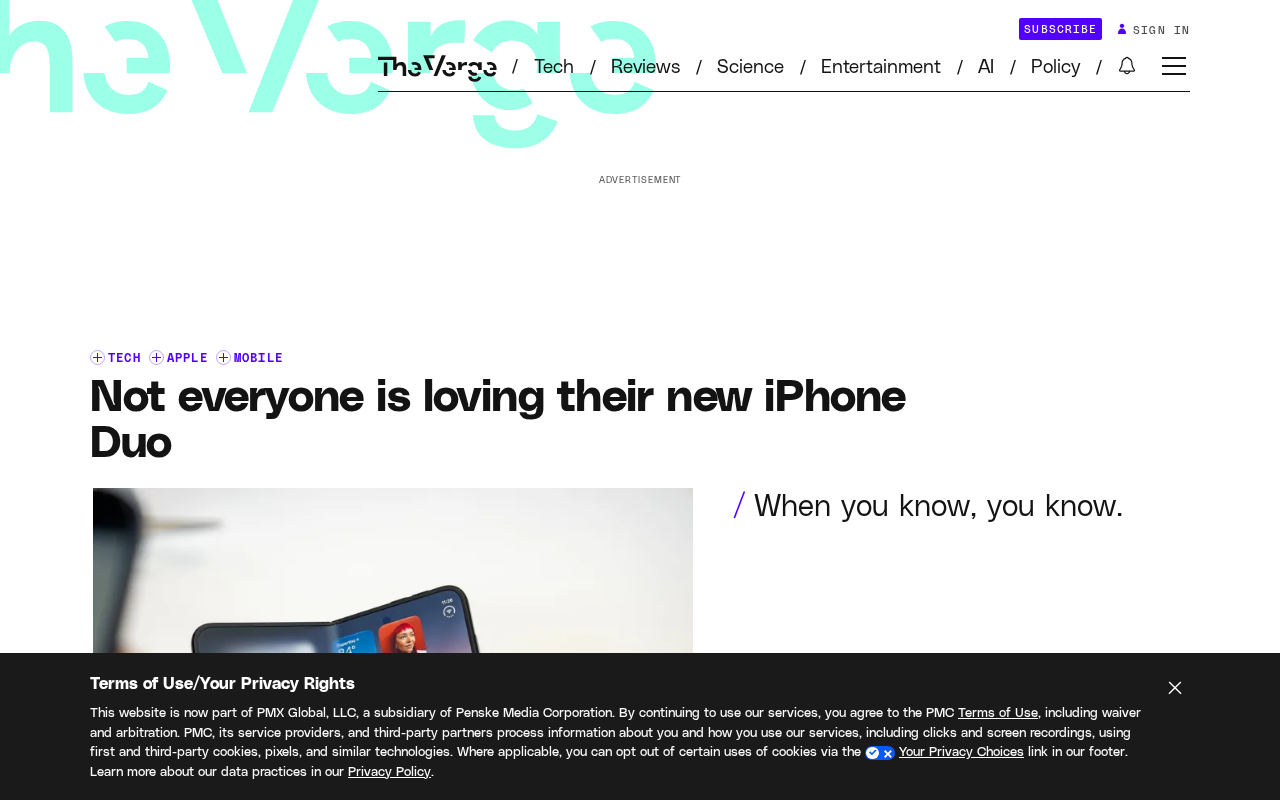
Just over two weeks after the iPhone Duo hit the market, some users who bought it on launch day are already voicing dissatisfaction. For a new relationship, two weeks may not be enough to judge whether you can commit long-term; but for a new phone, two weeks is often enough to form a clear opinion. That's exactly the situation the iPhone Duo faces now — a group of early adopters are giving less-than-positive feedback based on real-world experience.
Two Weeks Is Enough for Early Adopters to Make a Judgment
According to a report from an RSS source, just over two weeks after the iPhone Duo launched, some users who purchased it on launch day are already disappointed with the device and have begun taking action. The original article compares the phone experience to an intimate relationship: two weeks may not be enough to decide on a long-term relationship, but for a new phone, users often already know how they feel.
This analogy points to a product principle: the "honeymoon period" for new-form-factor devices is usually short. In the first two weeks after getting their hands on a device, users intensively test core functions and observe friction points in daily use. Once clear negative experiences accumulate within this window, thoughts of returning or reselling the device quickly take shape. The report specifically notes that those reacting are "launch-day buyers" — the group most willing to try new things and also the most discerning. Their attitude often foreshadows how the product will be received by a broader user base.
"Launch-day buyers" are typically referred to in consumer electronics as early adopters. This group was identified by Everett Rogers in Diffusion of Innovations as the second category of people in the technology adoption lifecycle, right after innovators. They are willing to bear the premium and uncertainty of new products, and they also possess strong technical judgment and willingness to express their views. As a result, their evaluations are often treated by manufacturers as important input for product iteration, and are used by later mainstream users on social media as a reference for decision-making. However, early adopters' preferences may themselves deviate from mainstream needs: they are more tolerant of immature software and place greater value on the novelty brought by form-factor innovation. Therefore, their dissatisfaction can neither be simply equated with product failure nor easily ignored.
Why Early Users Aren't Buying In
The original report does not elaborate on a specific list of complaints, but from the phrasing "not everyone is loving" it can be inferred that the problem is not isolated but affects a subset of users. For new-form-factor devices, early dissatisfaction typically centers on several dimensions: the learning curve of new interaction methods, the practicality discount in everyday scenarios, and the磨合 between software ecosystem and hardware form factor in the launch phase. (Note: "磨合" here means the adjustment/integration process.)
It should be emphasized that this does not equate to product failure. The original wording is quite measured — "not everyone," not "nobody." This means a considerable portion of users still approve of the device, with dissatisfaction concentrated in a specific subset. For a product with an entirely new form factor, the divided feedback from first-wave users is itself an important market signal: it delineates the product's current capability boundaries and marks the shortcomings that need priority fixes.
"Software ecosystem adjustment for new-form-factor hardware" refers to the situation where, after a device deviates from mainstream standards in interaction methods, screen ratio, or peripheral form factor, third-party apps often have not yet adapted to its characteristics. Take foldable screens, dual screens, and similar form factors as examples: apps may simply stretch rather than re-layout, causing selling points like split-screen and hover to be greatly diminished in actual use. Such problems usually cannot be solved by a single system update; they depend on whether developers are willing to invest adaptation costs for a relatively limited installed base, forming a typical "chicken-and-egg" dilemma: users wait and see due to insufficient ecosystem, while developers delay adaptation due to insufficient user scale. Much of the dissatisfaction in the launch phase stems from this structural contradiction rather than defects in the hardware itself.
What Divided Launch Reviews Mean
Early reviews of new-form-factor hardware often show a polarized distribution. Users willing to order on launch day are themselves people with high expectations for the new form factor; the higher the expectations, the stronger the negative expression when they are not met. These voices are easily amplified on social media and review communities, creating the impression of a "reputation collapse," but the actual distribution of user satisfaction may be far more balanced than it appears on the surface.
For readers following this type of product, what's more worth tracking is not single emotional reviews but where dissatisfied users go after two weeks: whether they return the device, resell it, or change their minds after a software update. The original report mentions these users have "begun taking action," and where things go from here will be more telling than the current complaints.
Negative voices on social platforms are easily amplified, which is related to the combined effect of "negativity bias" and survivorship bias: dissatisfied users are more motivated to speak out publicly, while satisfied users tend to remain silent, so the visible sample is naturally skewed negative. In addition, algorithmic recommendation amplifies the spread of emotional content, giving a small number of complaints exposure far beyond their actual proportion. Therefore, to assess the true reputation of a new-form-factor device, a more reliable approach is to refer to return rates, repair rates, e-commerce rating distributions, and long-term usage reviews, rather than drawing conclusions solely from frequent complaints on social platforms. The original article's emphasis on "not everyone" rather than "nobody" is precisely a reminder of the gap between surface impressions and the true satisfaction distribution.
Takeaways for Potential Buyers
If you're considering whether to get the iPhone Duo, the feedback from these two weeks provides an observation window. The first batch of users of new-form-factor devices is effectively bearing the trial-and-error cost for you, and their complaints are the usage scenarios you need to verify carefully. Rather than being led by headlines saying "some people are unhappy," it's better to focus on specific issues: which features carry the most weight in your daily use, and whether these features are repeatedly mentioned in early feedback.
Two weeks is not enough to make a final judgment on a product, but it is enough for the market to see the attitude of the first batch of real users. The iPhone Duo story has only just begun, and the divided feedback from early users is the first key indicator of whether it can mature.
Related articles

Hands-On with Shopify AI Toolkit: Official Validation for AI-Generated Shopify Code
Hands-on with Shopify's official AI Toolkit: connect Shopify docs, API schemas, and code validation to Claude Code and other coding assistants to intercept AI-fabricated fields. Installation steps, offline validation, and telemetry-on-by-default warnings.

Claude Orchestrating an AI Coding Team: A Practical Analysis of Agent Orchestrator
The open-source Agent Orchestrator lets Claude Code dispatch Codex, Gemini, Cursor and more for parallel AI coding, with Git Worktree isolation, CI auto-correction, and mobile notifications for AI team collaboration. This article analyzes its core mechanisms, cost structure, and use cases.

Google's New AI Coding Model Beats Claude at One-Third the Cost
Google's Gemini 4 Carbon edges past Claude Fable 5.2 Max on CursorBench 4.0 at 60.4% vs 60%, costing just $9.22 per task versus $32.79—about one-third.