Understanding DeepSeek Super-agent in 3 Minutes: Architecture and Boundaries of a Team AI Coding System

DeepSeek's open-source team-level AI coding system that integrates AI into development workflows via entry, scheduling, and execution layers.
The article systematically outlines DeepSeek's open-source Super Agent: it is not a new model or prompt, but an AI coding system running in DeepSeek Harness for development teams, requiring integration with a model, code repository, and dedicated account, and usable via a Feishu bot and web panel. Its structure has three parts: entry (receiving GitHub and Feishu messages), scheduling (determining new task vs. continuation), and execution (reading files, modifying code, running commands in independent sessions and working directories). It emphasizes the distinction between tasks and conversations—a task can span multiple rounds, with supplements sent back to the original task's Agent—and that permissions are separated from discussion, so remarks don't auto-escalate permissions. Currently a research prototype; recommended to validate with small tasks.
Understanding DeepSeek Super-agent in 3 Minutes: Architecture and Boundaries of a Team AI Coding System
Recently, many developers have had the name "Super Agent" flooding their feeds, but discussions around it often stay at the conceptual level. A short video on Bilibili explains its positioning, structure, and practical usage clearly in just three minutes—here we organize that content into a systematic overview.
Let's start with the conclusion: Super Agent is not a new model, nor is it a prompt pasted into a chat window. According to the video, it is an open-source AI coding system from DeepSeekAd, primarily aimed at development teams. Once you connect it to a GitHub repository, the team can assign work to it through the discussion area, let it organize AI to handle the tasks, and then receive code changes or processing results back. What you get is software that needs to be installed and configured—not a one-off conversational experience.
It's not a model, but a team-level AI coding system
The first step to understanding Super Agent is to distinguish between "model capability" and "engineering system." The model is responsible for deciding what to do next based on context, while Super Agent is responsible for connecting engineering elements like messages, tasks, permissions, and execution environments.
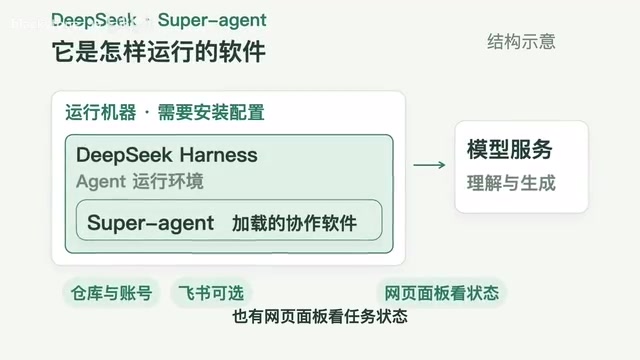
This system runs inside DeepSeek Harness, an Agent runtime environment. It needs to be connected to a model, a code repository, and a dedicated account; a Feishu bot can be integrated as needed. Once running, there's also a web panel to check task status. This means the deployment cost mainly lies in configuration, not in writing prompts.
From this perspective, Super Agent's ambition is not to "let AI write a snippet of code," but to make AI a manageable execution unit within the team's workflow.
DeepSeek Harness is the Agent runtime environment (harness) that DeepSeek provides for its own models. It handles underlying capabilities such as session lifecycle management, tool invocation, execution environment isolation, and state persistence. It is not the same as the model itself, but rather a middle layer between the model and the outside world: the model gains tools like file read/write and command execution through it, and task states are also stored by it. It's apt to think of it as "the runtime container for Agents"—Super Agent, as an application running on top of it, reuses this environment for scheduling and execution. Therefore, deployment requires preparing Harness and the corresponding model integration first, rather than simply running a script.
Three-part structure: entry, scheduling, execution
The video suggests understanding its internal structure through three parts, which is a quite pragmatic breakdown.
Entry: receiving GitHub and Feishu messages
The entry layer is responsible for receiving messages from GitHub and Feishu. Requirements, supplementary explanations, and review comments raised by the team in the discussion area all enter the system from here.
Scheduling: determining whether it's a new task or a continuation
The scheduling part determines whether a message is meant to start a new task or continue an existing one. Once a message arrives, the system must first clarify "what to do" and "who can authorize it to do so," and only then start working. This judgment step is key to the entire system's ability to operate continuously.
Session is the basic unit in an Agent system that stores context and state. A session typically corresponds to a continuous interaction history, in which the model retains previously read files, made modifications, and user supplementary explanations. Super Agent gives each task its own session and working directory, meaning contexts between different tasks are isolated to avoid mutual contamination; subsequent messages for the same task reuse the same session, thereby "remembering" previous progress. This design is also the technical foundation for separating tasks from conversations: sessions are bound to tasks rather than chat windows, so closing the page does not cause the task to lose context.
Execution: operating on code and environment
The execution part is where code is actually operated on. During concrete work, each task has its own session and working directory, and the coding Agent reads files, modifies code, and runs commands within that directory. The model decides the next step based on context, and tools turn those decisions into file modifications and program execution.
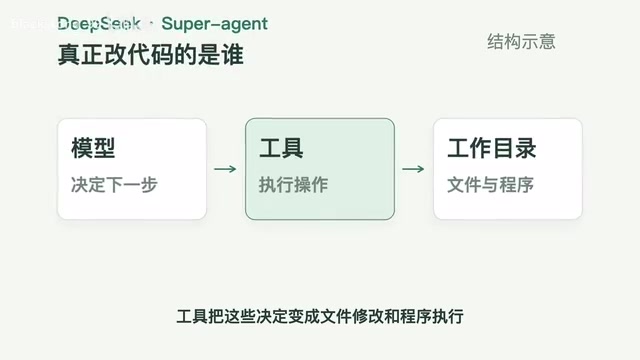
The value of Super Agent lies in connecting these execution processes with external task discussions and permissions to form a closed loop.
Tasks and conversations are two different things
This is the most noteworthy point from the video. A task can span many rounds: someone adds requirements, code review offers comments, and the AI needs to continue processing. The system saves the relationship between tasks and related discussions, sending subsequent messages back to the Agent responsible for that matter.
Here's a brief example from the video. You report on GitHub that exporting a file throws an error and ask it to fix it; it takes on the task and arranges for an Agent to investigate the code. Later you add, "It only errors on large files," and this condition is sent back to the original task rather than starting an entirely new conversation. Once the fix is ready for review, it sends the result back.
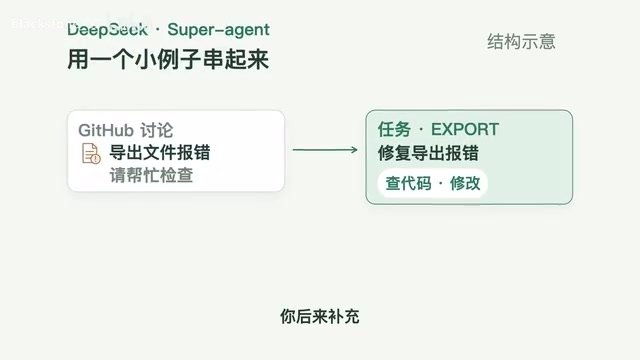
This design gives the AI's work continuity, rather than starting from scratch to understand context every time.
Permission boundaries: being able to read a message doesn't mean it can act on it
Just because the system can read a message doesn't mean it will do whatever anyone says. Who can assign tasks must be configured in advance, and when accepting a task, the allowed scope of processing must be recorded. If you want it to proactively look for work, you need to configure the corresponding rules.
A sentence newly added in a discussion cannot automatically become broader permissions. This constraint is especially important in team collaboration scenarios, as it separates "discussion" and "authorization" into two distinct actions, preventing a casual remark from being misinterpreted by the system as an escalation of instructions.
The principle of least privilege is a classic guideline in security engineering: a subject should only be granted the minimum permissions necessary to complete its task. Super Agent's requirement to configure "who can assign tasks" in advance and record the authorization scope is precisely this principle applied to the Agent scenario. Unlike human employees, an Agent will indiscriminately process all text it reads, so if a casual "why not change it while you're at it" in the discussion area were directly executed as a command, it could cause unauthorized changes. Separating the authorization action from discussion content amounts to adding an explicit authorization gate for the Agent—a common practice for preventing prompt injection and instruction escalation in multi-user collaborative environments.
The human role: making requests, answering questions, checking results
Human interaction with this system mainly involves making requests, answering key questions, and checking results. During normal operation, it should minimize interruptions and only send messages back when there are results to review or decisions for you to make.
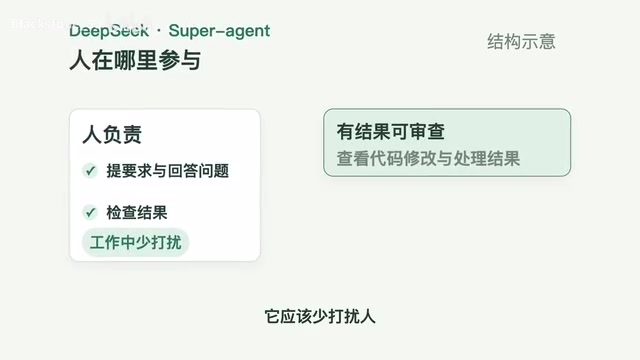
The web panel also prioritizes these items that need human attention, making it easy to know where to look next. This "low-interruption" design orientation indicates that it targets teams with review processes, rather than individual users seeking full automation.
Research prototype: validate with small tasks first
The video ends with a pragmatic reminder. What's been released this time is a research prototype, and the official team also states that some ideas have not yet been implemented. Whether it can reliably complete your tasks still needs practical verification.
If you really want to use it, it's recommended to start with a small-scope task whose results are easy to check, and observe what it does and how many times human intervention is needed along the way. This advice speaks more to its current positioning than any feature list: a collaborative system with clear potential but whose boundaries need to be explored through hands-on use—not an out-of-the-box productivity tool.
One-line Summary
DeepSeek's open-source team-level AI coding system that integrates AI into development workflows through three layers: entry, scheduling, and execution.
Paragraph Summary
The article systematically outlines DeepSeek's open-source Super Agent: it is not a new model or prompt, but an AI coding system running in DeepSeek Harness, aimed at development teams. It requires integration with a model, code repository, and dedicated account, and can be used via a Feishu bot and web panel. Its structure is divided into three parts: entry (receiving GitHub and Feishu messages), scheduling (determining whether it's a new task or a continuation), and execution (reading files, modifying code, and running commands in independent sessions and working directories). The article particularly emphasizes the distinction between tasks and conversations—a task can span multiple rounds, with subsequent supplements sent back to the Agent of the original task; meanwhile, permissions are separated from discussion, so remarks in discussions do not automatically escalate permissions. The current version is a research prototype, and it's recommended to start with small tasks for validation.
Related articles

Deleted Reddit Post Sparks Debate Over AI Content Moderation
A Reddit post removed with only a 'Removed by Reddit' notice highlights AI content moderation's transparency gaps, misjudgment risks, and appeal challenges for platforms and creators.

DSH + Ollama Local LLM Deployment in Practice: Free Chat with Da Fei Yu
Bilibili creator tests DSH + Ollama local LLM deployment end to end: Ollama install, Xunlei-accelerated downloads, ModelScope GGUF model import, DSH custom API address setup, and a comparison of Qwen 3.5 4B, 8B, Gemma, and other models on 8GB VRAM, with advice on choosing local deployment vs. API calls.
Tested: A $899 Mac Mini vs. a $200/Month AI Subscription
Real-world test of whether an M4 Mac mini can replace a $200 AI subscription: 16GB can't fit large models, and both speed and quality fall short—but privacy, no caps, and near-zero running costs make it an ideal host for an always-on agent. Includes buying advice per configuration and money-saving strategies.