US Government Warns: Industrial Cold-Chain Equipment Hit by Large-Scale Hacker Attacks, Supply Chain Security Alarms Sound

US warns of large-scale hacker attacks on industrial refrigeration equipment, affecting multiple industries and sounding the alarm for OT security.
US government agencies issued a joint statement warning that large-scale cyberattacks targeting industrial refrigeration equipment are ongoing, with affected facilities spanning retail cold chains, industrial refrigeration systems, and even military freezing equipment, impacting critical industries including food, transportation, and healthcare. Attackers target internet-exposed temperature-control devices, exploiting low-barrier vulnerabilities such as default passwords, unpatched firmware, and weak encryption protocols. Once devices are compromised, consequences range from temperature loss causing material damage to serving as a springboard for penetrating corporate internal networks. The statement urges industries to audit exposed devices, update credentials, and implement network segmentation. The article notes that this incident exposes systemic weaknesses in OT security and sets new security design requirements for AI-driven industrial automation—security must become a first-class citizen of system design.
US government agencies recently issued a joint statement warning that large-scale hacker attacks targeting industrial refrigeration equipment are ongoing and have affected multiple critical industries including food, transportation, and healthcare. This incident has once again pushed Industrial Internet of Things (IIoT) security into the spotlight.
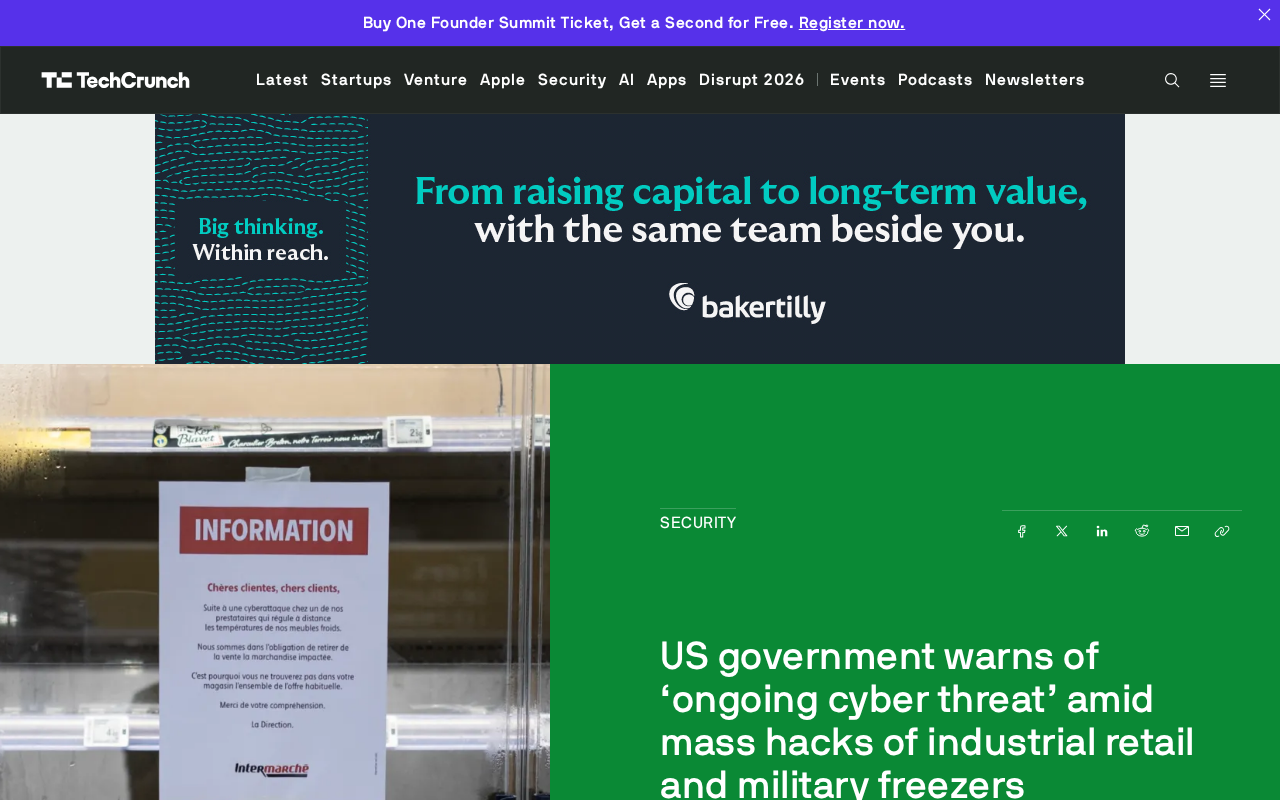
Attack Scope Spans Civilian and Military Domains
According to the joint statement, the facilities affected by this wave of attacks include retail cold-chain systems, industrial refrigeration systems, and even freezing equipment at military installations. Attackers appear to be targeting temperature-control devices exposed on the internet, which are typically used to safeguard temperature-sensitive materials such as food and pharmaceuticals.
The statement notes that affected industries include food, transportation, and healthcare. This means that everything from supermarket freezers to logistics cold chains to hospital drug storage could become potential targets for attackers. Although the statement did not disclose the specific identity or motives of the attackers, the phrase "ongoing cyber threat" suggests that the attacks may still be in progress.
Common paths by which HVAC and industrial refrigeration systems are exposed to the public internet warrant additional explanation. These devices typically connect to networks through building management systems (BMS) or remote monitoring platforms, and operations personnel often map them directly to public IP addresses for convenience, or use vendor default cloud gateways and port forwarding. Search engines such as Shodan and Censys can discover devices with open BACnet, Modbus, or vendor proprietary protocols at scale, and attackers can attempt default credential logins without advanced exploit techniques. Some temperature-control devices also support remote firmware updates and debugging interfaces, which become entry points for persistent control if not disabled or left unauthenticated. Understanding these exposure surfaces helps enterprises conduct targeted asset discovery and reduction efforts.
IIoT Security Weaknesses Exposed
This incident is not isolated. In recent years, as industrial equipment has become increasingly networked, large numbers of refrigeration units, HVAC systems, and other critical infrastructure have been exposed on the public internet, and such equipment often lacks adequate security protections. Issues such as default passwords, unpatched firmware vulnerabilities, and weak encryption protocols are widespread, making them low-barrier attack targets.
Once attackers gain control of these devices, the consequences range from temperature loss causing material damage to using them as a springboard to penetrate corporate internal networks. For the healthcare and food industries, cold-chain interruptions can directly trigger public safety incidents.
The security differences between OT (operational technology) and IT are key background for understanding such incidents. OT refers to the software and hardware systems used to monitor and control physical devices and processes, such as PLCs, SCADA, DCS, and refrigeration unit controllers; their design goal is reliability and real-time performance, not information security. Unlike IT systems that prioritize confidentiality, OT values availability and integrity more highly, and many industrial protocols (such as Modbus and BACnet) lacked authentication and encryption mechanisms from the outset. In addition, OT devices often have lifecycles of 10 to 20 years, making frequent firmware updates difficult, and downtime maintenance costs are extremely high, leading to long-term vulnerability exposure. Once attackers gain access at the OT layer, they can directly manipulate physical processes and cause real-world consequences—this is precisely why industrial refrigeration attacks are more dangerous than ordinary data breaches.
Government and Enterprise Countermeasures
The joint statement urges relevant industries to take immediate action, including auditing devices exposed on the internet, updating default credentials, and deploying network segmentation and monitoring measures. For critical facility operators, it recommends isolating refrigeration control systems from general networks as soon as possible and establishing abnormal temperature alerting mechanisms.
From a broader perspective, this warning also reflects regulators' increasing attention to OT (operational technology) security. Traditional IT security strategies cannot be directly applied to industrial equipment, and enterprises need to establish security management processes covering the entire device lifecycle, incorporating security considerations from procurement and deployment to operations and maintenance.
Implications for the AI and Automation Industry
The large-scale compromise of cold-chain equipment sounds an alarm for AI-driven industrial automation. As more and more physical systems connect to networks and are scheduled by algorithms, security must become a first-class citizen of system design. AI can be used for anomaly detection and threat hunting, but only if the devices themselves are observable and manageable.
For teams developing industrial AI solutions, this means embedding zero-trust architecture, secure boot, and remote attestation capabilities at the product design stage. Otherwise, the efficiency gains from intelligence could easily be offset by security incidents.
Currently, the joint statement did not provide specific data on the scale of the attacks or the exact number of affected devices, but the phrase "large-scale" is sufficient to indicate the breadth of the problem. Relevant industries need to remain vigilant and continue to monitor official updates.
Zero-trust architecture and remote attestation are two concepts suggested in the article but not elaborated upon. The core principle of zero trust is "never trust, always verify," which in industrial scenarios means that any user, device, or service accessing a refrigeration controller or BMS must undergo continuous identity authentication and least-privilege authorization rather than relying on network perimeter defenses. Remote attestation is a mechanism supported by a hardware root of trust (such as a TPM) that measures the integrity of firmware and system images during device boot and reports the results to a remote verifier, thereby detecting firmware tampering or backdoor implantation. Combining the two allows networked temperature-control devices to prove their trusted state before going online and to continuously verify during operation, providing a trustworthy data foundation for AI anomaly detection.
One-line Summary
US warns of large-scale hacker attacks on industrial refrigeration equipment, affecting multiple industries and sounding the alarm for OT security.
Paragraph Summary
US government agencies issued a joint statement warning that large-scale cyberattacks targeting industrial refrigeration equipment are ongoing, with affected facilities spanning retail cold chains, industrial refrigeration systems, and even military freezing equipment, impacting critical industries including food, transportation, and healthcare. Attackers target internet-exposed temperature-control devices, exploiting low-barrier vulnerabilities such as default passwords, unpatched firmware, and weak encryption protocols. Once devices are compromised, consequences range from temperature loss causing material damage to serving as a springboard for penetrating corporate internal networks. The statement urges industries to audit exposed devices, update credentials, and implement network segmentation. The article notes that this incident exposes systemic weaknesses in OT security and sets new security design requirements for AI-driven industrial automation—security must become a first-class citizen of system design.
Related articles
 Tech Frontiers
Coldframe: A Honeypot Disguised as a Supermarket Freezer Controller
Coldframe is a honeypot disguised as Danfoss AK-SM 800A and Dixell XWEB freezer controllers, built as a single Python file that detects CVE-2025-41450 attempts and is identified as real devices on Shodan.
 Tech Frontiers
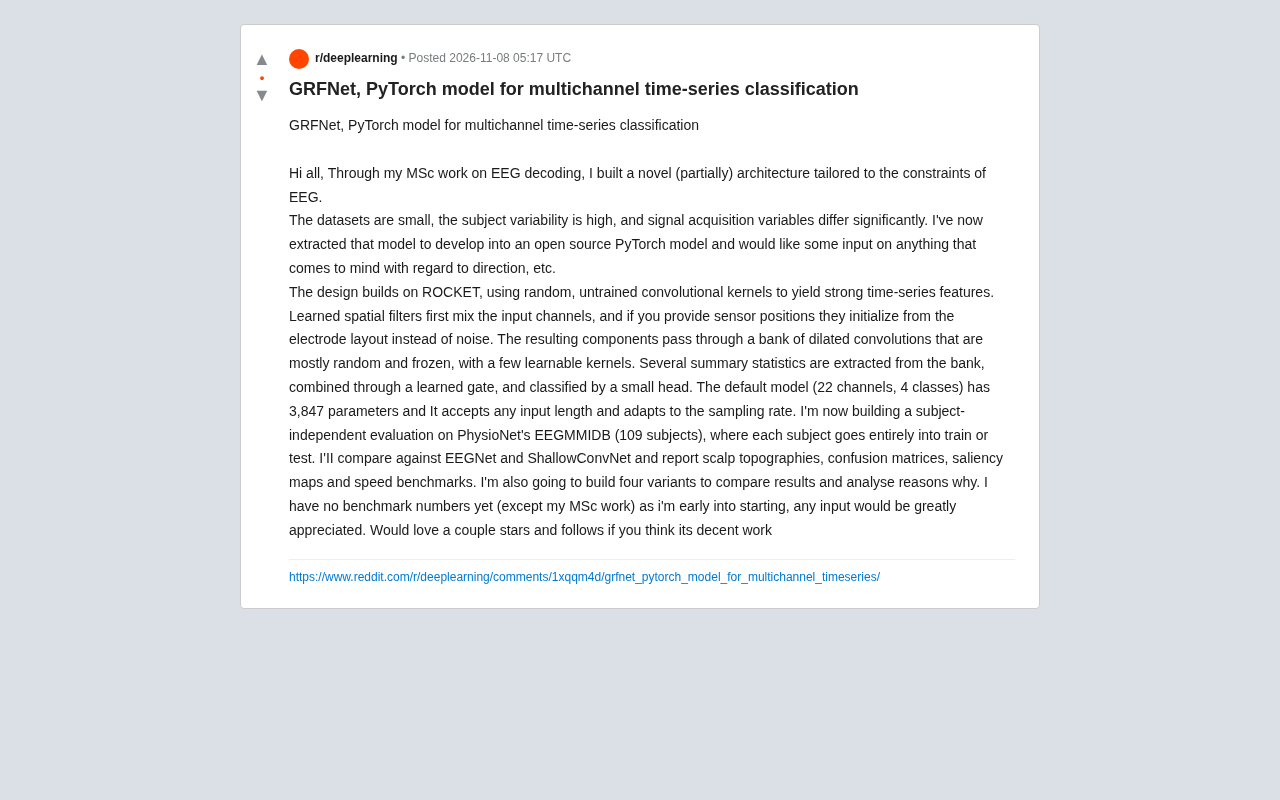
GRFNet: A Lightweight PyTorch Model Designed for Multichannel Time-Series Classification
GRFNet is a lightweight PyTorch model for multichannel time-series classification, originating from EEG decoding research. With only 3,847 parameters, it is based on the ROCKET architecture, combining random convolution kernels with learnable spatial filters, supports arbitrary input lengths, and will soon be evaluated on the PhysioNet dataset.
 Tech Frontiers
CUDA-Accelerated Rocket League Simulator: A Player-Made Hardcore Experiment
A Reddit post shows a "100% Accurate" Rocket League simulator accelerated with CUDA. We analyze its technical context, CUDA's value in game physics simulation, and the significance and limitations of such community projects.