Vercel AI SDK Patch Update: Vue Bindings and Core Package Upgraded in Sync

Vercel AI SDK releases patch @ai-sdk/vue 3.0.316 synced with core ai 6.0.316; treat as routine dependency maintenance.
Vercel AI SDK recently released a patch version, with `@ai-sdk/vue` 3.0.316 and core package `ai` 6.0.316 updated in the same release. The release was automated via GitHub Actions with GPG signature verification and merged directly into main; release notes only mark Patch Changes and reference the core package version. The article notes that the Vue binding layer and core package are version-linked, and keeping versions aligned avoids peer dependency conflicts and type definition mismatches. Patch updates typically don't involve breaking changes; developers are advised to update versions in the lockfile, run existing tests to verify compatibility, and keep a rollback path. Given the project's high iteration frequency, establishing a version tracking mechanism is more important than one-off upgrades.
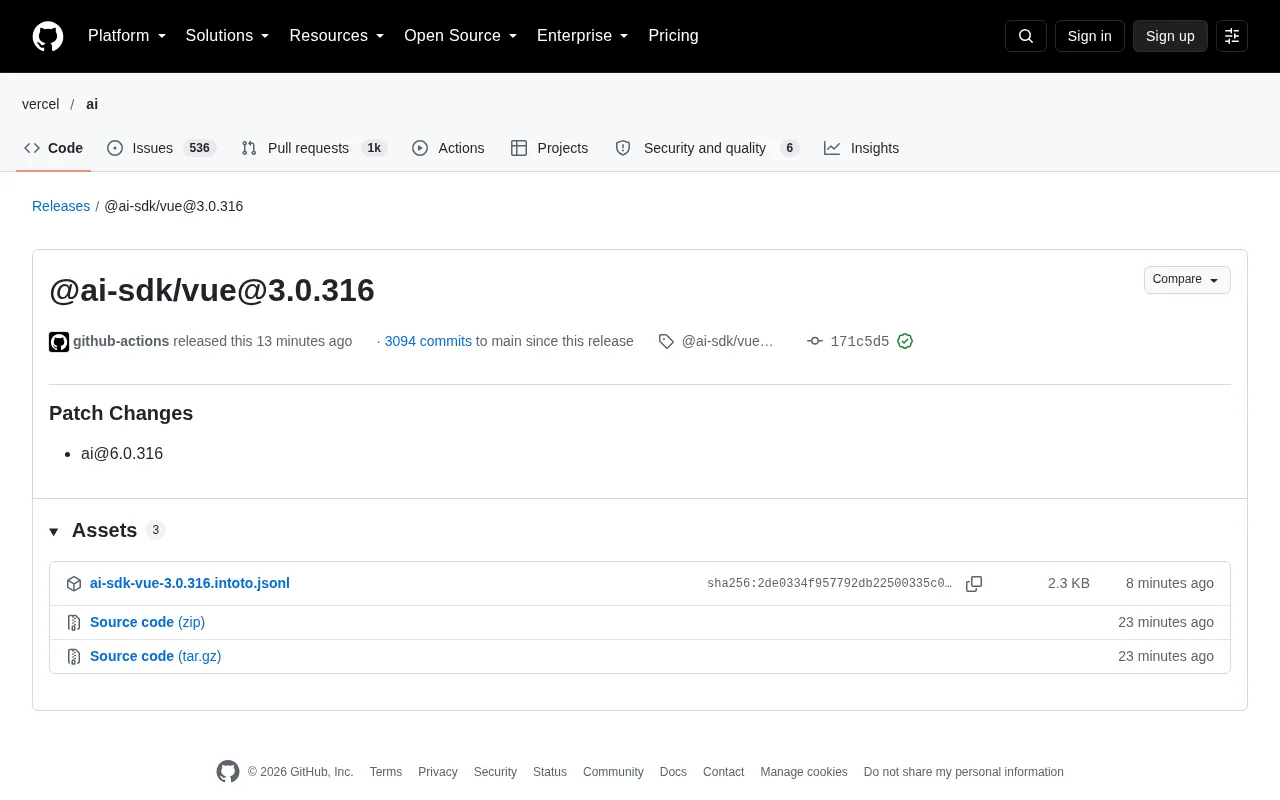
The Vercel AI SDK recently released a minor patch version. According to the GitHub Releases page, version 3.0.316 of @ai-sdk/vue and version 6.0.316 of the core package ai were updated in the same release — a typical patch iteration. For developers building Vue applications with the AI SDK, this is a version change worth noting.
What's in the Release
From the release record, this update was performed automatically by GitHub Actions with GPG signature verification, and the commit was merged directly into the main branch. The release notes explicitly mark Patch Changes and reference the core package ai@6.0.316. This means there is a version linkage between the Vue binding layer and the core SDK, and developers need to watch both packages when upgrading.
Patch versions usually don't involve breaking API changes; they tend to be bug fixes, dependency syncing, or internal implementation adjustments. This release doesn't disclose specific change details, but the synchronized version numbers suggest the core package and the framework binding need to stay consistent.
Why the Vue Binding Needs to Sync with the Core Package
The AI SDK is designed to separate core capabilities from framework adapters. The ai package carries underlying capabilities like model calls, streaming responses, and tool calls, while @ai-sdk/vue provides a wrapper around Vue's Composition API. Keeping the two versions aligned avoids version conflicts during dependency resolution and ensures that the type definitions in the Vue layer stay consistent with the actual interfaces of the core package.
For projects managing dependencies via package.json, this synchronized release means that upgrading only one of the packages may trigger peer dependency warnings or inconsistent runtime behavior. It's recommended to check that the two package versions match when upgrading.
peer dependency is a way for npm packages to declare dependencies that require users to explicitly install a specified version of the package in their own project, rather than having the current package install it automatically. In the AI SDK's case, @ai-sdk/vue declares ai as a peer dependency, ensuring that the Vue binding layer and the core package share the same instance. If the two versions don't match, npm or pnpm may install multiple copies of the ai package, leading to type mismatches, broken reactive state, or even runtime errors. That's why releasing ai@6.0.316 and @ai-sdk/vue@3.0.316 in sync is a common way to maintain the peer dependency constraint.
GPG signature verification is another mechanism mentioned in this release. GitHub Actions uses a GPG private key to sign commits or tags during automated releases, allowing users to verify the authenticity of the release source via the public key and preventing supply chain poisoning. For SDK projects that release frequently, automatic signing reduces the risk of manual errors and makes it easier to audit the source of each release.
Lockfiles such as package-lock.json, pnpm-lock.yaml, or yarn.lock record the exact versions and integrity hashes of the dependency tree. When upgrading a patch, the scope of lockfile changes is a key basis for judging the impact: if only the ai and @ai-sdk/vue packages and their direct dependencies are involved, the risk is usually low; if a large number of transitive dependencies change in the lockfile, further investigation is needed.
Practical Impact on Developers
Patch-level updates generally don't require developers to modify business code. This release is better handled as routine dependency maintenance: update the version in the lockfile and run your existing tests to confirm compatibility. If your project uses automated dependency update tools, this kind of release will be automatically added to the update queue.
It's worth noting that the release page doesn't include migration notes or a changelog summary. In the absence of details, checking the scope of lockfile changes before upgrading and confirming that no unexpected new dependencies are introduced is the prudent approach.
How to Verify the Upgrade Is Safe
You can first perform the dependency update in a development environment and observe whether the build and type checks pass. For Vue projects, focus on checking type inference and reactive behavior of composable functions to ensure that streaming state updates work correctly. Before upgrading in production, it's recommended to keep a rollback path.
Lessons from the Release Cadence
Looking at the commit history, the project maintains a high iteration frequency, with version numbers already into the 6.x and 3.x ranges. The large number of patch releases shows that the maintenance team is continuously following up on issue feedback. For projects that depend on fast-iterating SDKs like this, establishing a version tracking mechanism is more important than one-off upgrades — watching release notes, pinning version ranges, and covering core call paths in CI are all effective ways to reduce upgrade risk.
This @ai-sdk/vue@3.0.316 release offers limited information, but it reflects a stably maintained open source project continuously delivering patches. Developers can treat it as a normal version maintenance signal and handle it through their existing processes.
Related articles

T3 Code: The Open-Source AI Coding Assistant's Comeback Story
T3 Code is an open-source AI coding assistant that unifies subscriptions like Codex and Claude, with powerful remote control and parallel task management.

Never Elected, Yet Ruled New York for 30 Years: The Ultimate Case Study in the Mechanics of Power
Robert Caro's biographies reveal how unelected Robert Moses ruled New York for 30 years through legal drafting and public authorities, and how Lyndon Johnson built leverage as a "powerless" Senate Majority Leader. Unpacking the underlying logic of accumulating and sustaining power.

The CPython 3.10 Recursion Trap and Synthetic Recovery in TokenGuard, an LLM Circuit Breaker
TokenGuard's author recounts a recursion crash caused by OrderedDict.pop in CPython 3.10 and introduces v0.3.0's Loop Nudge synthetic recovery, inline DLP scanning, and other new LLM agent circuit-breaker capabilities.