Vercel AI SDK Releases @ai-sdk/svelte 3.0.270 Patch Update

Vercel AI SDK ships @ai-sdk/svelte@3.0.270 patch to sync dependencies with core package ai@5.0.270.
`@ai-sdk/svelte@3.0.270` is a routine patch update in the Vercel AI SDK ecosystem, released alongside the core package `ai@5.0.270`. Classified as a Patch change, it only involves aligning upstream dependencies with no new features or breaking changes. The AI SDK uses a monorepo architecture where the `ai` core package drives capability, and framework adapters like `@ai-sdk/svelte` must stay in sync to avoid version mismatch issues. Svelte and SvelteKit developers can safely upgrade via their package manager, though validating streaming output and state management in a test environment beforehand is still recommended.
Vercel's AI SDK ecosystem recently shipped @ai-sdk/svelte@3.0.270. This is a dependency-sync patch release published alongside the core package ai@5.0.270, primarily targeting developers building AI applications with the Svelte framework.
What's in This Update
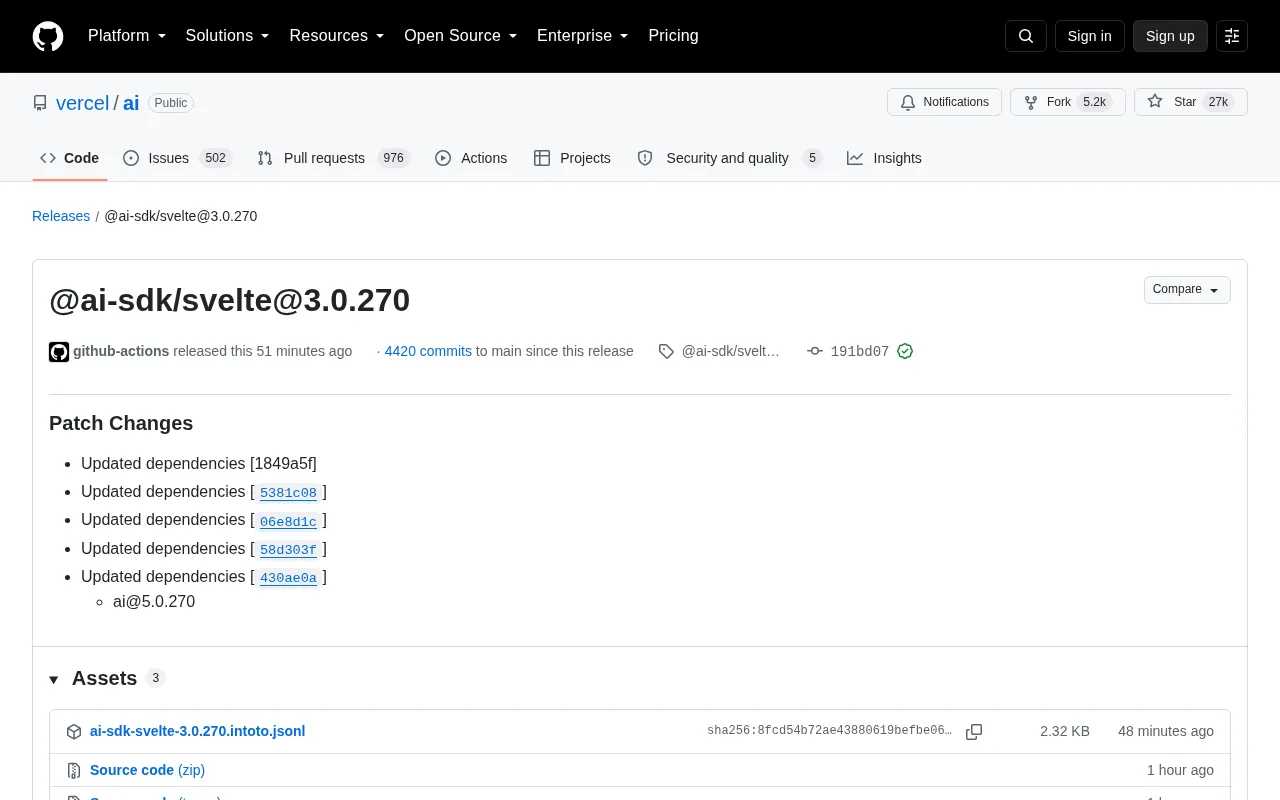
According to the release notes, @ai-sdk/svelte@3.0.270 is classified as a Patch Change — following Semantic Versioning (SemVer) conventions, this means no breaking changes and no significant new features. The focus is purely on fixes and dependency alignment.
The update primarily syncs several upstream dependencies. The release notes list a number of Updated dependencies entries tied to commit hashes including 1849a5f, 5381c08, 06e8d1c, 58d303f, and 430ae0a. These changes ultimately converge in the core package ai@5.0.270, meaning the Svelte adapter layer is now in sync with the AI SDK mainline.
For teams maintaining AI applications day-to-day, this kind of update ensures that framework adapter packages stay aligned with core logic — preventing subtle bugs caused by version mismatches.
Semantic Versioning (SemVer) is a widely adopted software versioning convention with the format
MAJOR.MINOR.PATCH. The core rules are: a PATCH increment represents backward-compatible bug fixes only; a MINOR increment adds backward-compatible new functionality; a MAJOR increment signals breaking changes that require careful migration assessment before upgrading. The270in@ai-sdk/svelte@3.0.270is the patch number, indicating that this release makes no changes to any public API — developers can upgrade directly without modifying business logic. This is precisely why patch updates are generally safe to apply without hesitation: SemVer itself is the source of that confidence.
Why Dependency Syncing Matters
The AI SDK uses a multi-package monorepo architecture, with core capabilities concentrated in the ai package, while @ai-sdk/svelte, @ai-sdk/react, @ai-sdk/vue, and similar packages serve as framework-specific adapter layers.
This design enables capability reuse, but it also means any update to the core package requires the corresponding framework packages to follow suit. @ai-sdk/svelte@3.0.270 is a direct reflection of this mechanism: once ai@5.0.270 was updated, the Svelte adapter immediately shipped a corresponding patch, ensuring Svelte developers have immediate access to the same underlying capabilities as the mainline.
The version numbers also hint at this dynamic — the Svelte adapter is on 3.x, while the ai core package it depends on is already at 5.x. Having different major versions is perfectly normal, as each package maintains its own independent version line. However, the aligned patch number (270) indicates that their release cadences are tightly synchronized.
A monorepo (monolithic repository) is the practice of managing multiple related packages or projects within a single code repository, as opposed to the polyrepo model where each package lives in its own repository. Vercel AI SDK's use of a monorepo means that a fix or optimization to core logic can trigger update pipelines for all framework adapter packages in a single commit, reducing cross-repository coordination overhead. Common monorepo toolchains include Turborepo (Vercel's own product), Nx, and pnpm workspaces. In this kind of architecture, CI/CD pipelines typically auto-detect affected sub-packages and batch-publish patch versions — which is why
@ai-sdk/sveltecan align its version with theaicore package on the same day. It's not manual maintenance; it's an automated release pipeline.
Practical Impact for Developers
If you're using Svelte or SvelteKit to build conversational AI interfaces, streaming responses, or tool calling functionality, it's recommended to upgrade to the latest patch version. Patch updates are generally low-risk and safe to apply.
Upgrading is straightforward with any common package manager:
npm install @ai-sdk/svelte@latest
# or
pnpm add @ai-sdk/svelte@latest
One thing to keep in mind: since this update carries dependency changes in the core ai package, it's worth validating your streaming output and state management logic in a test environment before deploying to production, just to confirm there are no regressions.
Summary
@ai-sdk/svelte@3.0.270 is an unassuming patch update, but it reflects the Vercel AI SDK team's high-frequency, consistent release cadence. For projects that depend on this SDK, keeping framework adapter packages in sync with the core package is a fundamental practice for long-term application stability.
Since the official release notes only list dependency update entries without detailed descriptions of each change, developers who want to understand the specifics of what changed in ai@5.0.270 should consult the full changelog for that core package.
Related articles

Anthropic IPO Explained: Fuel for the AI Boom or the Spark for a Bubble?
Anthropic files for an IPO under ticker ANT. Breaking down the prospectus: 80% of revenue from usage-based pricing, $72B of an $80.7B net loss being non-cash charges, 900% net revenue retention, and how past IPOs like SpaceX performed on day one and over three years — answering the AI bubble question.

Will AI Kill the Research Paper? Mathematicians Offer a New Answer
Mathematicians on the Lex Fridman podcast discuss whether AI will kill research papers—from journal review pressure to Lean formal verification, GitHub open source fatigue to Mathlib's crowdsourcing model, exploring the evolution of academic contributions and the future of mathematical knowledge verification.

Enterprise LLM Development: From RAG to Multi-Agent in Practice
A course breakdown of enterprise LLM application development: from prompt engineering and RAG to multi-agent engineering practice and FDE project delivery, helping developers understand why Agent technology is a key focus for enterprise deployment and learn systematically to avoid detours.