Vercel AI SDK Releases @ai-sdk/svelte Version Update

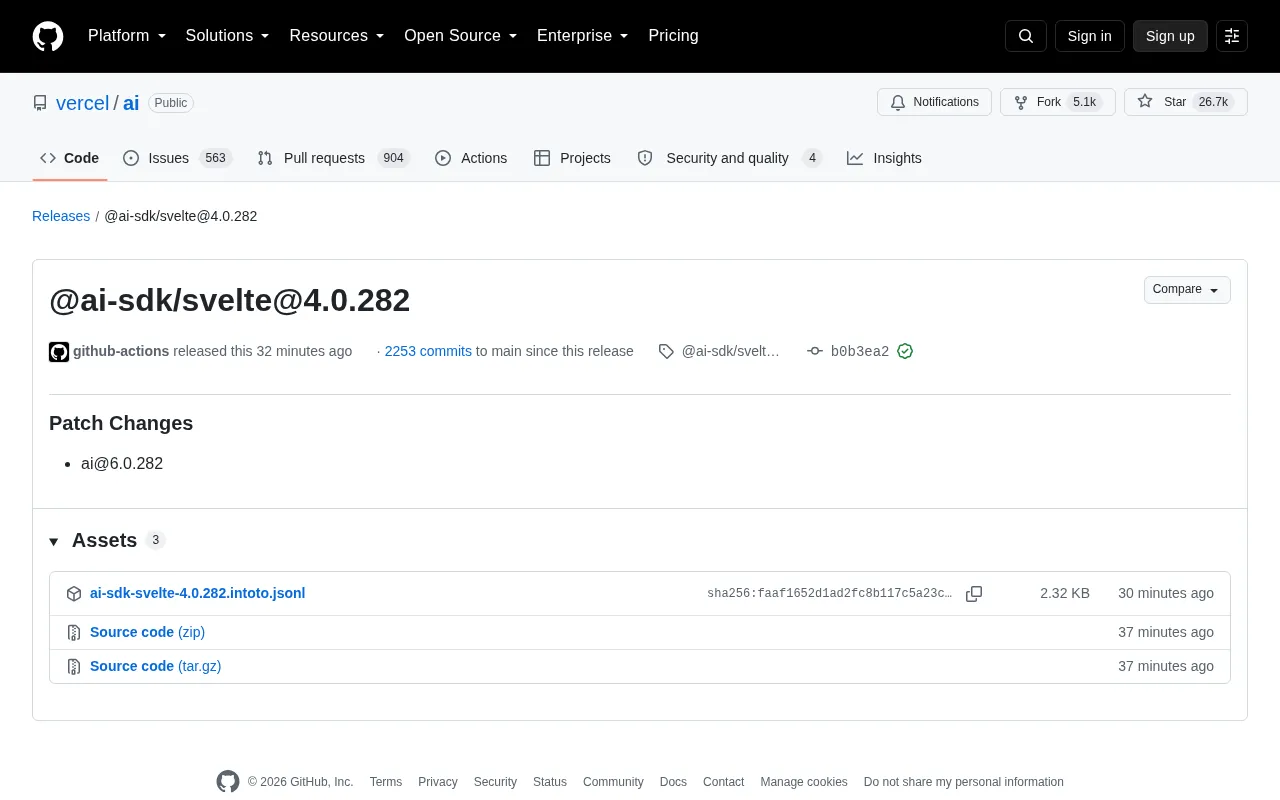
Vercel AI SDK releases @ai-sdk/svelte@4.0.282 patch to sync with core package ai@6.0.282.
@ai-sdk/svelte@4.0.282 is a routine maintenance patch release for Vercel AI SDK, primarily syncing the Svelte adapter's internal dependency to the core package ai@6.0.282 with no breaking API changes. As the official UI binding layer for Svelte/SvelteKit, it enables developers to access OpenAI, Anthropic, and other major LLM providers through a unified interface with idiomatic Svelte-style streaming and state management. Following Vercel AI SDK's monorepo release cadence, developers should review the core package changelog before upgrading.
Vercel's AI SDK project has released a patch update for @ai-sdk/svelte@4.0.282. This is a minor dependency-sync release, with the primary change being an upgrade to follow the core package ai@6.0.282.
Due to the limited information available in the source material, this article provides an objective overview of the published release information and a brief introduction to AI SDK's role in the Svelte ecosystem.
Release Overview
According to the GitHub Release information in Vercel's ai repository, @ai-sdk/svelte@4.0.282 is classified as a Patch Change, with the core update being a sync of the internal dependency to ai@6.0.282. This type of update typically does not involve breaking API changes — it fixes issues and maintains version consistency with the core library, making it a routine maintenance release.
The release was automated via GitHub Actions and carries GitHub's verified signature (GPG key ID: B5690EEEBB952194), with a commit hash of b0b3ea2. The Vercel ai repository has accumulated over 26,000 stars and 5,100 forks, making it one of the most widely followed AI application development frameworks today.
What Is @ai-sdk/svelte
@ai-sdk/svelte is the official adapter package that Vercel AI SDK provides for the Svelte framework. Vercel AI SDK is a TypeScript toolkit for building AI-powered applications. It abstracts away the differences between various large model providers (such as OpenAI, Anthropic, Google, etc.), allowing developers to access text generation, streaming responses, tool calling, and other capabilities through a unified interface.
For different frontend frameworks, the AI SDK provides corresponding UI binding packages. @ai-sdk/svelte is one of them, parallel to the React and Vue versions. It helps Svelte/SvelteKit developers more easily implement chat interfaces, streaming output, and other interactive scenarios — without having to manually handle low-level stream parsing and state management.
Svelte is a frontend framework known as a "compile-time framework." Unlike React and Vue, which manipulate a virtual DOM at runtime, Svelte compiles components into efficient native JavaScript at build time, reducing runtime overhead. SvelteKit is a full-stack application framework built on Svelte, offering routing, server-side rendering (SSR), and API routes — functionally comparable to Next.js for React. @ai-sdk/svelte is designed specifically for this ecosystem. It wraps streaming data state using Svelte's reactive store mechanism, allowing developers to subscribe to AI response streams using idiomatic Svelte syntax (such as $store) without manually managing ReadableStream reads or UI update logic.
What Patch Updates Mean for Developers
For projects currently using this package, the semantic meaning of a patch version is "backward-compatible fixes." Since the primary content of this update is syncing the core ai@6.0.282, developers are advised to review the core package's full changelog before upgrading, to confirm whether any fixes affect their specific usage.
Keeping dependency versions in sync is a common practice in monorepo projects like this one. Vercel AI SDK follows a unified versioning cadence, where framework adapter packages frequently release patches alongside the core library to ensure feature consistency and timely bug fixes. For production projects, gradually tracking these patches generally helps improve stability.
Monorepo (monolithic repository) refers to a project organization approach where multiple related packages are managed together in a single Git repository. Vercel AI SDK uses this structure — the core package
aiand the various framework adapters (@ai-sdk/react,@ai-sdk/svelte,@ai-sdk/vue, etc.) share the same repository, coordinated through tools like Turborepo or pnpm workspaces. In this setup, when the core package releases a new version, adapter packages often follow with a version-aligned patch release, even if the adapter layer's own code hasn't changed. When reviewing the actual contents of such patches, developers should prioritize the core package's changelog, since adapter package patch notes typically only mention "dependency upgrade" — the real change details are recorded upstream in the core package.
Summary
This @ai-sdk/svelte@4.0.282 release is a routine dependency-sync patch with no significant functional changes. For AI application developers in the Svelte ecosystem, you can evaluate whether to upgrade by reviewing the changelog for the core package ai@6.0.282. For more details, it's recommended to consult the Release page and Changelog in Vercel's official GitHub repository.
Related articles

world2vec: Building Mechanistic World Models with Latent Dynamics Learning
world2vec proposes a reward-free method for learning mechanistic world models via latent dynamics, faithfully reproducing systems over long horizons with at least an order of magnitude fewer parameters than DreamerV3, TD-MPC2, and LeWM, and achieving accurate system identification on 71 attractor benchmarks.

A New KL-DRO Paradigm: Adaptive Scenario Generation Around a Learned Density Model
KL-DRO research proposes centering the KL ball on a learned density model instead of the empirical distribution, with adaptive scenario generation guiding sampling toward the worst case. Experiments show lower cost under distribution shift when records are scarce and the model can extrapolate, with comparable in-distribution cost.

ODE Samplers for Discrete Diffusion Models: Exponential Residual Flows Accelerate Generation
Discrete diffusion models lack deterministic ODE sampling? This article introduces Exponential Residual Flows (ERFs), which introduce continuous residual variables per token to construct piecewise ODEs for deterministic sampling and support consistency distillation acceleration. Superior to prior methods on code and text generation tasks.