Vercel AI SDK Releases @ai-sdk/xai 2.0.99 Patch Update

Vercel AI SDK releases @ai-sdk/xai 2.0.99 patch update — a routine dependency sync with no breaking changes.
`@ai-sdk/xai@2.0.99` is a patch-level maintenance update that syncs underlying dependencies `provider-utils@3.0.41` and `openai-compatible@1.0.58`, introducing no breaking changes. Since xAI's Grok API is designed to be compatible with OpenAI's interface format, the xai provider is heavily dependent on the openai-compatible layer, meaning any change there triggers a cascading xai release. Vercel AI SDK's monorepo architecture ensures ecosystem-wide version consistency through this high-frequency, coupled release cadence. For developers using xAI models, this update carries minimal risk and is a straightforward upgrade.
The xAI provider package for Vercel AI SDK (@ai-sdk/xai) has released version 2.0.99. This is a patch-level update focused on syncing internal dependencies, with no breaking changes introduced.
Update Overview
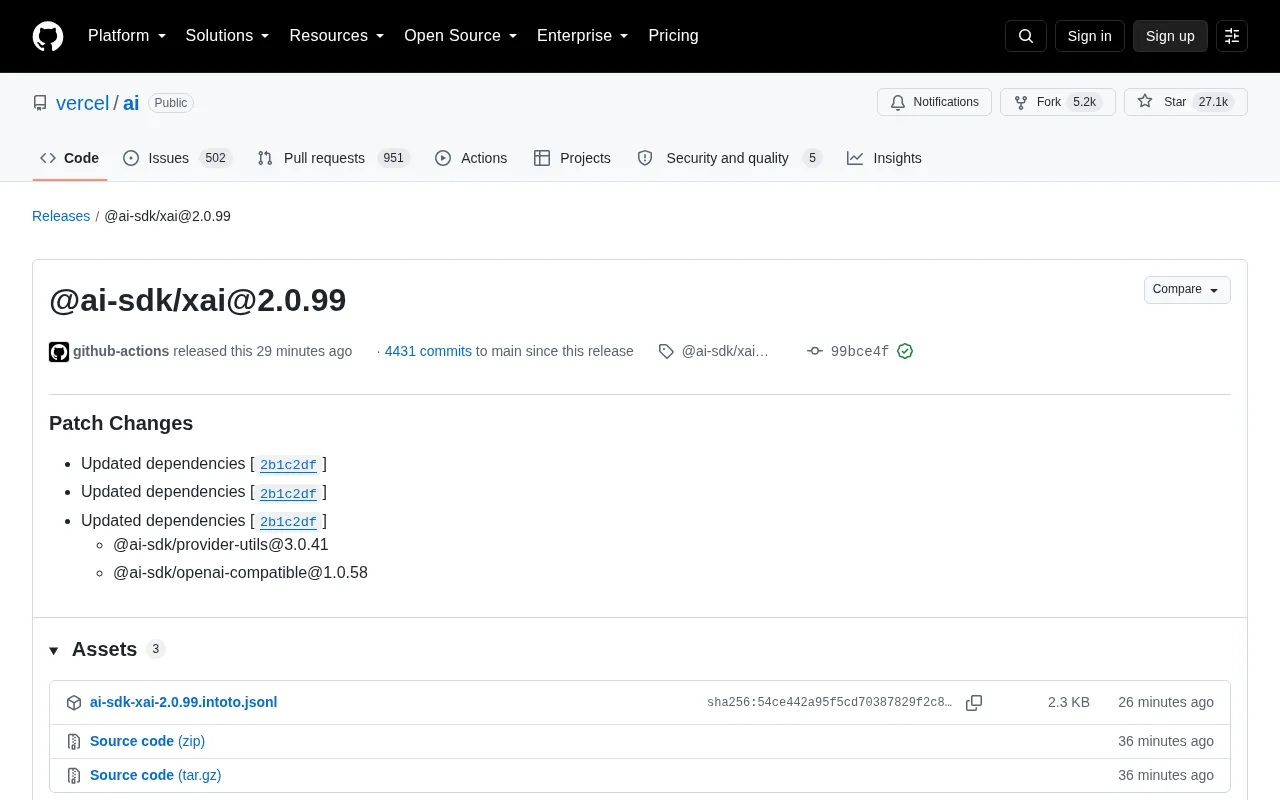
According to the release notes in Vercel's official GitHub repository, the core changes in @ai-sdk/xai@2.0.99 are centered around dependency updates. This release syncs the following associated packages:
@ai-sdk/provider-utils@3.0.41@ai-sdk/openai-compatible@1.0.58
Updates to these underlying dependencies typically address compatibility issues, optimize tool-calling behavior, or standardize interface contracts. For developers using xAI (Grok series models) as their backend, upgrading to this version ensures alignment with other modules in the AI SDK ecosystem.
What a Patch Update Means
Under Semantic Versioning (SemVer), the increment from 2.0.98 to 2.0.99 represents a patch bump — a backwards-compatible bug fix, not a new feature or architectural change. The risk of upgrading such versions in production environments is relatively low.
One detail worth noting is the synchronized update to @ai-sdk/openai-compatible. xAI's Grok API is designed to be compatible with OpenAI's interface format, meaning the xai provider package is heavily dependent on this compatibility layer. This explains why any change to that dependency triggers a cascading release of the xai package.
About Semantic Versioning (SemVer): SemVer defines version numbers in a three-part
MAJOR.MINOR.PATCHstructure. A major version bump indicates breaking changes, a minor bump indicates new backwards-compatible features, and a patch bump indicates backwards-compatible bug fixes only. Vercel AI SDK follows this convention for package releases, allowing developers to quickly assess upgrade risk based on version type — patch updates are generally safe to apply, while major version updates require careful review of migration guides. In a monorepo architecture, a patch update to a shared base package (such asprovider-utils) often triggers synchronized releases of all dependent packages, even if those packages have no code changes themselves. This is a common engineering practice to maintain version consistency across the entire ecosystem.
Recommendations for Developers
If you're integrating xAI models via the Vercel AI SDK, here are a few things to keep in mind:
Do You Need to Upgrade Immediately?
As a patch update, this is not a must-upgrade unless you're experiencing specific issues related to the updated dependencies. That said, keeping your dependencies reasonably up to date helps avoid compatibility friction when performing larger cumulative upgrades later.
Watch for Ecosystem Coupling
The AI SDK uses a monorepo structure, which means provider-utils, openai-compatible, and the various provider packages (such as xai, openai, anthropic) are tightly coupled. When upgrading any single package, it's a good idea to also verify that related dependency versions are properly aligned.
About Monorepo: A monorepo (monolithic repository) is an engineering pattern where multiple related packages are maintained within a single codebase. Vercel AI SDK uses this structure to centrally manage
provider-utils,openai-compatible, and over a dozen provider packages includingxai,openai, andanthropic, leveraging tools like Turborepo or pnpm workspaces for dependency tracking and batch publishing. The key advantage is that changes to shared interfaces can be immediately propagated to all dependent packages, preventing version fragmentation. The trade-off is that even if a provider package likexaihas no substantive code changes in a given cycle, it still needs to publish a new version whenever its underlying dependencies release a new version — this keeps the npm dependency graph accurate.
Summary
@ai-sdk/xai@2.0.99 is a routine dependency sync and maintenance update, reflecting Vercel AI SDK's high-frequency iteration and continuous maintenance engineering cadence. The project has garnered over 27,000 stars and 5,200 forks on GitHub, making it one of the most widely adopted AI application development frameworks in the TypeScript/JavaScript ecosystem. For projects relying on xAI models, staying current with these maintenance releases is a good practice for maintaining stability.
Related articles

Data Scraping, AI Proofs, and Open Source Contracts: This Week's Deep Dive into the Tech World
From the 3D model crawler controversy and OpenAI's Lean formal proofs to AI agents challenging Brooks' Law and Debian rejecting LLM review, this week's tech discussions center on openness and verifiability.

Build a Reasoning Model from Scratch: An 11-Hour Open-Source Course Breakdown
Sebastian Raschka releases a free 8-episode, ~11-hour video course teaching you to build a reasoning model from scratch with Python and PyTorch—from a small Qwen3 model through Verifier, Inference Time Scaling, GRPO, and distillation, with open-source code on GitHub.

An 11-Hour Reasoning Model Course in Practice: How Small Models Learn to Think
Starting from Sebastian Raschka's 11-hour reasoning model course and HN buzz, this analyzes small-model training, legal text version control, Anthropic data policy, and product reliability reviews.