Vercel AI SDK Releases harness-grok-build 1.0.70: What the Dependency Update Means

Vercel AI SDK ships harness-grok-build 1.0.70 patch with automated dependency sync and coordinated updates to two related packages.
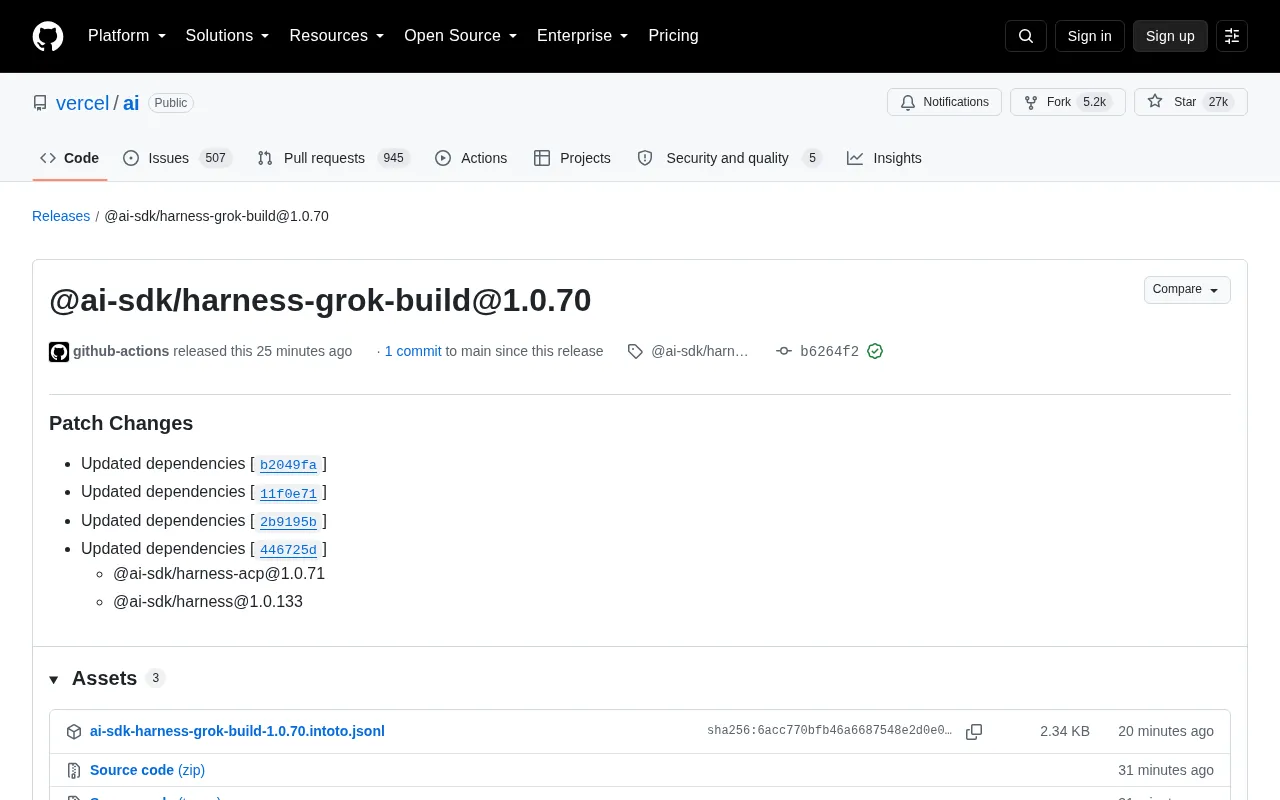
Vercel AI SDK has released `@ai-sdk/harness-grok-build@1.0.70`, a patch update focused on internal dependency synchronization with no breaking changes. Due to the monorepo's cascading release mechanism, `@ai-sdk/harness-acp@1.0.71` and `@ai-sdk/harness@1.0.133` were published alongside it. The entire release was automated via GitHub Actions and signed with GPG verification. For teams using Vercel AI SDK to integrate models like Grok, these frequent patch releases are a routine part of keeping the SDK's dependency tree healthy.
Vercel's official AI SDK repository recently published @ai-sdk/harness-grok-build@1.0.70. This is a patch release focused primarily on dependency updates — a small change, but one that reflects the steady iteration pace of the Vercel AI SDK ecosystem.
Release Overview
This is a Patch-level update centered on internal dependency synchronization. According to the GitHub Release page, the version incorporates changes from several upstream commits, including b2049fa, 11f0e71, 2b9195b, and 446725d.
Two related packages were also updated alongside this release: @ai-sdk/harness-acp@1.0.71 and @ai-sdk/harness@1.0.133. This kind of cascading version bump is typical of monorepo projects — a change in a lower-level package triggers coordinated releases across multiple dependent packages.
The release was committed to the main branch at 09:47 by GitHub Actions automation, signed with a verified GPG key (key ID: B5690EEEBB952194), ensuring the integrity and trustworthiness of the published artifacts.
A monorepo (monolithic repository) is an engineering practice where multiple related projects or packages are managed together in a single Git repository — widely adopted by Google, Meta, and many large open-source projects. Vercel AI SDK uses a monorepo structure, managing the build, testing, and release pipelines for dozens of sub-packages through tools like Turborepo or pnpm workspaces. When a shared lower-level package (such as @ai-sdk/core) is updated, all packages that depend on it need to publish new versions to maintain internal consistency. This is exactly why harness-grok-build, harness-acp, and harness were all updated together in this release.
What Is harness-grok-build
Based on the name, harness-grok-build is a build package within the Vercel AI SDK related to the harness (test/runtime framework) and Grok model integration. It is one of many sub-packages under the Vercel AI project, serving developers who need to integrate various large language models into their applications.
Vercel AI SDK is one of the most widely used AI integration libraries in the frontend and full-stack development space. Its GitHub repository has accumulated over 27k stars and 5.2k forks, reflecting a vibrant community. Through a unified API abstraction layer, it helps developers work across different model providers — such as OpenAI, Anthropic, and xAI Grok — without dealing with their individual interface differences, significantly reducing the complexity of multi-model integration.
Grok is a large language model developed by Elon Musk's xAI, notable for its access to real-time data from X (formerly Twitter). It sits alongside OpenAI's GPT series and Anthropic's Claude as a major commercial LLM. Vercel AI SDK provides native support for Grok through a unified Provider interface, allowing developers to switch between models simply by changing their provider configuration — no need to rewrite business logic. In software engineering, "harness" typically refers to a test harness or runtime framework. The harness family of packages in this SDK handles model integration testing and runtime environment encapsulation, with harness-grok-build specifically responsible for the build and packaging steps of Grok model integration.
The Significance of a Patch Release
For projects following Semantic Versioning (SemVer), a PATCH increment like 1.0.70 typically signals backward-compatible fixes or dependency synchronization — no breaking changes are introduced. Developers generally don't need to modify existing code when upgrading.
What's worth noting here is the ripple effect: a single release simultaneously bumped harness-grok-build, harness-acp, and harness. This kind of high-frequency, automated patch release is a standard practice for large open-source SDKs to keep dependencies healthy and address upstream issues promptly. For teams using this SDK, keeping dependencies reasonably up to date helps avoid potential compatibility and security risks.
Semantic Versioning (SemVer) is the widely adopted standard for naming software package versions, using the format MAJOR.MINOR.PATCH. A MAJOR bump indicates breaking API changes; a MINOR bump means new backward-compatible features have been added; a PATCH bump covers only backward-compatible bug fixes or internal dependency updates. Following SemVer lets developers quickly assess upgrade risk from the version number alone. Combined with npm's ^ (compatible with minor versions) or ~ (compatible with patch versions) range specifiers, it enables safe, automatic dependency upgrades.
Recommendations for Developers
If your project uses Vercel AI SDK's harness family of packages, check the specific dependency change commits listed in the GitHub Release to determine whether they affect any features you rely on. Since this is a pure patch update, the risk is low — validate in a test environment first, then upgrade with confidence.
For AI application developers more broadly, keeping an eye on Vercel AI SDK's release cadence is a good way to stay ahead of emerging model support updates — including for Grok and other newer models — helping you make better-informed technology decisions.
Related articles

Type-Safe Keep Rules in R8 and DEX Optimization in Practice
Google Play requires over 25% DEX optimization. This article explains the R8 configuration analyzer, Jetpack Keep type-safe annotations, and the Android CLI validation tool to help Android developers narrow keep rules, improve shrinking/optimization/obfuscation, and reduce ANRs.

Why Are Old Buildings More Beautiful Than New Ones? Pulitzer Prize-Winning Author Reveals an Overlooked Economic Truth
Pulitzer Prize-winning author Robert Caro found that poorer countries built more beautiful buildings. He reveals how cheap skilled craftsmen created the intricate details of old New York architecture, and how rising labor costs changed architectural aesthetics.

The Truth About AI Coding: Code Output Soars, So Why Is Delivery Still Hard to Speed Up?
Engineering leaders from Databricks, Uber, and Google Maps discuss AI coding's real impact: code output soars but delivery bottlenecks shift, code review faces rethinking, and enterprises begin fine-grained token governance.