Vercel AI SDK Releases sandbox-just-bash 1.0.119 Patch Update
Vercel AI SDK releases a routine patch for its bash sandbox sub-package, syncing internal dependencies.
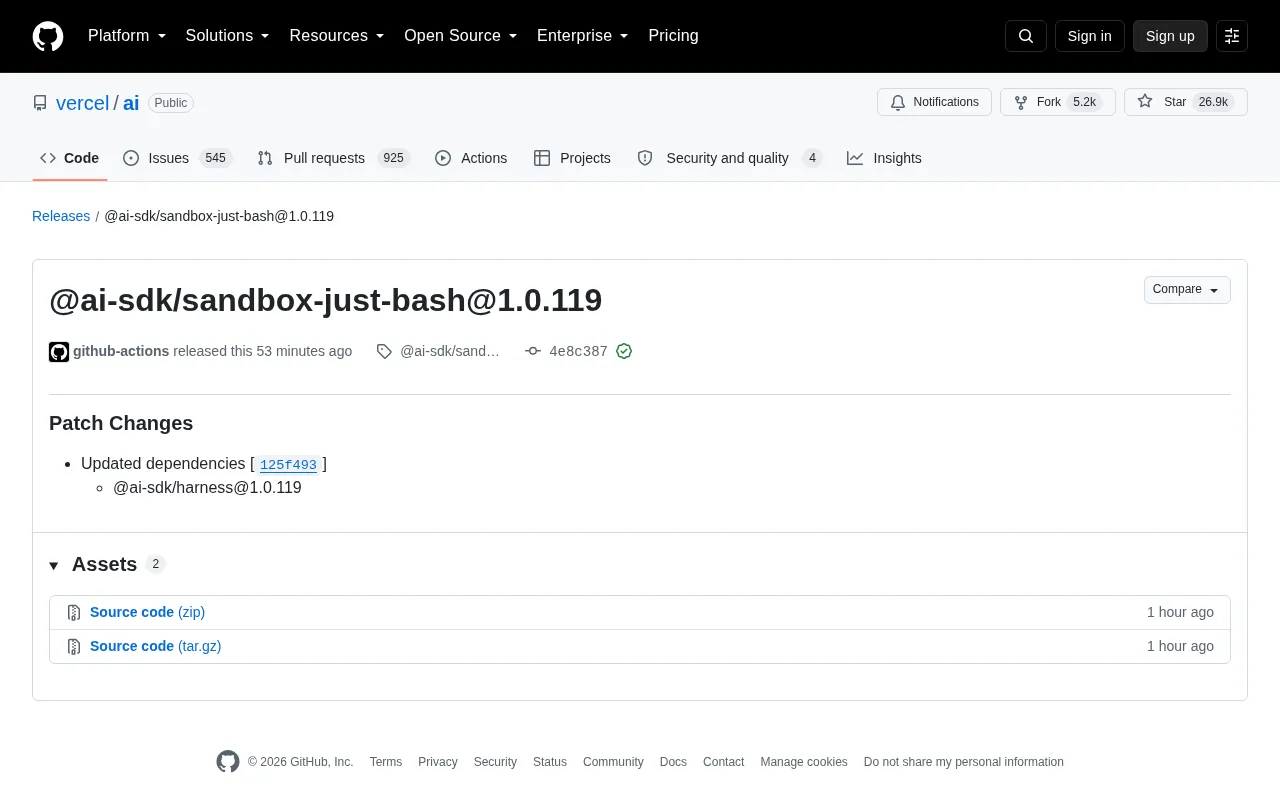
Vercel's open-source AI SDK has released `@ai-sdk/sandbox-just-bash@1.0.119`, a patch update focused solely on syncing the internal `@ai-sdk/harness@1.0.119` dependency with no new features or breaking changes. The package provides a lightweight bash sandbox for AI Agent code execution scenarios and is tightly coupled with the harness framework layer. The release was automatically triggered by GitHub Actions with an official verified signature, reflecting a mature engineering pipeline with automated publishing, supply chain security, and synchronized sub-package versioning. This is a routine maintenance release, and developers can safely upgrade.
Vercel's popular open-source project ai (approximately 26.9k GitHub stars and 5.2k forks) has recently released @ai-sdk/sandbox-just-bash@1.0.119. This is a patch-level release focused primarily on a dependency update — a small change, but one that reflects the AI SDK ecosystem's consistently high-frequency iteration cadence.
What's in This Update
According to the GitHub Release page, this version was published via github-actions automation with commit hash 4e8c387, and carries a verified GitHub signature (Verified, GPG key ID: B5690EEEBB952194).
This release falls under Patch Changes, with the core update being a synchronized internal dependency bump:
- Updated dependency
@ai-sdk/harness@1.0.119(associated commit125f493)
From a Semantic Versioning (SemVer) perspective, patch releases typically contain only backward-compatible bug fixes or dependency syncs — no new features or breaking changes. For developers already using this package, the upgrade risk is minimal.
Semantic Versioning (SemVer) is the most widely adopted version numbering convention in the open-source ecosystem, using the format MAJOR.MINOR.PATCH. A Patch increment indicates only backward-compatible bug fixes or internal dependency syncs, with no new public APIs introduced. A Minor increment signals new backward-compatible functionality, while a Major increment denotes breaking changes that may render existing code incompatible. The patch number reaching 119 in 1.0.119 indicates the package has gone through a large number of small iterations since its stable release — a testament to the Vercel AI SDK team's high-frequency maintenance cadence. For dependency management tools (such as npm's ^ prefix rule), patch version updates are typically applied automatically, requiring no manual intervention from users.
What Is sandbox-just-bash
@ai-sdk/sandbox-just-bash is a sub-package within the Vercel AI SDK ecosystem. As the name implies, it targets AI Agent or code execution scenarios, providing a "bash-only" sandboxed execution environment.
As AI applications increasingly involve code generation and automated execution, safely running model-generated commands in a controlled, isolated environment has become a critical engineering challenge. Sandbox solutions are designed precisely to address this — they constrain the execution scope, isolate system resources, and reduce the risk posed by malicious or erroneous commands. The just-bash naming suggests a lightweight, minimal sandbox implementation focused specifically on shell command execution.
The fact that this package maintains version parity with @ai-sdk/harness indicates the two are tightly coupled in their release process and are components of the same toolchain.
@ai-sdk/harness serves as the testing and execution framework layer within the Vercel AI SDK toolchain, responsible for providing a unified interface abstraction and runtime scheduling capability for various sandbox implementations. The term "harness" originates from software testing, referring to the infrastructure that connects components under test to a standardized testing or execution pipeline. In AI Agent scenarios, the harness layer typically handles task dispatching, context injection, and output capture, while specific execution environments (such as sandbox-just-bash) serve as pluggable backend implementations. This layered design allows developers to swap or extend the underlying execution engine without modifying upper-layer logic — paving the way for future implementations like sandbox-docker or sandbox-wasm with higher isolation levels.
Observations on the Iteration Cadence
The version number 1.0.119 reveals that Vercel AI SDK follows a very dense release strategy. This update was pushed in the early hours of September 22nd, triggered by a CI/CD automation pipeline — a sign of a mature engineering management system:
- Automated releases: Version publishing is managed uniformly via
github-actions, minimizing manual intervention. - Signature verification: Every release includes a GitHub-verified signature, ensuring supply chain security.
- Dependency synchronization: Sub-package versions are kept in sync, maintaining ecosystem consistency.
This high-frequency, automated, and verifiable release model is the standard practice for leading open-source infrastructure projects today, and it provides users with a higher degree of reliability.
What This Means for Developers
For developers building AI Agents, code execution tools, or automated workflows on top of Vercel AI SDK, keeping up with patch updates helps ensure access to the latest dependency fixes and security improvements. Since this is a patch release, developers can upgrade with confidence while also noting the synchronized update to @ai-sdk/harness.
It's worth noting that the official release notes are fairly brief, only indicating a dependency update without disclosing specific fix details. Developers interested in the exact changes can refer to the associated commit 125f493 for a detailed change log.
Overall, this is a typical routine maintenance release. While it carries limited informational value on its own, it serves as a useful snapshot for observing the vitality of the AI SDK ecosystem and the engineering standards behind it.
Related articles
Salesforce Acquires Rune for $375M: AI Logistics Tech Bolsters Defense Business
Salesforce reportedly acquires defense tech startup Rune for $375M. Rune's AI logistics tech will strengthen Salesforce's Missionforce defense platform, continuing its M&A spree.

Why Fair Use Benefits Everyone in the AI Era
Starting from a Hacker News discussion, this article analyzes the legal logic and controversies of the fair use principle in AI training and content creation, and its dual impact on creators and the tech ecosystem.

Mistral Large 4 Open-Sources a Trillion Parameters, Microsoft Offers Voluntary Severance to 60,000 Employees
Mistral Large 4 open-sources a trillion-parameter multimodal model with a coding agent score of 48; SanDisk earnings show AI inference reshaping NAND demand; Google Gemini adds in-app file editing, OpenAI raises Codex quotas, and Microsoft offers voluntary severance to 60,000 employees.