Vercel AI SDK Releases workflow-harness 1.0.109 Patch Update

Vercel AI SDK ships a workflow-harness patch update, syncing its core dependency and maintaining its rapid release cadence.
Vercel AI SDK has released `@ai-sdk/workflow-harness@1.0.109`, a patch-level update focused on aligning the underlying `@ai-sdk/harness@1.0.109` dependency with no breaking changes. The release was automatically triggered via GitHub Actions and verified with a GPG signature, reflecting standard open-source delivery practices. Despite the modest scope, the project's ~26.7k GitHub stars and high-frequency versioning highlight its continuous delivery philosophy and active maintenance. Teams building Agents, RAG pipelines, or multi-step workflows on this SDK should treat such patch updates as both a source of potential bug fixes and a useful signal of dependency health.
A Routine Patch and What It Says About the Vercel AI SDK Ecosystem
Vercel's AI SDK project recently released @ai-sdk/workflow-harness@1.0.109. Based on the release notes, this is a patch-level update whose primary change is syncing with the @ai-sdk/harness@1.0.109 dependency. The release was automated via GitHub Actions and verified with an official GitHub GPG signature (Key ID: B5690EEEBB952194) — a hallmark of a mature, automated release pipeline.
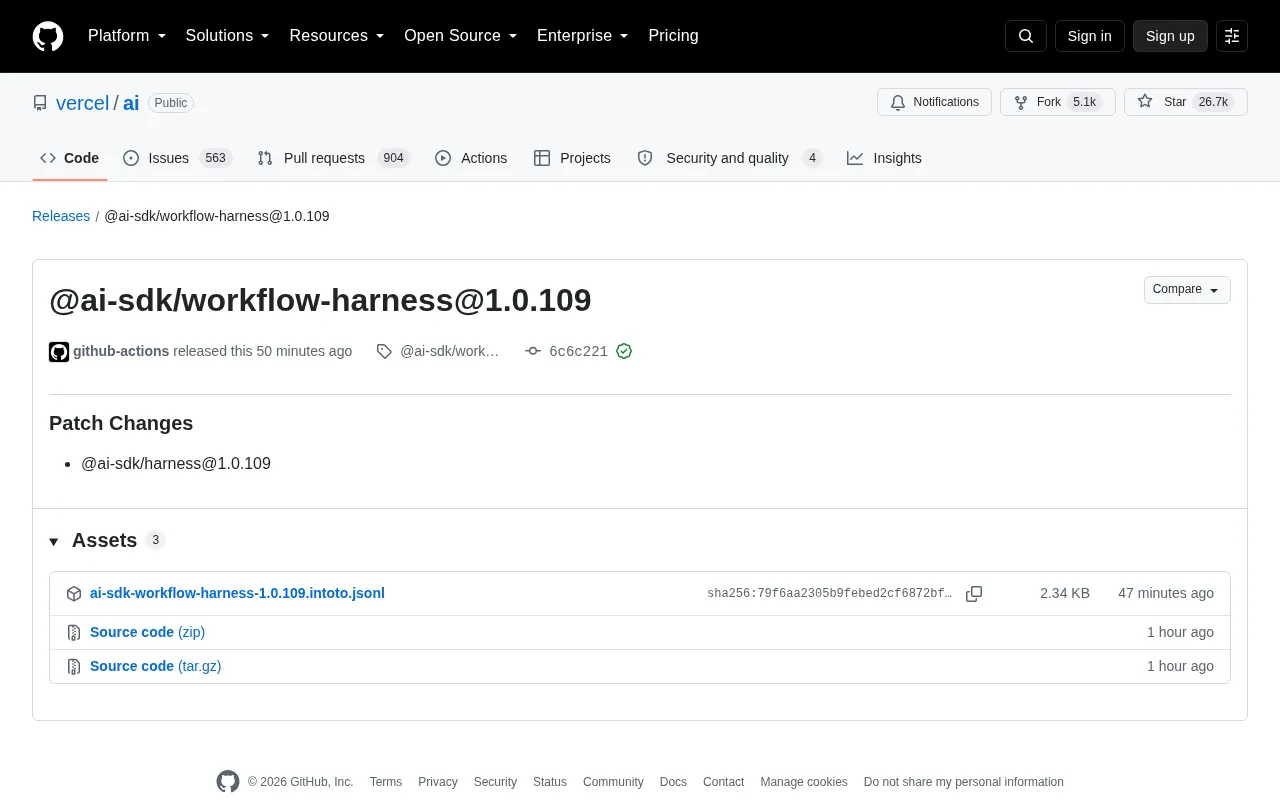
What's worth noting isn't just the version number itself, but the project it belongs to. The Vercel AI repository has accumulated roughly 26.7k stars and 5.1k forks on GitHub, making it one of the most closely watched AI development toolkits in the JavaScript/TypeScript ecosystem. This kind of high-frequency, small-increment versioning reflects a project that is actively maintained and rapidly evolving.
What Is workflow-harness?
workflow-harness is a sub-package within the Vercel AI SDK family. As the name suggests, it relates to the execution and testing environment (a "harness") for AI workflows. In modern AI application development, developers often need to orchestrate multi-step model calls, tool invocations, and state transitions. Harness-style tools provide a unified runtime, debugging, and validation layer for these complex pipelines.
The core change in version 1.0.109 is tagged as a Patch Change — a same-version bump of the @ai-sdk/harness dependency. Patch versions typically mean bug fixes, internal dependency alignment, or minor optimizations, with no breaking changes introduced. For developers currently using this package, updates like this are generally safe to adopt with minimal upgrade risk.
Why High-Frequency Minor Versions Are Worth Watching
From an engineering perspective, a project like Vercel AI SDK pushing its version to 1.0.109 reflects a "continuous delivery" development philosophy. Each small patch may fix a subtle edge-case bug or keep sub-package versions in sync. This strict version alignment — workflow-harness and harness sharing the same version number — also reduces the likelihood of compatibility conflicts in dependency trees.
For teams building Agents, workflows, or RAG applications on top of the AI SDK, staying on top of these releases provides two practical benefits: first, you get potential bug fixes as soon as they land; second, the release cadence itself signals the project's activity level and maintenance quality. An open-source project shipping releases weekly or even daily typically reflects a stable, dedicated team behind it.
How to Upgrade
Developers using the Vercel AI SDK can upgrade to the latest patch version directly via their package manager:
npm install @ai-sdk/workflow-harness@1.0.109
# or
pnpm add @ai-sdk/workflow-harness@1.0.109
It's recommended to review the full Changelog in the repository before upgrading to confirm the scope of changes. Since this is a patch-level update, most projects can migrate smoothly without modifying existing code. Also, given that workflow-harness depends on harness, it's advisable to align related sub-packages to the same version to avoid version mismatches in the dependency tree.
Summary
Taken in isolation, @ai-sdk/workflow-harness@1.0.109 is an unremarkable patch release. But it reflects the high-quality, high-frequency maintenance cadence of the Vercel AI SDK project. For developers relying on this ecosystem, understanding the nature of version updates (patch vs. minor vs. major) and building a habit of staying current is fundamental to keeping AI applications stable. Since the official release notes are minimal, the full commit history and Changelog remain the best reference for specific fix details.
Related articles

world2vec: Building Mechanistic World Models with Latent Dynamics Learning
world2vec proposes a reward-free method for learning mechanistic world models via latent dynamics, faithfully reproducing systems over long horizons with at least an order of magnitude fewer parameters than DreamerV3, TD-MPC2, and LeWM, and achieving accurate system identification on 71 attractor benchmarks.

A New KL-DRO Paradigm: Adaptive Scenario Generation Around a Learned Density Model
KL-DRO research proposes centering the KL ball on a learned density model instead of the empirical distribution, with adaptive scenario generation guiding sampling toward the worst case. Experiments show lower cost under distribution shift when records are scarce and the model can extrapolate, with comparable in-distribution cost.

ODE Samplers for Discrete Diffusion Models: Exponential Residual Flows Accelerate Generation
Discrete diffusion models lack deterministic ODE sampling? This article introduces Exponential Residual Flows (ERFs), which introduce continuous residual variables per token to construct piecewise ODEs for deterministic sampling and support consistency distillation acceleration. Superior to prior methods on code and text generation tasks.