Vercel AI SDK Releases workflow-harness 1.0.137 Patch Update

Vercel AI SDK releases workflow-harness 1.0.137 patch to sync the underlying harness dependency — a routine, low-risk update.
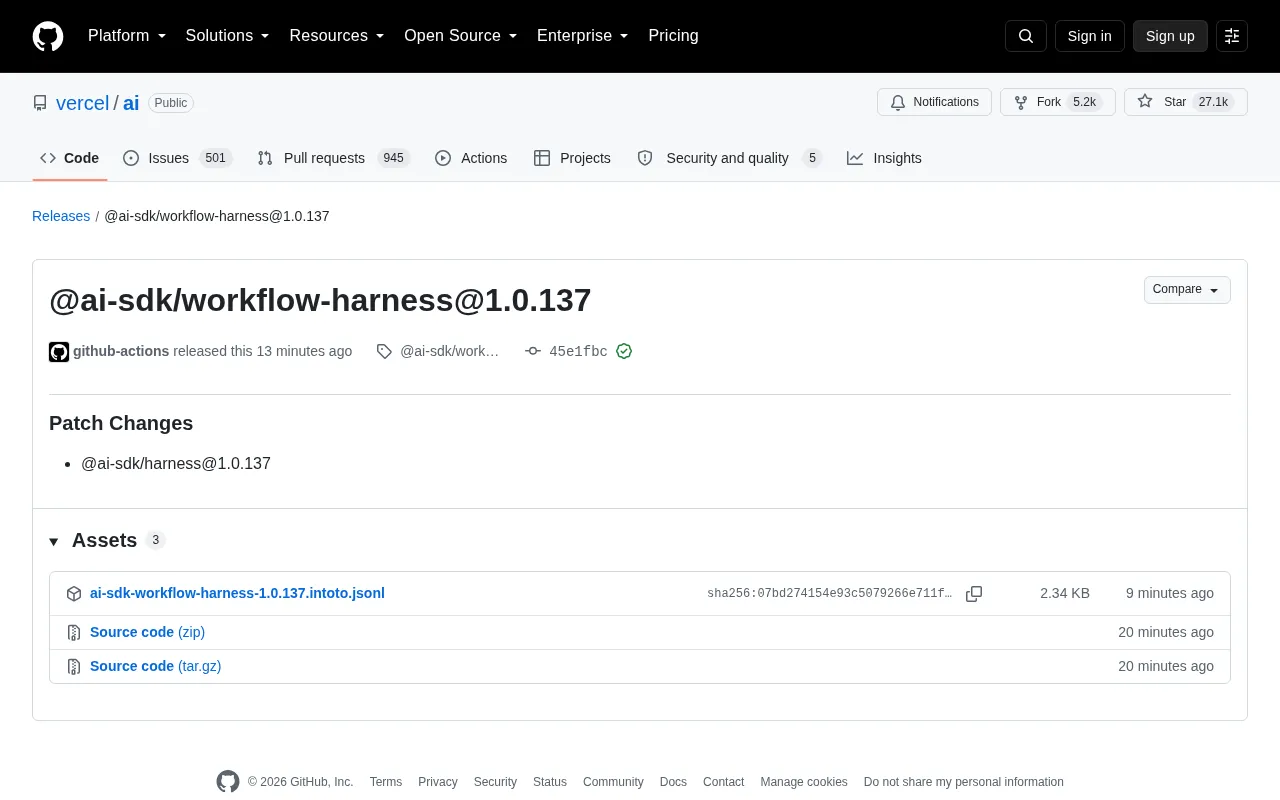
Vercel's open-source AI SDK has released `@ai-sdk/workflow-harness@1.0.137`, a patch-level update whose core change is syncing the `@ai-sdk/harness` dependency to the same version. Published via GitHub Actions and verified with a GPG signature, this release is part of the SDK's high-frequency iteration cadence enabled by its monorepo architecture. With over 27k GitHub stars, the Vercel AI SDK is a leading toolkit for integrating LLM capabilities in frontend and full-stack apps. This update contains no breaking changes or new features — developers can upgrade directly.
Vercel's open-source AI SDK project has released @ai-sdk/workflow-harness@1.0.137. This is a patch-level update that primarily syncs the dependency @ai-sdk/harness@1.0.137. For developers building AI applications with the Vercel AI SDK, these minor version updates may seem unremarkable, but they play an important role in keeping the toolchain stable.
What's in This Update
According to the GitHub release page, the workflow-harness 1.0.137 release falls under Patch Changes, with the core change being an upgrade of the @ai-sdk/harness dependency to the matching version 1.0.137. Patch updates typically mean bug fixes, internal dependency syncs, or minor stability improvements — not breaking changes or new features.
This version was published via an automated GitHub Actions workflow and verified with a GitHub verified signature (GPG key ID: B5690EEEBB952194), ensuring the integrity and trustworthiness of the release artifact.
About the Vercel AI SDK
The Vercel AI SDK is one of the most popular AI development toolkits in the frontend and full-stack ecosystem. Its GitHub repository (vercel/ai) has accumulated over 27.1k stars and 5.2k forks, reflecting a large and active developer community. The SDK is designed to help developers more easily integrate large language model capabilities into JavaScript/TypeScript applications, covering common scenarios such as text generation, streaming responses, and tool calling.
workflow-harness is a sub-package within the SDK ecosystem, primarily targeting workflow-related testing and runtime support scenarios. Harness-type tools are typically used to provide runtime environments and validation capabilities for core functionality — forming the underlying infrastructure that ensures SDK quality.
Monorepo architecture is the key reason Vercel AI SDK can achieve frequent and precise version synchronization. In a monorepo setup, all sub-packages of the SDK (such as @ai-sdk/core, @ai-sdk/harness, @ai-sdk/workflow-harness, etc.) are managed within a single Git repository, sharing build tooling and release workflows. When a foundational package (like @ai-sdk/harness) changes, automated scripts can identify all dependent packages and trigger coordinated version bumps and releases — avoiding the version drift and dependency inconsistencies common in multi-repo setups. Vercel AI SDK uses the Changesets tool to manage this multi-package versioning process, with a bot automatically generating changelogs and incrementing version numbers on each PR merge.
What High-Frequency Minor Releases Tell Us
The version number 1.0.137 makes it clear that Vercel AI SDK maintains a very high release cadence. This kind of dense, CI/CD-driven release strategy is a hallmark of modern, actively maintained open-source projects:
- Rapid fixes: Issues can be patched and released quickly once confirmed, reducing user wait time.
- Dependency sync: Sub-packages in a monorepo stay on consistent versions, reducing compatibility risk.
- Automated assurance: GitHub Actions and signature verification ensure every release is traceable and secure.
For teams depending on this SDK, it's worth keeping an eye on patch changelogs and upgrading promptly to benefit from stability and security improvements. Since this update is purely patch-level, most users can upgrade directly without worrying about breaking existing integrations.
Semantic Versioning (SemVer) is the foundational spec for understanding version numbers like 1.0.137. The format is MAJOR.MINOR.PATCH: a major version bump indicates breaking changes; a minor version bump indicates backward-compatible new features; and a patch version bump (as in this release) represents only backward-compatible bug fixes or internal adjustments. A patch number as high as 137 in 1.0.137 vividly reflects the project's sustained high-frequency iteration pace under the 1.0 major version — and also signals to users that such updates can be applied directly without worrying about API-level compatibility breaks.
Summary
@ai-sdk/workflow-harness@1.0.137 is a low-risk, routine patch release whose core change is syncing the @ai-sdk/harness dependency. It introduces no functional changes, but reflects Vercel AI SDK's ongoing commitment to continuous maintenance and rapid iteration. For developers, keeping your toolchain up to date is a good practice for building reliable AI applications.
Related articles
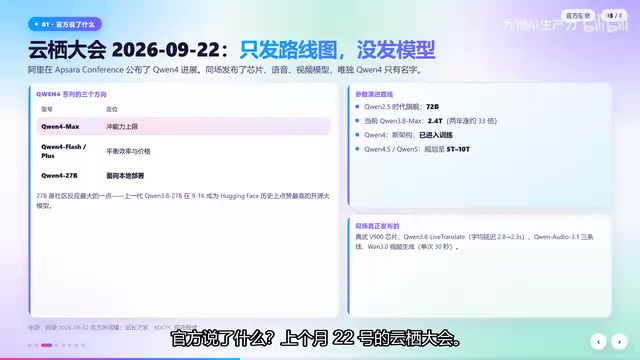
Qwen4 Architecture Preview Open-Sourced: 125B Parameters, 512 Experts, Designed for VRAM-Constrained Hardware
Qwen4 isn't released yet, but its architecture is previewed via open-source Qwen3.8 Flash Next: 125B params, 6B activated per token, 512 experts, 262K context, built for VRAM-limited hardware. This article covers official confirmations, key config.json metrics, and local deployment tests on 24G memory.
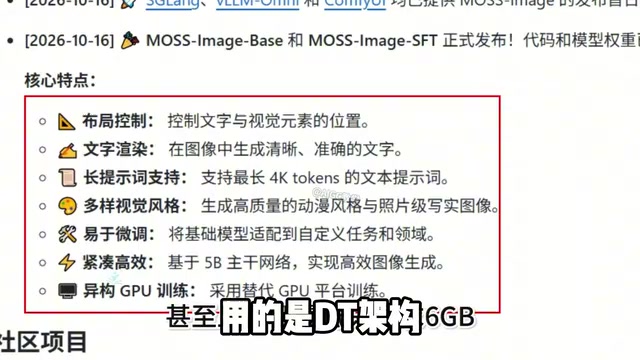
Run 8K Images on 6GB VRAM! Hands-On Test of Fudan's Open-Source MOSS-Image Model
Fudan OpenMouse team and Shanghai MOSS Intelligence open-source MOSS-Image, a 500M-parameter DT architecture text-to-image model that runs locally on 6GB VRAM with precise text rendering, structured layout control, and 4K Token prompt support—ideal for e-commerce posters and local deployment by individual creators.
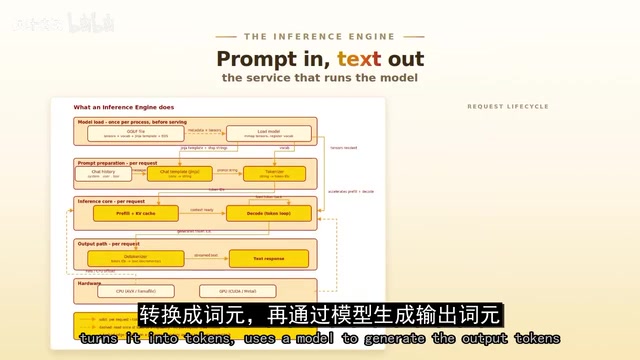
Overseas Blogger Tests Local Deployment of 100B-Parameter MoE Model: Key Lessons on Quantization and Tool Calling
Overseas blogger tests local deployment of Alibaba's Qwen 3.8 Flash Next 100B MoE model on a Strix Halo mini PC and CUDA workstation, revealing how quantization precision affects tool-calling success and the real-world performance of the Strata and GUFO inference engines.