Vercel AI SDK Releases workflow-harness Patch Update

Vercel AI SDK releases workflow-harness 1.0.118 patch update with internal dependency syncs and no breaking changes.
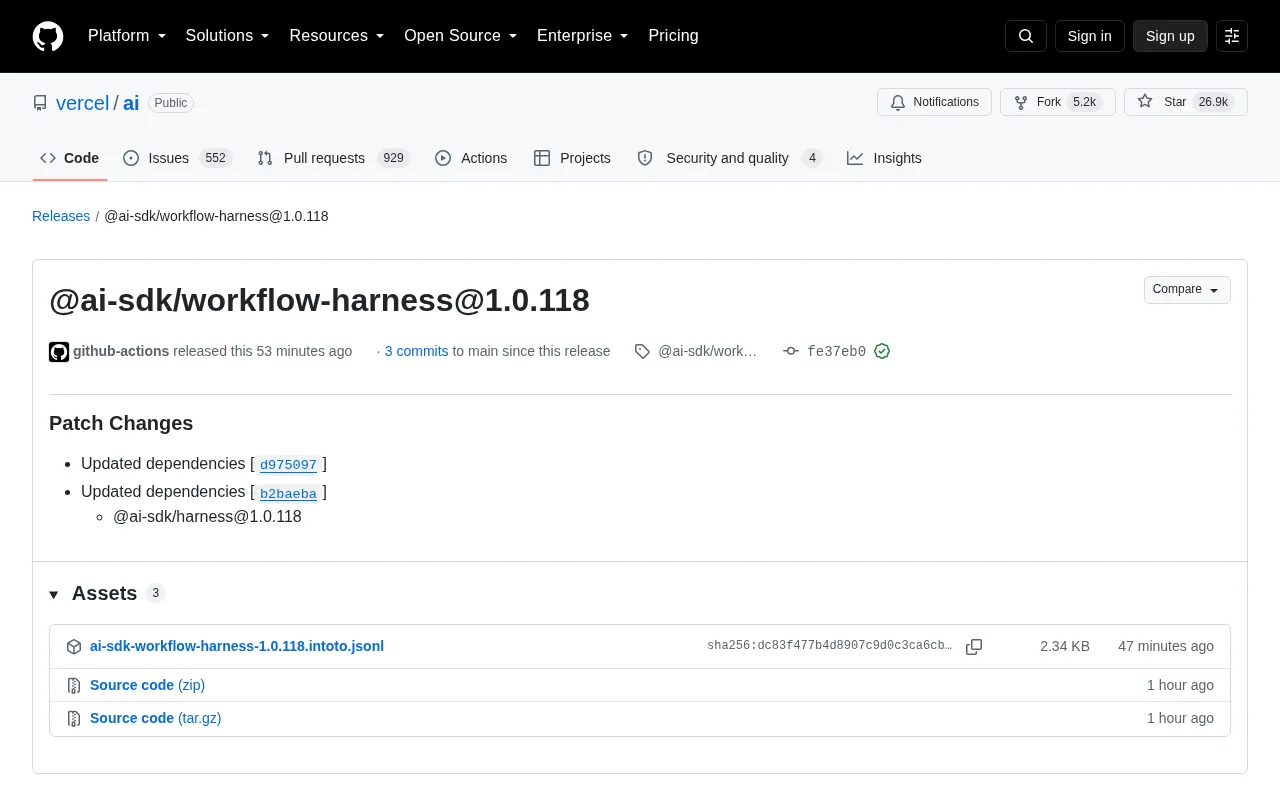
Vercel AI SDK has released `@ai-sdk/workflow-harness@1.0.118`, a patch-level update that syncs two internal dependencies (commits `d975097` and `b2baeba`) and aligns with `@ai-sdk/harness@1.0.118`. The `workflow-harness` package is an internal testing support tool within the AI SDK ecosystem, not typically referenced directly by end developers. Built and GPG-signed via GitHub Actions, this release follows SemVer and introduces no breaking changes — developers can simply update alongside the main SDK.
Vercel's AI SDK repository recently released @ai-sdk/workflow-harness@1.0.118. This is a patch-level update focused primarily on syncing internal dependencies. While this kind of release doesn't introduce breaking changes, it reflects the continuous, high-frequency maintenance cadence of this toolchain — something developers building workflows on the Vercel AI SDK should be aware of.
Update Overview
According to the GitHub Release page, @ai-sdk/workflow-harness@1.0.118 falls under Patch Changes, with the core changes being internal dependency updates:
- Updated dependencies [
d975097] - Updated dependencies [
b2baeba] - Associated package:
@ai-sdk/harness@1.0.118
This release was automatically built by GitHub Actions and signed with a verified GitHub GPG key (ID: B5690EEEBB952194), ensuring the trustworthiness of the published artifact. The version number reveals that this package maintains a synchronized versioning strategy with @ai-sdk/harness — together, they form the foundational infrastructure for AI SDK workflow testing and execution.
What Is workflow-harness?
workflow-harness is an internal utility package within the Vercel AI SDK ecosystem, typically used as a testing scaffold or runtime support layer for workflows. In software engineering, a "harness" refers to a set of auxiliary code that provides a controlled execution environment for components, allowing developers to verify workflow logic under various conditions.
Packages like this are generally not referenced directly by end developers — they exist as a glue layer facilitating collaboration between internal AI SDK modules. Their frequent updates are typically cascade syncs triggered by changes in upstream core packages (such as @ai-sdk/harness), maintaining version consistency across the entire monorepo.
Semantic Versioning (SemVer) defines the version format as
MAJOR.MINOR.PATCH: a MAJOR bump indicates breaking changes, MINOR indicates new backwards-compatible features, and PATCH indicates backwards-compatible bug fixes or internal adjustments (like dependency syncs). The1.0.118in@ai-sdk/workflow-harness@1.0.118means there have been 118 patch-level iterations since 1.0.0, with neither the major nor minor version changing. This means you can safely set your dependency range to^1.0.0to automatically receive the latest patches without worrying about interface breakage. Understanding this convention is the most fundamental basis for judging whether an SDK update requires active developer intervention.
What the Iteration Pace Says About AI SDK Maintenance
The Vercel AI repository currently has over 26.9k stars and 5.2k forks, making it one of the most popular AI application development frameworks available. Fine-grained patch versions like 1.0.118 reflect the project's adoption of a monorepo + changesets release model — where each sub-package is versioned independently but advances in unison through dependency linkage.
Practical implications for developers include:
- No need to worry about breaking changes: Patch versions follow SemVer and contain only fixes and dependency syncs — safe to upgrade.
- Clean dependency tree: Synchronized updates prevent potential conflicts caused by version mismatches between sub-packages.
- Strong auditability: Every release includes corresponding commit hashes and signatures, making audits straightforward.
Monorepo + Changesets is a version management combination widely adopted by large JavaScript/TypeScript projects. A monorepo places multiple related packages in a single repository for unified management, enabling cross-package refactoring and atomic commits. Changesets is a versioning tool designed specifically for monorepos — developers attach a "changeset" file alongside their commits, describing the scope of impact (patch/minor/major) and a summary. At release time, Changesets automatically aggregates these descriptions, calculates the appropriate version bump for each sub-package, and generates a CHANGELOG. This mechanism allows repositories like Vercel AI SDK — with dozens of sub-packages — to ship high-frequency, granular releases while maintaining clear version tracking. A high patch number like 1.0.118 is simply the natural accumulation of long-term, high-frequency iteration.
Recommendations for Developers
If your project directly or indirectly depends on the Vercel AI SDK, it's advisable to track overall SDK releases rather than individual internal packages. For low-level tools like workflow-harness, simply updating alongside the main SDK upgrade is sufficient — no need to handle it separately.
It's worth noting that the release announcement itself contains limited information, disclosing only the commit references for the dependency updates without providing detailed descriptions of functional changes. If you need to understand the specifics of commits d975097 and b2baeba, you'll need to look into the corresponding changeset records directly.
Related articles

T3 Code: The Open-Source AI Coding Assistant's Comeback Story
T3 Code is an open-source AI coding assistant that unifies subscriptions like Codex and Claude, with powerful remote control and parallel task management.

Never Elected, Yet Ruled New York for 30 Years: The Ultimate Case Study in the Mechanics of Power
Robert Caro's biographies reveal how unelected Robert Moses ruled New York for 30 years through legal drafting and public authorities, and how Lyndon Johnson built leverage as a "powerless" Senate Majority Leader. Unpacking the underlying logic of accumulating and sustaining power.

The CPython 3.10 Recursion Trap and Synthetic Recovery in TokenGuard, an LLM Circuit Breaker
TokenGuard's author recounts a recursion crash caused by OrderedDict.pop in CPython 3.10 and introduces v0.3.0's Loop Nudge synthetic recovery, inline DLP scanning, and other new LLM agent circuit-breaker capabilities.