Vercel AI SDK Releases xAI Provider Update: Multi-Model Integration Progress

Vercel AI SDK's xAI provider releases patch v2.0.93 with three core dependency upgrades.
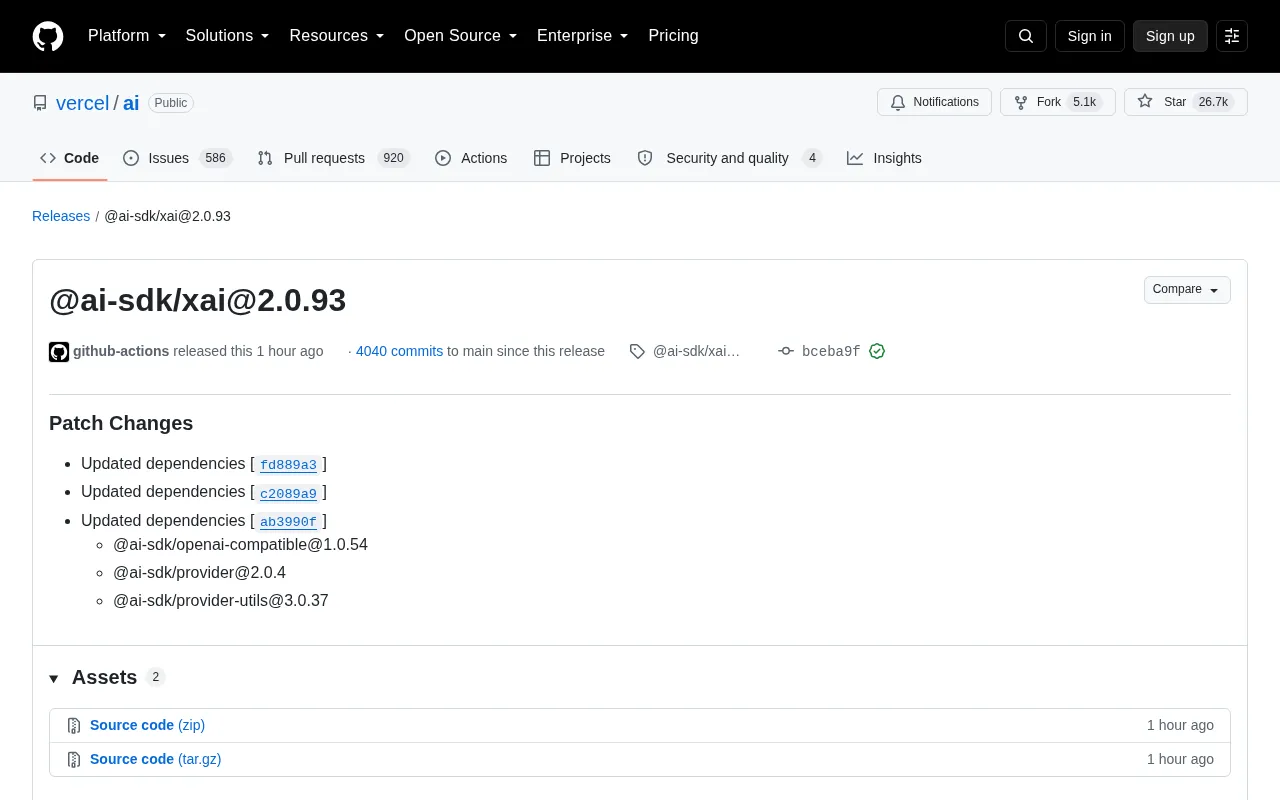
The `@ai-sdk/xai` package in Vercel AI SDK has released patch version 2.0.93, with the core change being upgrades to three underlying dependencies: the OpenAI compatibility layer `@ai-sdk/openai-compatible` (1.0.54), the provider abstraction interface `@ai-sdk/provider` (2.0.4), and the utility package `@ai-sdk/provider-utils` (3.0.37). The SDK's unified provider pattern lets developers call xAI Grok, OpenAI, Anthropic, and other models with the same API, significantly reducing multi-model integration costs. As a patch release following SemVer, it contains no breaking changes and is safe to upgrade.
Release Overview
Vercel has released version 2.0.93 of @ai-sdk/xai, a patch update to the official xAI provider package within the Vercel AI SDK ecosystem. This package enables integration with xAI's models (from Elon Musk's AI company), and this release primarily focuses on syncing dependency upgrades.
As a key component of the Vercel AI SDK, the xAI provider allows developers to easily integrate Grok and other xAI models into their applications — with the same consistent calling experience as other major AI providers like OpenAI and Anthropic.
Core Dependency Updates
This patch release updates three core dependency packages:
- @ai-sdk/openai-compatible: Upgraded to version 1.0.54. This package provides the foundational implementation of the OpenAI-compatible interface, allowing providers like xAI to reuse standardized API call patterns.
- @ai-sdk/provider: Upgraded to version 2.0.4. This abstraction layer defines the interface specifications that all AI providers must follow.
- @ai-sdk/provider-utils: Upgraded to version 3.0.37. Provides common utility functions required for provider implementations.
These dependency updates typically include performance optimizations, bug fixes, and interface improvements, ensuring the xAI provider stays in sync with the SDK core.
Semantic Versioning (SemVer) is the standard convention for open-source package management. Version numbers follow the format
MAJOR.MINOR.PATCH. A patch update contains only backward-compatible bug fixes; a minor update adds backward-compatible features; a major update introduces breaking changes. Since@ai-sdk/xaiis moving from 2.0.92 to 2.0.93, this is a patch-level update — meaning no public API behavior changes. Developers can safely upgrade via their package manager's auto-update mechanism without modifying any business logic.
Technical Architecture and Advantages
Unified Multi-Model Interface
Vercel AI SDK implements unified multi-model access through a provider pattern. Developers can call models from different vendors using the same API — just swap out the provider:
import { xai } from '@ai-sdk/xai';
import { generateText } from 'ai';

const result = await generateText({
  model: xai('grok-beta'),
  prompt: 'Your prompt here'
});
This design significantly reduces the cost of migrating between AI services and makes it easier to run A/B tests and model comparisons in production.
OpenAI Compatibility Advantages
By depending on @ai-sdk/openai-compatible, the xAI provider inherits a mature OpenAI interface implementation. This means most code written for OpenAI can be seamlessly migrated to xAI — no need to learn a new API pattern.
xAI's Grok model series follows OpenAI's interface specification in its API design, which has become the de facto industry standard. Many emerging AI providers (such as Mistral, Together AI, Groq, etc.) have chosen to be compatible with the OpenAI Chat Completions API because the large existing developer base is already familiar with it, and the tooling ecosystem (LangChain, LlamaIndex, etc.) has built extensive integrations around it.
@ai-sdk/openai-compatibleabstracts this compatibility into a reusable base package — any model provider following the spec can quickly build an SDK adapter on top of it, without implementing complex features like streaming responses, Function Calling, or multimodal input from scratch.
Upgrade Guide for Developers
For developers already using the Vercel AI SDK, this update is recommended to get the latest stability improvements. Since this is a patch release, it introduces no breaking changes per Semantic Versioning — safe to upgrade:
npm update @ai-sdk/xai
# or
pnpm update @ai-sdk/xai
As a side note, the Vercel AI SDK has accumulated 26.7k stars and 5.1k forks on GitHub, reflecting its widespread adoption in AI application development. The frequent release cadence also demonstrates the project's active maintenance.
The Evolving AI Development Ecosystem
xAI's official support within the Vercel AI SDK reflects several industry trends:
- Multi-model competitive landscape: Developers no longer rely on a single AI provider, but instead choose the most suitable model for each use case.
- Demand for standardized interfaces: A unified SDK reduces integration complexity and accelerates AI application development iterations.
- Open-source tooling ecosystem: Open-source projects like the Vercel AI SDK are becoming critical infrastructure connecting AI models with application development.
For teams evaluating AI solutions, the Vercel AI SDK offers a production-grade abstraction layer worth considering for your tech stack. By managing multiple AI providers through a unified interface, developers can more flexibly navigate model selection and technology evolution challenges.
Related articles

T3 Code: The Open-Source AI Coding Assistant's Comeback Story
T3 Code is an open-source AI coding assistant that unifies subscriptions like Codex and Claude, with powerful remote control and parallel task management.

Never Elected, Yet Ruled New York for 30 Years: The Ultimate Case Study in the Mechanics of Power
Robert Caro's biographies reveal how unelected Robert Moses ruled New York for 30 years through legal drafting and public authorities, and how Lyndon Johnson built leverage as a "powerless" Senate Majority Leader. Unpacking the underlying logic of accumulating and sustaining power.

The CPython 3.10 Recursion Trap and Synthetic Recovery in TokenGuard, an LLM Circuit Breaker
TokenGuard's author recounts a recursion crash caused by OrderedDict.pop in CPython 3.10 and introduces v0.3.0's Loop Nudge synthetic recovery, inline DLP scanning, and other new LLM agent circuit-breaker capabilities.