Vercel AI SDK Vue 4.0.168 Update: useChat Adds Experimental Message Queue Feature
@ai-sdk/vue patch update adds experimental message queuing capability to useChat.
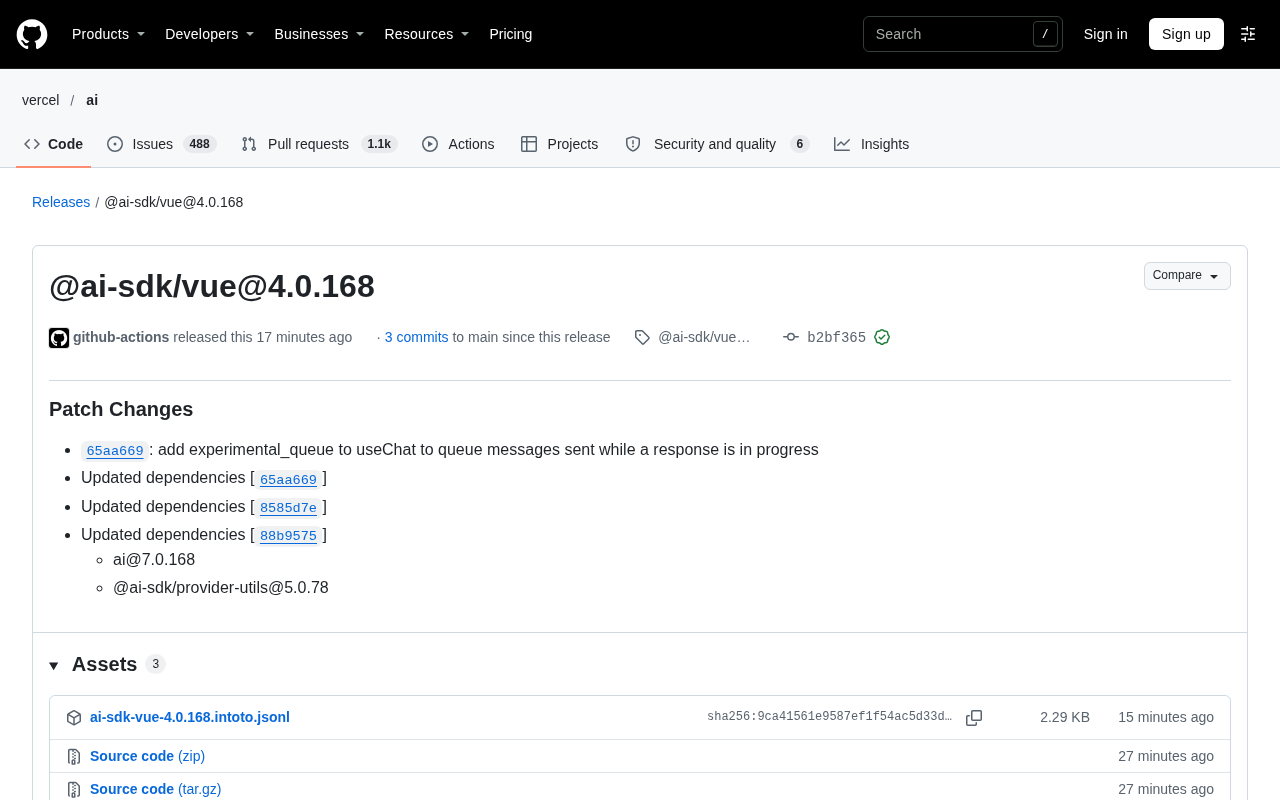
@ai-sdk/vue released patch version 4.0.168, adding an experimental experimental_queue option to the useChat hook so that new messages sent by the user while an AI response is being generated can wait in a queue instead of being discarded or causing the input box to be disabled. This update also incremented two dependencies, ai@7.0.168 and @ai-sdk/provider-utils@5.0.78, reflecting cross-package linkage under the AI SDK's layered architecture. The article points out that the experimental_ prefix means the API is not yet stable, and developers should encapsulate an adapter layer to cope with subsequent changes; meanwhile, details such as queue capacity, concurrency strategy, and interaction with options like abort and regeneration have not been disclosed and need to be confirmed by checking the source code. Message queuing has clear experience value for high-frequency input scenarios such as customer service and code assistants, but queuing feedback should be provided in the UI and backend request pressure should be evaluated.
Vercel's AI SDK Vue package has received a seemingly minor patch update, yet it brings a key capability to chat interaction scenarios: when the AI is still generating a response, new messages sent by the user are no longer discarded but can enter a queue to await processing.
The Feature Increment Behind the Patch Update
According to the GitHub Releases page, @ai-sdk/vue has released version 4.0.168. This update is a patch changes release, with the core change being the addition of the experimental_queue capability to the useChat hook. This option is used to queue messages sent by the user while a response is still in progress.
The same batch also updated several dependencies, including ai@7.0.168 and @ai-sdk/provider-utils@5.0.78. Since the change is marked as experimental, it means it has not yet entered the scope of stable API guarantees, and the interface shape may still be adjusted in subsequent versions.
Why Message Queuing Deserves Attention
In a typical AI chat product, useChat is responsible for managing the message list, input state, and communication with the backend streaming API. When the model is outputting token by token, most implementations either directly disable the input box or simply overwrite new messages. This approach has obvious shortcomings in experience: when the user types faster than the model responds, their thoughts are easily interrupted, and the interaction rhythm is forced to follow the model.
experimental_queue allows the frontend to temporarily store such messages first and then send them into the request chain in order after the current response ends. For developers building multi-turn conversation products, this reduces the repetitive work of implementing a queue themselves at the business layer and also makes frontend interaction closer to the human intuition of "interjecting and waiting" in conversation.
useChat is the core composable function provided by AI SDK for frontend frameworks (in Vue it takes the form of a hook/composable function). It internally maintains a reactive message array and sends user input to the backend through a streaming HTTP API, then parses the returned token stream chunk by chunk and appends it to the message list. The so-called "streaming API" usually refers to incremental transmission based on Server-Sent Events or ReadableStream, where the model pushes a small piece of text as soon as it generates it, and the frontend renders it in real time accordingly. Since a single request may last several seconds or even longer, how the input box is handled during that period becomes an interaction design issue: disabling it is the simplest approach but interrupts the user's train of thought. Queue capability essentially maintains a pending-send buffer on the client, decoupling the "request lifecycle" from the "user input rhythm", which is also a common experience optimization point in multi-turn conversation products.
What Synchronized Dependency Chain Updates Indicate
This release also updated two dependencies: the main ai package and provider-utils. The AI SDK architecture has always been layered: the Vue adapter layer depends on the core ai package for streaming protocols and tool calling logic, while provider-utils carries adaptation utilities for various model providers. Patch versions incrementing together usually means that queue-related logic requires coordination with the core layer, or at least has undergone cross-package regression verification.
For teams using a monorepo or locking dependency versions, such cross-package updates require attention to version alignment. If the project also uses other framework adapters such as React or Svelte, it is best to confirm whether those packages contain equivalent changes, avoiding behavioral differences across frontend entry points.
AI SDK is managed as a monorepo. The core ai package provides framework-agnostic streaming protocols, message state machines, and tool calling logic. Each framework adapter package (Vue, React, Svelte, etc.) is only responsible for binding core capabilities to the corresponding framework's reactivity system, while @ai-sdk/provider-utils encapsulates request/response conversion utilities for different model providers (such as OpenAI and Anthropic). The synchronized version increments of the three usually stem from fixed version linkage in the release process rather than strong functional coupling. For users, this means upgrading an adapter package can easily pull along the core package version. Under pnpm/npm dependency resolution, if multiple ai instances appear, it may lead to inconsistent message type checks or stream parsing behavior. Therefore, it is recommended to explicitly align the versions of these packages in the lockfile.
What the Experimental Label Means
The experimental_ prefix is a clear signal in AI SDK: the API is available but not guaranteed to be stable. Developers can try the queue capability early, but should be prepared for renaming, parameter adjustments, or even removal in later versions. A prudent approach is to encapsulate related calls in the project's own adapter layer rather than scattering them directly across business components.
In addition, the source material does not disclose details such as the queue's capacity limit, concurrency strategy, or interaction with other options (such as request abort and regeneration). Developers need to check the source code or type definitions of the corresponding version to confirm these.
Applicable Scenarios and Implementation Recommendations
For high-frequency input scenarios such as customer service bots, code assistants, and content creation tools, message queuing can reduce the frustration of user actions being cut off. In implementation, it is recommended to provide clear feedback at the UI layer, such as showing a "message queued" status and updating the prompt when the queue starts processing, so users do not mistakenly think their messages were lost. At the same time, businesses should evaluate whether consecutive inputs need to be merged to prevent queue buildup from increasing backend request pressure.
This update itself does not change the overall positioning of AI SDK, but it fills in a detail in chat interaction that is often overlooked. As frontend AI applications move from demos to production, "interaction infrastructure" such as queues, interruptions, and retries will become increasingly important.
One-line Summary
@ai-sdk/vue patch update adds experimental message queuing capability to useChat.
Paragraph Summary
@ai-sdk/vue released patch version 4.0.168, adding an experimental experimental_queue option to the useChat hook so that new messages sent by the user while an AI response is being generated can wait in a queue instead of being discarded or causing the input box to be disabled. This update also incremented two dependencies, ai@7.0.168 and @ai-sdk/provider-utils@5.0.78, reflecting cross-package linkage under the AI SDK's layered architecture. The article points out that the experimental_ prefix means the API is not yet stable, and developers should encapsulate an adapter layer to cope with subsequent changes; meanwhile, details such as queue capacity, concurrency strategy, and interaction with options like abort and regeneration have not been disclosed and need to be confirmed by checking the source code. Message queuing has clear experience value for high-frequency input scenarios such as customer service and code assistants, but queuing feedback should be provided in the UI and backend request pressure should be evaluated.
Related articles
Microsoft WebIQ: Verifiable Real-Time Web Grounding for AI Agents
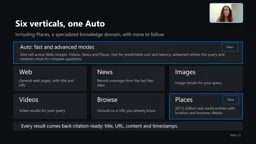
Microsoft WebIQ gives AI Agents real-time, citable web grounding across web, news, images, videos, and Places—164ms P95 latency, 50% fewer tokens, Scopes source control, and MCP integration.
Augmentable Gaussian Splatting: Building Photorealistic Simulation Environments for Robot Training
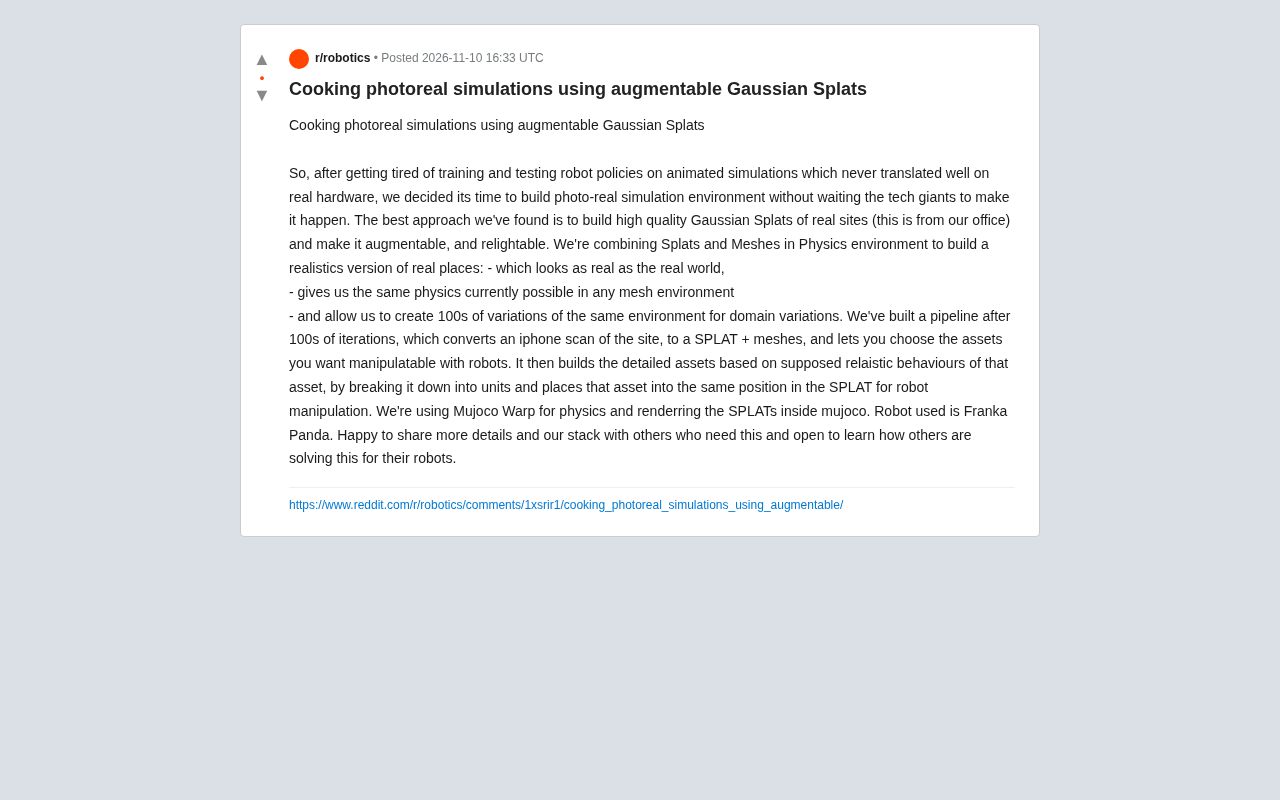
Team combines Gaussian Splatting with meshes to build photorealistic robot simulation environments, integrating MuJoCo Warp physics and Franka Panda for augmentable, relightable real-site simulation.

Gemini 4 Carbon Released: The Leap from Gemini 3 to Gemini 4 in Under a Year
Google releases Gemini 4 Carbon, less than a year after Gemini 3. In the official demo, Carbon reverse-engineered the Theme Park binary, added a new DeepMind-themed ride, and ported it to the web in one shot.