Vercel AI SDK Vue Package Releases Version 3.0.324: Synchronized Upgrade of ai Dependency
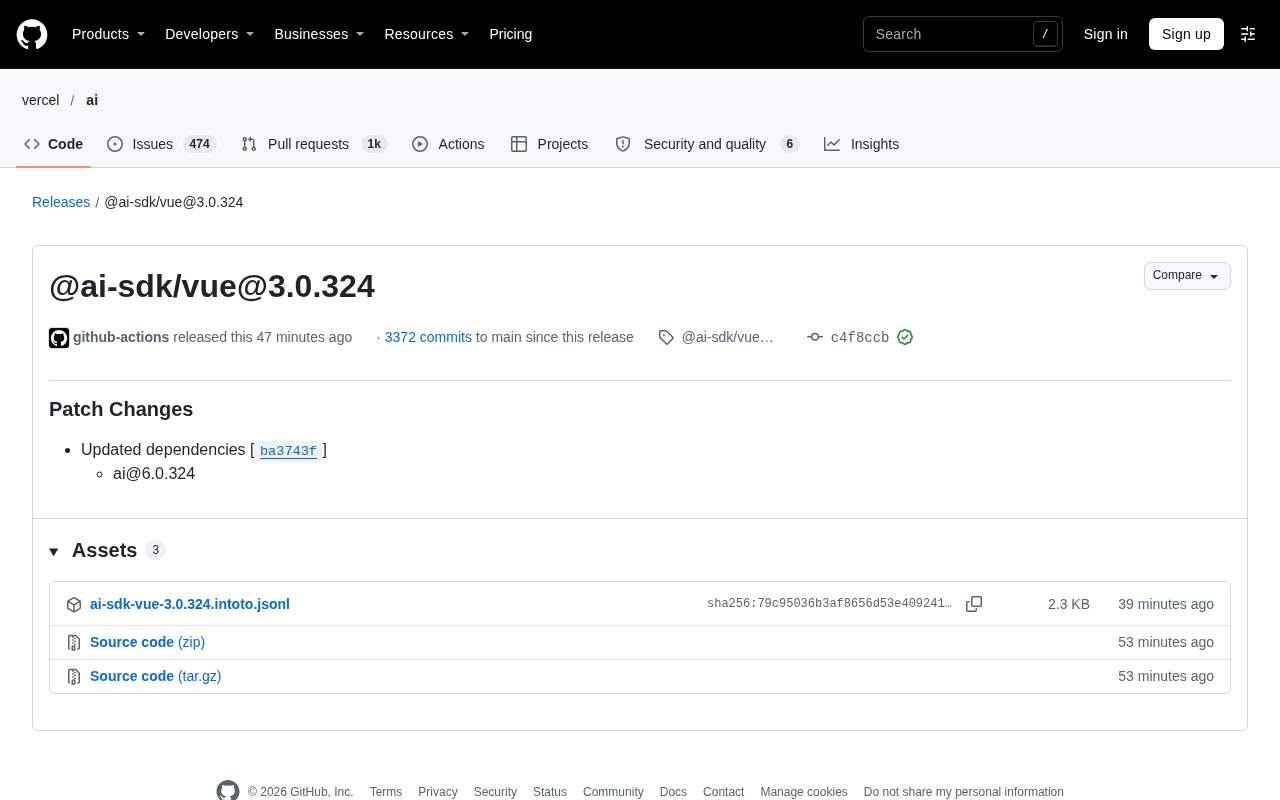
@ai-sdk/vue releases patch 3.0.324, synchronizing core ai package to 6.0.324.
Vercel's @ai-sdk/vue releases patch version 3.0.324, with the core change being synchronizing the underlying ai package dependency to 6.0.324, automatically released by GitHub Actions with no breaking API changes. The article notes that AI SDK uses a core package plus framework adapter package structure with synchronized version numbers, enabling the Vue adapter layer to promptly benefit from underlying improvements in functionality, performance, and error handling. This high-frequency patch release pattern is the project's strategy for maintaining stability amid rapid evolution. For Vue developers, the upgrade itself is simple, but they should confirm ai package version alignment, read release notes, and verify core paths like streaming responses and tool calls in a test environment before pushing to production.
Vercel's AI SDK ecosystem sees another routine iteration. @ai-sdk/vue has released version 3.0.324, a patch-level update whose core change is synchronizing the underlying ai package dependency version. For developers using Vue to integrate AI capabilities, this is a signal worth noting: the framework adapter layer is keeping pace with the core SDK.
What's in the Update
According to the release notes on GitHub, the change type for @ai-sdk/vue@3.0.324 is marked as Patch Changes, with the main action being updating the dependency ai@6.0.324 to the new version. The commit record shows this release was automatically completed by github-actions, linked to a specific dependency update commit.
Such patch updates typically don't involve breaking API changes—they're more about version alignment and internal dependency synchronization. For projects with locked dependency versions, upgrade risk is low; but if you use both the ai core package and the Vue adapter package in your project, it's advisable to upgrade both together to avoid potential issues from version mismatches.
Semantic Versioning and Patch Updates: 3.0.324 follows the major.minor.patch format, where incrementing the patch number theoretically includes only backward-compatible bug fixes and internal adjustments, without introducing new APIs or breaking changes. Tools in the dependency ecosystem (such as npm, pnpm) rely on this convention to determine the safety boundaries of automatic upgrades—range declarations like ^3.0.324 allow automatic acquisition of subsequent patch versions. However, semantic versioning is a convention rather than a mandate; transitive dependency upgrades in the dependency chain can still introduce behavioral differences, so checking the changelog and verifying in a test environment before upgrading in production remain necessary steps.
Why Such Updates Matter
The AI SDK's package structure uses a core package plus framework adapter packages design. The ai package provides unified underlying capabilities such as model invocation, streaming responses, and tool calls, while @ai-sdk/vue wraps these capabilities into composable functions and reactive interfaces familiar to Vue developers. Keeping the version numbers of both in sync means the Vue layer can promptly benefit from improvements in functionality, performance, and error handling at the core layer.
According to the GitHub release page and community developers' observations of the version sequence, this high-frequency patch release pattern is the norm for AI SDK project maintenance. Frequent minor version iterations reflect the project's strategy of maintaining stability amid rapid evolution: delivering fixes in small, fast steps rather than accumulating them into major versions. For developers, consistently following patch versions helps obtain the latest compatibility fixes.
Framework Adapter Package Design Pattern: The AI SDK splits capabilities into two layers: the core package and adapter packages. The core package ai handles framework-agnostic underlying logic such as model invocation, streaming responses, and tool calls, while adapter packages translate core capabilities into idiomatic interfaces for specific frameworks. In Vue, the adapter layer typically exposes state as composable functions—for example, streaming text, loading states, and error information are all wrapped as ref, naturally fitting Vue's reactivity system. The benefit of this layering is that core logic only needs to be maintained once; React, Svelte, Vue and other adapter packages each remain thin wrappers, and aligning version numbers with the core package ensures the underlying interfaces referenced by the adapter layer always exist.
Practical Advice for Vue Developers
If you're building AI chat or streaming generation applications with Vue, upgrading to 3.0.324 is straightforward—just run your package manager's update command. What you need to confirm is that the ai package is also synchronized to 6.0.324, since the two packages' collaborative operation depends on version matching.
For production environments, it's recommended to check the changelog for any changes affecting your current usage before upgrading. Although patch versions are usually safe, dependency chain updates can sometimes introduce indirect effects. Verifying in a test environment first before pushing to production is the prudent approach.
Dependency Version Alignment and Lock Files: When a project depends on both ai and @ai-sdk/vue, the package manager may resolve different versions of the ai copy due to transitive dependencies, causing type mismatches or inconsistent runtime behavior. In practice, you can check the actually installed version via npm ls ai or pnpm why ai, and explicitly declare both versions in package.json, or use the overrides/resolutions fields to force unification. Additionally, you can configure dependency update notifications in CI (such as Dependabot, Renovate), presenting patch upgrades as automated PRs—following fixes while retaining a manual review step.
Reading AI SDK's Evolution Direction from Version Cadence
This update itself carries limited information, but viewed within the AI SDK's overall version sequence, some trends emerge. Core packages and framework adapter packages being released in sync with tight dependency relationships indicates the team adopts a unified version management strategy when maintaining multi-framework support. Vue, React, Svelte and other adapter packages share the same core capabilities, reducing the mental burden for developers switching frameworks.
For technology selection, this structure means you can confidently adopt AI SDK in Vue projects without worrying that the adapter layer lags too far behind core features. Continuous minor version releases also indicate active project maintenance, with short cycles for getting fixes when issues arise.
Upgrade Notes Summary
- Confirm that
aipackage and@ai-sdk/vueversions are aligned to avoid mixing different generations - Patch updates generally don't involve API changes, but reading release notes is still recommended
- Automated release processes mean frequent version releases; consider setting up dependency update notifications in CI
- Before upgrading in production, verify core paths such as streaming responses and tool calls in a test branch
Overall, 3.0.324 is a typical dependency synchronization update with no new features or breaking changes. Its value lies in maintaining consistency between the Vue adapter layer and the core SDK—for teams seeking stability and the latest fixes, simply following the cadence is sufficient.
Related articles
 Tech Frontiers
Coldframe: A Honeypot Disguised as a Supermarket Freezer Controller
Coldframe is a honeypot disguised as Danfoss AK-SM 800A and Dixell XWEB freezer controllers, built as a single Python file that detects CVE-2025-41450 attempts and is identified as real devices on Shodan.
 Tech Frontiers
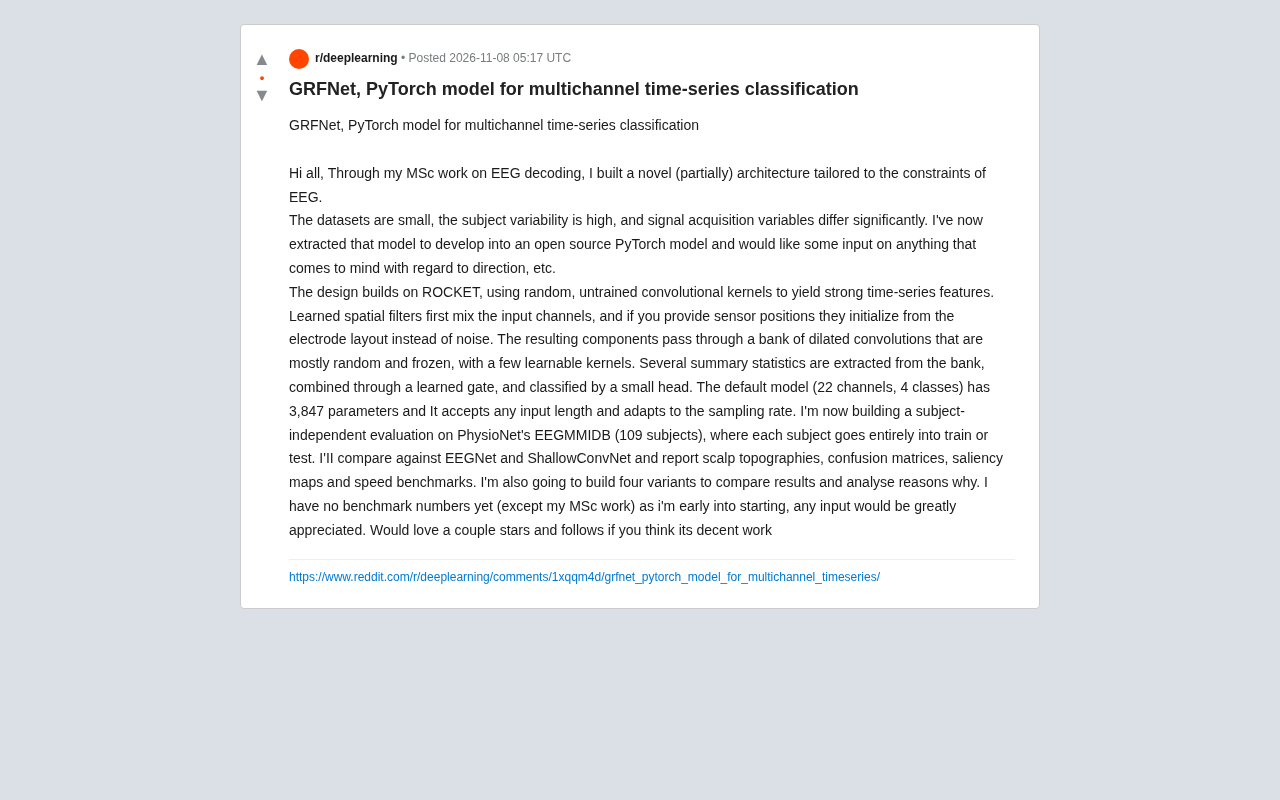
GRFNet: A Lightweight PyTorch Model Designed for Multichannel Time-Series Classification
GRFNet is a lightweight PyTorch model for multichannel time-series classification, originating from EEG decoding research. With only 3,847 parameters, it is based on the ROCKET architecture, combining random convolution kernels with learnable spatial filters, supports arbitrary input lengths, and will soon be evaluated on the PhysioNet dataset.
 Tech Frontiers
CUDA-Accelerated Rocket League Simulator: A Player-Made Hardcore Experiment
A Reddit post shows a "100% Accurate" Rocket League simulator accelerated with CUDA. We analyze its technical context, CUDA's value in game physics simulation, and the significance and limitations of such community projects.