Vercel Daemons Adds Service Bindings: Direct Access to Private Services

Vercel introduces service bindings for Daemons, letting background processes call same-deployment services via private internal links.
Vercel adds service bindings for Daemons, enabling long-running background processes to directly call other services within the same deployment. Previously this communication relied on externally exposed HTTP addresses or self-built internal channels; now you simply declare the target service, the environment variable name for the injected URL, and the binding format in vercel.toml, and the platform handles internal routing, authentication, and TLS while keeping services private. Daemons can call using standard fetch without any proprietary SDK. The article also notes two boundaries: bindings are one-way, so Services cannot bind back to Daemons; and each Daemon instance always calls the deployment that started it, unaffected by promotion or rollback. Therefore this capability is better suited for one-way data flow scenarios where workers consume internal APIs.
Vercel has introduced service bindings for Daemons, allowing long-running background daemon processes to directly call other services within the same deployment. At first glance this change may look like just another configuration option, but it actually fills a critical gap in Daemons' intra-deployment communication.
What Problem Do Service Bindings Solve
In Vercel's deployment model, Services carry the actual application logic, while Daemons are long-running processes such as workers, queue consumers, or background task processors. Previously, communication between these two types of components required externally exposed HTTP addresses, meaning you either had to make services public or build your own internal access channel.
Service bindings change this. According to Vercel's official documentation, a Daemon can obtain the URL of a target service by declaring a binding; Vercel handles internal routing, authentication, and TLS, and the service itself remains private without needing to be externally exposed.
The Positioning Difference Between Daemons and Services
To understand the value of service bindings, you first need to clarify the two core components in Vercel's deployment model. Services are request-driven application units that typically respond to users or upstream calls as HTTP services; Daemons are long-running processes whose lifecycle is tied to the deployment, suited for carrying background logic such as workers, queue consumers, and scheduled tasks. The runtime characteristics of the two determine their different communication needs: Services can be discovered through platform-provided routing, while Daemons have long played the role of "initiator" and previously lacked a platform-managed internal link. Service bindings are exactly the channel added for this role.
What It Means for Internal Routing and TLS to Be Platform-Managed
In traditional self-built architectures, internal service calls typically require maintaining service discovery, mTLS certificate rotation, and access control lists yourself. In service bindings, Vercel takes these responsibilities back to the platform: once a binding is declared, the platform resolves the target service's URL to the correct internal endpoint and completes TLS and identity verification at the transport layer. For developers, this means you don't need to embed certificates, signing logic, or internal DNS configuration in your business code, and services don't need to expose public endpoints. The trade-off is that this link's behavior is defined by the platform, so troubleshooting depends on the observability tools the platform provides.
Configuration: Declarative Bindings
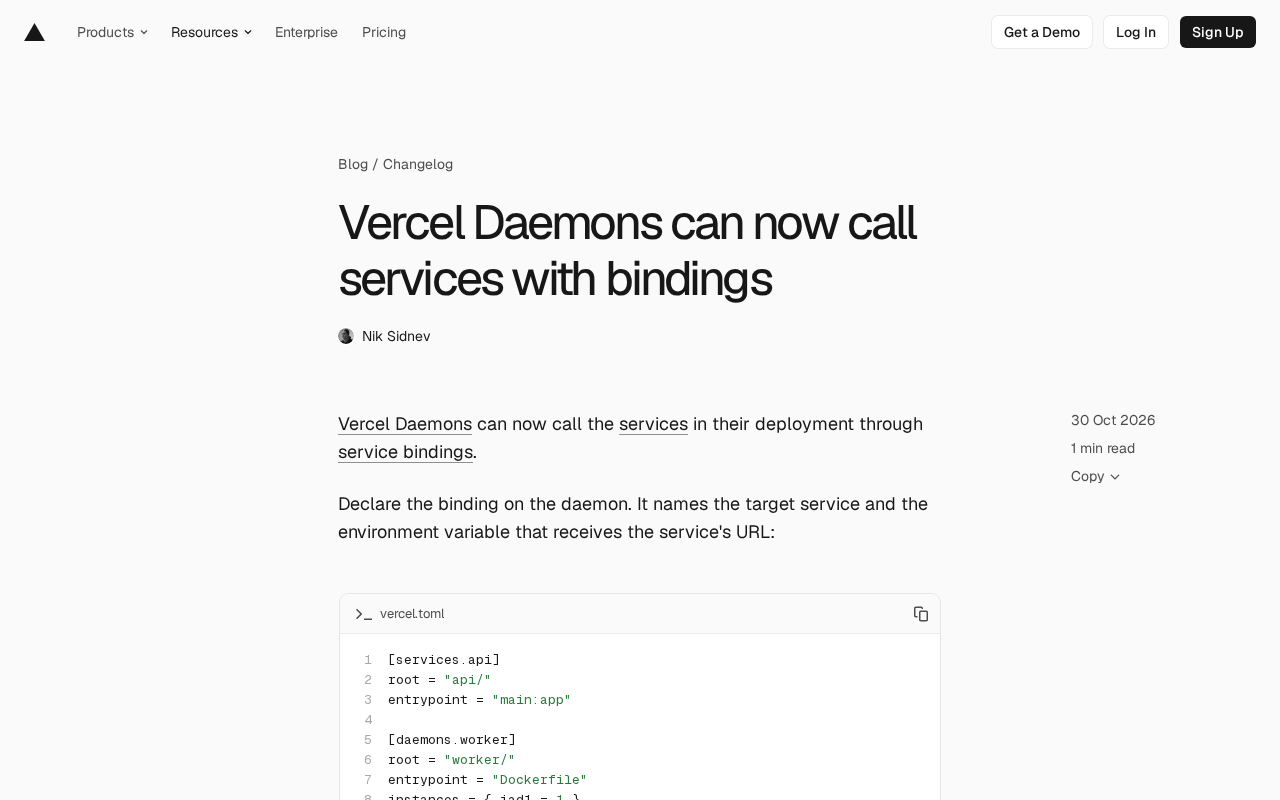
Bindings are declared in vercel.toml. Developers need to specify three things: the target service's name, the environment variable name that will receive the service URL, and the binding format.
[[daemons.worker.bindings]]
type = "service"
service = "api"
format = "url"
env = "API_URL"
This configuration means: the Daemon worker binds to the api service, and the service's URL will be injected into the environment variable API_URL. format = "url" indicates that a directly usable URL string is injected.
vercel.toml and the Deployment Descriptor File
vercel.toml is a configuration file in Vercel projects used to declare deployment behavior. It belongs to the same category as vercel.json as project-level configuration, but uses TOML syntax, which is better suited for expressing nested structures and array tables. The double-bracket syntax [[daemons.worker.bindings]] in the example is TOML's array table syntax, meaning an element is appended to the bindings array — so the same Daemon can declare multiple bindings. The four fields type, service, format, and env together describe the complete semantics of a binding: binding type, target service, injection format, and receiving variable. Understanding this helps you correctly organize configuration when you need to bind multiple services, rather than mistakenly assuming only one can be declared.
Calling Is No Different from Regular HTTP
Once you have the URL, code in the Daemon can make requests using standard fetch:
await fetch(new URL('jobs/next', process.env.API_URL));
For developers, the mental overhead is very low: no proprietary SDK to introduce, no signing or certificates to handle — internal routing and authentication are handled by the platform. This design leaves complexity on the platform side and gives business code a simple HTTP interface.
One-Way Bindings and Instance Stability
Two boundary conditions are worth noting.
Bindings are one-way: Services can bind to services outside of Daemons, but conversely, Services cannot bind to Daemons. This is consistent with Daemons' positioning — they are background consumers, not callable servers. If your architecture requires bidirectional communication, the Daemon side still needs other mechanisms.
Another detail is instance persistence. Each Daemon instance always calls the deployment that started it, even if a promotion or rollback occurs afterward. This is critical for long-running background tasks: a deployment change won't cause a worker mid-processing to suddenly point to a new version of the service, avoiding the risks of version mismatch. Conversely, this also means that during rolling updates, old and new instances each access their own deployments, requiring developers to account for this temporary inconsistency in their design.
The Meaning of Promotion and Rollback
In Vercel's deployment system, each push generates an independent, immutable deployment with its own URL. Promotion means promoting an existing deployment to the version pointed to by the production alias; rollback means switching the production alias back to a previous deployment. Both are alias-level switches and do not rebuild or restart existing instances. For this reason, already-running Daemon instances still hold the context of the deployment at their startup time — the environment variables injected and service URLs bound all point to the original deployment. This mechanism ensures long tasks won't be silently rerouted during version switches, but it also requires developers to accept the temporary state during rolling update windows where old and new instances coexist, each accessing their own deployments.
Practical Impact on Architecture Design
Service bindings bring the background task architecture on Vercel closer to the traditional internal network service call model: private, authentication-free configuration, and using internal links. For teams that deploy workers and APIs separately, this capability reduces dependence on external network endpoints and makes permission boundaries clearer.
However, it's not a silver bullet. One-way bindings plus the instance-locked deployment feature determine that it's better suited for one-way data flow scenarios like "worker consuming internal APIs," rather than complex topologies that require flexible service discovery or bidirectional calls. Only by taking these two points into account can you make good use of this new capability.
Related articles

Salesforce Acquires Rune for $375M: AI Logistics Tech Bolsters Defense Business
Salesforce reportedly acquires defense tech startup Rune for $375M. Rune's AI logistics tech will strengthen Salesforce's Missionforce defense platform, continuing its M&A spree.

Why Fair Use Benefits Everyone in the AI Era
Starting from a Hacker News discussion, this article analyzes the legal logic and controversies of the fair use principle in AI training and content creation, and its dual impact on creators and the tech ecosystem.

Mistral Large 4 Open-Sources a Trillion Parameters, Microsoft Offers Voluntary Severance to 60,000 Employees
Mistral Large 4 open-sources a trillion-parameter multimodal model with a coding agent score of 48; SanDisk earnings show AI inference reshaping NAND demand; Google Gemini adds in-app file editing, OpenAI raises Codex quotas, and Microsoft offers voluntary severance to 60,000 employees.