Vibe Coding from Beginner to Practice: AI Intent Programming Paradigm and Tool Comparison

Vibe Coding uses natural language to drive AI code generation, improving efficiency and lowering barriers; tool choice varies by person.
This article introduces Vibe Coding, an emerging programming paradigm in which developers describe requirements in natural language and AI generates runnable code. It analyzes why Vibe Coding went viral: greatly improved efficiency, significantly reduced costs, and impact on the programmer market — not replacement, but liberation from repetitive work, with requirement-setting ability becoming key. It also compares six mainstream tools: Claude Code offers the best experience but has a high installation barrier; Trae and Zhipu are recommended in China; Cursor's cost-effectiveness has declined; Baidu Miaoda and Alibaba AI Coding Assistant are supplements.
Vibe Coding (often translated in China as "atmosphere programming" or "immersive programming") is a concept that has exploded in the global developer community since 2025, proposed by an OpenAI co-founder. It represents a brand-new way of programming: developers no longer type code line by line, but instead describe product requirements and details to AI in natural language, with AI generating runnable code. Developers are only responsible for stating requirements, reviewing results, and giving feedback. This article is based on a systematic sharing by Teacher Zhang of Ma's Education, a Bilibili content creator, and breaks down the core logic, efficiency advantages, and mainstream tool choices of this paradigm.
What Is Vibe Coding: From Coder to Requirement Setter
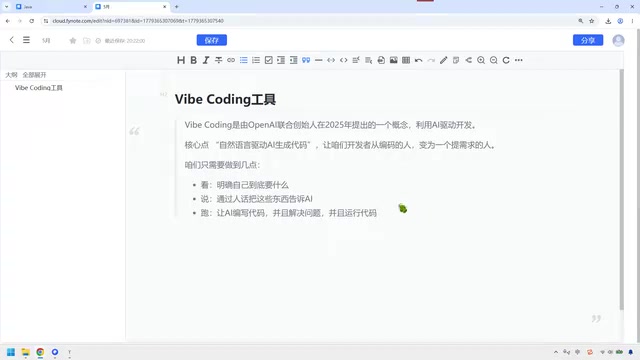
The core of Vibe Coding is using natural language to drive AI code generation. In traditional development, developers need to complete the entire process of requirement understanding, architecture design, interface documentation, coding, compilation, debugging, integration testing, and deployment. In the Vibe Coding model, developers are more like a "product manager who understands technology" — they clarify what they want and tell AI in "plain human language," while AI handles writing code, running it, and fixing errors.
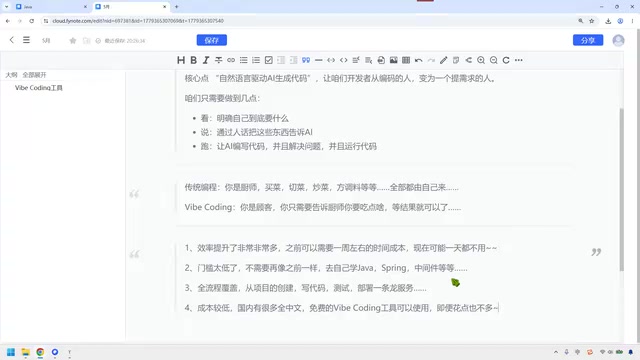
Teacher Zhang uses a chef analogy: traditional programming is buying groceries, chopping vegetables, stir-frying, and adding seasoning yourself; Vibe Coding is telling the chef what you want to eat — if it's too salty, ask them to add sugar; if it's not spicy enough, ask them to add chili. Throughout the process, you only need to give opinions, and all execution is handed to AI. According to his experience, if the product complexity is not high, about 80% of the code can be directly generated by AI and be usable.
This shift brings two direct results: efficiency is greatly improved (requirements that originally took about a week may be completed in less than half a day), and the barrier to entry drops sharply. Teacher Zhang mentions that a shepherd in Australia used Vibe Coding tools to build and deploy a product online. He could not understand code and only needed to repeatedly tell AI what he wanted and what needed to be changed. Developers no longer need to first learn Java, the Spring ecosystem, or middleware — they only need to be able to express requirements.
Efficiency and Cost: Why Vibe Coding Went Viral
The explosion of Vibe Coding is no accident. It hits several long-standing pain points in the traditional development process.
Efficiency Gains and Full-Process Coverage
In traditional development, an enterprise requirement often takes weeks from understanding, design, coding, building, debugging to integration testing and deployment. Vibe Coding tools cover the entire process from project creation, coding, testing to deployment. Teacher Zhang says, "How could it have needed about a week of time cost before? Now it may not even take a day." This has also given rise to the so-called "fd" (full-process developer) role — one person using AI to complete work that previously required collaboration among multiple roles.
Changes in Cost Structure
There are already multiple fully Chinese-language and free Vibe Coding tools available in China. In extreme cases, queuing may be required, but basic use costs nothing; even if paid, the main cost is only model tokens. Teacher Zhang gives an example: in the past, a university student might spend 800 to 1,000 yuan to buy a graduation project. Now, if the requirements are described clearly enough, two yuan worth of tokens can get it done. He also mentions that AI plagiarism checking can be handled with AI assistance, further lowering the project barrier for students.
Impact on the Programmer Market
The other side of efficiency gains is a change in demand volume. Teacher Zhang says bluntly that the market demand for programmers may be much lower than before. But he also emphasizes that the purpose of Vibe Coding is not to replace programmers, but to free developers from a large amount of repetitive, tedious coding. In the past, many people quit because "looking at code made them sick"; now more attention should be paid to how to fully explain product intent and how to communicate with tools — the ability to set requirements has become more important than memorizing syntax.

Comparison of Mainstream Vibe Coding Tools
Based on personal experience, Teacher Zhang gives tiered evaluations of six tools and clearly distinguishes between "best to use" and "most recommended for domestic users."
Claude Code: Best Personal Experience, but Installation Has a Barrier
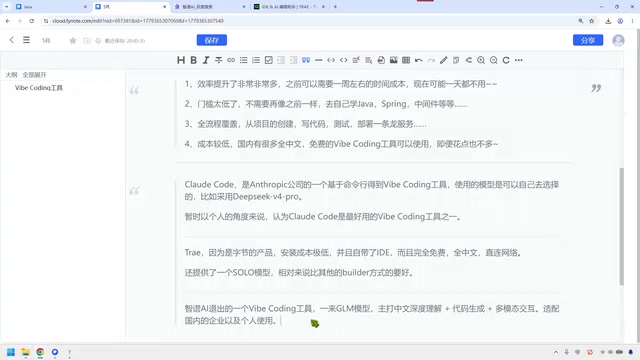
Claude Code is a command-line-based Vibe Coding tool launched by Anthropic. Teacher Zhang personally considers it one of the best tools, handling code writing precision, error-solving ability, and relatively complex backend business well, with code running locally. The model can be chosen freely; he personally uses a combination with DeepSeekAd V4 Pro.
The disadvantages are also obvious: the command-line form makes special requirements such as images cumbersome to handle; support for Chinese is "pretty average"; domestic installation requires circumventing network restrictions, and executing the installation command is "a matter of luck" — some people finish it in one go, while others have to run it repeatedly for two or three hours.
Command-line tools (CLI) are interfaces that interact with a computer through text commands, as opposed to graphical user interfaces (GUI). In Vibe Coding scenarios, Claude Code runs in command-line form, and developers need to enter natural language instructions in the terminal to drive AI code generation. The advantage of this approach is that it is lightweight, scriptable, and seamlessly integrated with the development environment, but the disadvantage is that it is unfriendly to non-technical users and cumbersome when handling multimodal inputs such as images. Command-line tools usually require users to have some environment configuration ability, such as installing Node.js and setting environment variables, which is also one reason Claude Code has a relatively high installation barrier.
Trae: ByteDance Product, Free, Fully Chinese, Direct Connection
Trae is a product under ByteDance, with its own IDE and a small communication window. Installation cost is extremely low. The domestic version is completely free, provides multiple free models including Doubao, is fully in Chinese, and connects directly to the network without needing to circumvent restrictions. Its Solo mode works better than the ordinary Builder mode, and queuing may be required during peak periods. Teacher Zhang comments: if Claude Code is 90 points, Trae is probably in the low 80s — the gap is not as big as imagined.
IDE (Integrated Development Environment) is a software application that integrates tools such as a code editor, compiler, debugger, and graphical user interface, aiming to improve development efficiency. Trae comes with an IDE, meaning it provides a complete development workbench where developers can complete coding, testing, and debugging without switching between multiple tools. Unlike traditional IDEs, Trae deeply integrates AI capabilities, embedding natural language interaction into the development process and forming an "AI-native IDE." Such IDEs usually provide chat windows, code completion, error diagnosis, and other functions, allowing developers to drive development through conversation and lowering the barrier to entry.
Zhipu: One of the Domestic Ceilings, Multimodality Is a Highlight
The Vibe Coding tool launched by Zhipu AI relies on its own GLM model, focuses on deep Chinese understanding, and supports multimodal interaction — you can not only set requirements in text, but also directly throw in documents for AI to analyze and generate products. Teacher Zhang's personal feeling is that Zhipu is one of the best Vibe Coding tools in China and can be regarded as one of the domestic ceilings. The personal version is free, and users need to purchase tokens themselves when usage is high.
Multimodal interaction refers to an AI system's ability to simultaneously process and understand multiple types of information input, such as text, images, audio, and video. In Vibe Coding, multimodal capabilities allow developers to directly upload product prototype images, UI design drafts, or requirement documents, and AI can parse the visual elements and textual descriptions within them to generate corresponding code. This greatly reduces ambiguity in requirement communication, especially for scenarios where users are not good at precisely describing interfaces in words. Zhipu's tool supports multimodality, meaning users can set requirements by throwing in documents, screenshots, and other materials, and AI automatically analyzes and produces products, improving communication efficiency and the accuracy of generated results.
Cursor: Pioneer of AI-Native IDE, but Cost-Effectiveness Has Declined
Cursor was the first Vibe Coding tool Teacher Zhang came into contact with and can be regarded as the pioneer of AI-native IDEs. It was once the product with the largest global user base and the most mature ecosystem, and many companies buy memberships for their employees. But it charges (Pro is about $20/month), domestic use is not stable enough and requires circumventing restrictions, and its understanding of Chinese is not as good as purely domestic products. In the current stage of blooming competition, Teacher Zhang believes there is no need to insist on using it.
Baidu Miaoda and Alibaba AI Coding Assistant: Supplementary Options from Big Tech
Baidu Miaoda is a zero-code AI programming tool launched by Baidu. The personal version is free and the team version is paid. Teacher Zhang only tried it lightly. Alibaba has also launched an AI coding assistant, deeply tied to the Alibaba ecosystem, with more plugin forms and better Chinese knowledge. These two are suitable as options for trying out.
How to Choose: Personal Advice and Trend Judgment
Teacher Zhang's selection advice is very direct: if you can circumvent network restrictions and pursue ultimate results, try Claude Code; if you want comfort and smoothness in China, prioritize Zhipu and Trae. Other tools are also worth trying more, because everyone understands "easy to use" differently, and the direction of tools is still evolving rapidly.
The more important judgment is the trend. Using natural language or even "programming by mouth" is definitely the direction. The value of Vibe Coding is not replacing programmers, but freeing developers from repetitive labor and shifting their energy toward requirement understanding, product intent communication, and collaborative communication with AI. Learning to set requirements and fully explain product intent is the ability more worth investing in under this paradigm.
One-line Summary
Vibe Coding uses natural language to drive AI code generation, improving efficiency and lowering barriers; tool choice varies by person.
Paragraph Summary
This article introduces Vibe Coding, an emerging programming paradigm whose core is that developers describe requirements in natural language and AI generates runnable code, shifting the developer's role to requirement setter. The article analyzes why Vibe Coding went viral: greatly improved efficiency (requirements that originally took a week may be completed in half a day) and significantly reduced costs (student graduation projects dropping from hundreds of yuan to two yuan worth of tokens), and discusses its impact on the programmer market — not replacing programmers, but freeing them from repetitive labor, with requirement-setting ability becoming key. In addition, the article compares six mainstream tools: Claude Code offers the best personal experience but has a high installation barrier; Trae and Zhipu are recommended as the most comfortable choices in China; Cursor's cost-effectiveness has declined; Baidu Miaoda and Alibaba AI Coding Assistant serve as supplements. Finally, it gives selection advice and judges that "programming by mouth" is the trend.
Related articles

No Coding Required: He Shipped an App Store App by 'Cutting Features' and Nitpicking with AI
A game designer with zero frontend/backend skills shipped a dual-platform App Store app with AI—not via one-click generation, but by cutting scope and nitpicking like a demanding client.

What Is Harness Engineering? From Concept Origins to Enterprise-Level Agent Implementation
What is Harness Engineering? This article traces the concept's origins and analyzes enterprise-level Agent requirements for tool call fault tolerance, data security, tenant isolation, and memory gaps.
Coze in Practice: A Three-Tier Agent Classification and a Multi-Agent Collaboration Guide
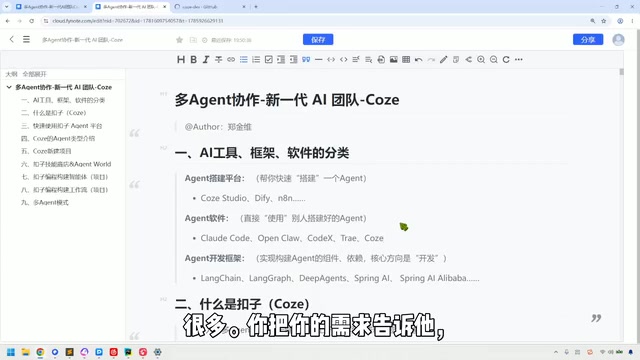
A Bilibili tutorial breaks down the multi-agent collaboration toolchain into three categories: building platforms like Coze Studio and Dify, Agent software like Claude Code, and development frameworks like LangChain—plus a Coze demo of industry templates, three-platform interoperability, local Agent integration, and the trade-offs of credit consumption.