vivo X500 Series Hands-On: Turning Your Phone Into a 400mm Telephoto Camera

The vivo X500 series achieves equivalent 400mm telephoto reach with its Photographer Kit and external teleconverters, pushing mobile imaging toward modular professional creation.
vivo has launched the X500, X500 Pro, and X500 Pro Max, continuing its joint development with Zeiss and positioning them from everyday imaging to professional creation. The standard and Pro versions fit a folded periscope telephoto into a squared-off body, while the Pro Max adopts a symmetrical camera layout and comes with a dedicated Photographer Kit. The kit includes an imaging grip (with a built-in 2300mAh battery, shutter, and dial), a strap, adapter rings, and two teleconverters, achieving an equivalent 400mm telephoto by stacking onto the periscope lens; samples show clear detail at long distances, and 4K 10-bit video performs stably. Professional video mode offers LUT, manual white balance, and focus control, with operating logic that leans toward cameras. The article argues that this modular approach extends the phone's use cases toward professional photography, at the cost of bulk, weight, and a price barrier.
From Phone to "Weapon": The vivo X500 Series Redefines Mobile Photography
When a phone can be described as "a weapon" right out of the box, it has clearly gone beyond the usual iterative upgrade. According to the latest unboxing video from a YouTube tech channel, vivo has launched three new devices—the X500, X500 Pro, and X500 Pro Max—continuing its joint development with Zeiss and focusing on imaging and video creation. With its dedicated "Photographer Kit," the Pro Max can achieve an equivalent 400mm telephoto capability through an external lens—a number that previously belonged only to the realm of professional cameras.

Three Models, Three Positions
X500: The Restraint of the Base Model
The standard X500 comes with 12GB RAM and 512GB storage, and includes a black protective case, SIM tool, and 90W fast charger in the box. The camera module is relatively understated but still houses a folded periscope telephoto structure. The body features brushed metal and a squared-off design, and can even stand on its own on a desk. The video specifically notes that this squared-off shape isn't purely for aesthetics—it lays the structural groundwork for the grip and lens accessories to come.
X500 Pro: Small Size, Big Ambition
The Pro version comes in white with 12GB+512GB. The body is smaller overall, but the camera module is significantly larger. The periscope telephoto lens moves from the offset position of the standard model to the center, achieving a more symmetrical visual balance. The video's author points out that this "small size + pro specs" combination is rare in the market: "Some people just prefer smaller phones but still want Pro-level imaging capabilities."
X500 Pro Max: Built for Creators
The top-tier Pro Max comes in gray with 12GB+1TB, and both the depth of the camera module and the number of lens elements far exceed the other two. The most notable difference is its symmetrical camera layout—the video explains that a symmetrical design effectively reduces wobble when set down, while an asymmetrical design inevitably produces slight tilting. For creators who need stable shooting, this detail matters more in practice than visual appeal.
The Photographer Kit: A "Pro Add-On" for Mobile Photography
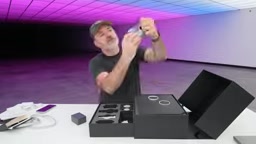
The Pro Max's Photographer Kit is the focus of the entire video. Opening the oversized box reveals a phone strap, an imaging grip, a phone case, a filter adapter ring, a lens adapter ring, and two teleconverters (Gen 2 and Gen 2 Ultra).
The Grip: More Than Just a Grip
The imaging grip connects to the phone via the Type-C port and provides a dedicated shutter button, zoom lever, programmable function button, video record button, and manual control dial. More practically, it has a built-in 2300mAh battery that can serve as an emergency power source to charge the phone. The grip surface uses a rubber-like material that provides a clear handling advantage when mounting large lenses. The video's author compares shooting with the bare phone versus with the grip attached: "If you're going to shoot for an hour, it's a completely different story."
The Lenses: From 2.35x to an Equivalent 400mm
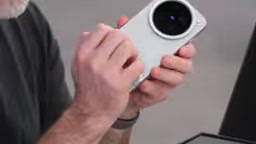
Of the two teleconverters, the smaller one provides 2.35x telephoto, while the larger Ultra version, when mounted, extends the phone's telephoto capability to an equivalent 400mm. The key is "zooming beyond zoom"—the teleconverter stacks on top of the phone's existing periscope telephoto lens to achieve this focal length. The mounting process produces a clear mechanical click, which the video deliberately preserves to emphasize its precision.
The lens adapter ring also provides two tripod mounting points, so the weight of the lens is supported directly by the tripod rather than bearing down entirely on the phone's mount, preventing the interface from deforming over prolonged use.
Teleconverter is an optical accessory mounted between the main lens and the camera body that uses an internal lens group to magnify the main lens's focal length by a fixed factor (commonly 1.4x, 2x, etc.). It is not digital zoom or cropping—it optically alters the imaging circle, so it preserves detail at the sensor's full resolution, but at the cost of some light loss (typically one to two stops of aperture) and possibly a slight reduction in edge sharpness. Teleconverters for phones work on a similar principle, but are more challenging to design due to the extremely short flange distance and miniaturized lens groups; vivo's approach clips the teleconverter onto the front of the periscope telephoto module, effectively adding a focusing optical path after the existing optical system to achieve 2.35x and even an equivalent 400mm focal length extension.
Real-World Performance: Detail at 400mm
The video shows continuous zoom samples of the same scene from 15mm ultra-wide to 400mm telephoto. At an equivalent 400mm, the details of distant wildlife remain clearly discernible. The video's author remarks: "Your brain will assume there must be a mirrorless camera here, but there isn't."

For video, the 4K 30fps 10-bit spec delivers natural depth of field and stable footage at the 400mm end, with no noticeable rolling shutter even when shooting from a tripod. The built-in professional video mode offers an audio level meter, LUT loading, manual white balance and ISO control, and manual focus switching—operating logic that leans toward professional cameras.
Rolling shutter effect is an inherent phenomenon of the CMOS sensor's line-by-line exposure method: when shooting fast-moving subjects or when the camera itself shakes, there is a tiny time difference in the exposure moment of different rows of pixels, causing straight objects in the frame to appear tilted, bent, or wobbly. This is especially noticeable at the telephoto end, because the narrower field of view magnifies any tiny displacement. The video's mention of "no noticeable rolling shutter" when shooting from a tripod indicates that the X500 Pro Max's sensor readout speed is fast, or that the stabilization algorithm compensates for the line-by-line exposure timing; for users focused on video creation, this metric directly affects the usability of footage involving camera movement.
Display and System
All three models feature an extremely high screen-to-body ratio, a maximum 144Hz refresh rate, two resolution options (Extreme HD and Ultra HD), and ship with Origin OS 7. The video's author notes that the choice of resolution and refresh rate directly affects battery life.
What This Means
The core idea behind the vivo X500 series isn't simply stacking specs, but extending the phone's use cases toward professional photography through an accessory ecosystem. The existence of the Photographer Kit lets the Pro Max become a shooting tool with a 400mm lens when needed, and return to an everyday phone form when the accessories are removed. This "modular imaging" direction forms an interesting contrast with the approach of simply increasing sensor size. Of course, the trade-off is extra bulk, weight, and price—the Pro Max is already the most expensive of the three, and the Photographer Kit raises the barrier even higher. For ordinary users, the standard or Pro version may be more balanced; but for creators who need to accomplish telephoto tasks on mobile, this combination offers a focal range that traditional phones cannot reach.
Modular imaging is not a new concept—the Sony QX series, the Motorola Hasselblad Mod, and external lenses from some brands have all attempted it, but most failed to gain traction due to connection stability, accessory ecosystem, or portability issues. What makes vivo's approach different is this: the phone itself retains its complete everyday form, the external kit achieves power and data communication through the Type-C port, the grip doubles as both a shutter handle and an emergency power source, and the adapter ring directs the lens weight to the tripod rather than the phone's mount. This design lowers the cost of switching to "professional mode" and extends the life of the mount. The core trade-off is: users get a telephoto focal range and control logic close to professional cameras, at the cost of carrying an extra set of accessories and a hefty kit price.
One-line Summary
With its Photographer Kit and external teleconverters, the vivo X500 series achieves an equivalent 400mm telephoto reach, pushing mobile imaging toward modular professional creation.
Paragraph Summary
vivo has launched three new devices—the X500, X500 Pro, and X500 Pro Max—continuing its joint development with Zeiss and positioning them from everyday imaging to professional creation. The standard and Pro versions fit a folded periscope telephoto into a squared-off body, while the Pro Max adopts a symmetrical camera layout and comes with a dedicated Photographer Kit. The kit includes an imaging grip (with a built-in 2300mAh battery, shutter, and dial), a strap, adapter rings, and two teleconverters, achieving an equivalent 400mm telephoto by stacking onto the periscope lens; samples show clear detail at long distances, and 4K 10-bit video performs stably. The professional video mode offers LUT, manual white balance, and focus control, with operating logic that leans toward cameras. The article argues that this modular approach extends the phone's use cases toward professional photography, at the cost of bulk, weight, and a price barrier.
Related articles

The Touchscreen MacBook and Apple's Delightful Mess: A Deliberate Gamble
The Vergecast unpacks the touchscreen MacBook Pro's launch logic, the ProLed naming controversy, the iPad squeezed between iPhone and Mac, and how Apple stays competitive with premium hardware in the AI era.

Fifty Years Studying Power: Robert Caro's Writing and Insights on Power
Robert Caro reflects on 50 years studying power: Lyndon Johnson's persuasion and leverage, Robert Moses's transformation from idealist to ruthless builder, the dilemmas of large-scale construction, and his methods of compressing themes and solitary focus in biography writing.

Can a $20,000 Robot Do Your Chores? The Test Results Are Surprising
A YouTube test video shows how a $20,000 robot responds to commands like washing dishes, turning off lights, taking out trash, and feeding the dog. This article analyzes its real capability boundaries, the state of voice interaction technology, and how far household robots are from mainstream adoption.