Waymo Teams Up with Toyota: Robotaxis to Launch in Japan and the UK

Waymo taps Toyota's bZ4X to deploy its autonomous driving system, starting in Japan and expanding to the UK.
Waymo has partnered with Toyota, which will supply the all-electric bZ4X as the Robotaxi carrier while Waymo integrates its Waymo Driver autonomous driving system. Testing will begin in Japan next year, with plans to extend to the UK. This "Toyota supplies the car, Waymo supplies the system" division lets Waymo focus on software and operational adaptation, while manufacturing, supply chain, and local compliance go to Toyota—clearly more scalable than building its own fleet. The article argues this reflects a shift among leading players from full-stack in-house development and self-built fleets to a hybrid model of owning core algorithms while sourcing vehicles and local resources externally, and represents a pragmatic bet for Toyota as well. However, key details such as test cities, fleet size, passenger service plans, and the UK timeline remain undisclosed.
Waymo is picking up the pace on globalization, and this time it's taking a lighter path—partnering with Toyota, which will supply the vehicle platform while Waymo provides the autonomous driving system. According to foreign media reports, the two companies will collaborate around Toyota's electric bZ4X model, starting autonomous driving tests in Japan first, with plans to extend the model to the UK market.
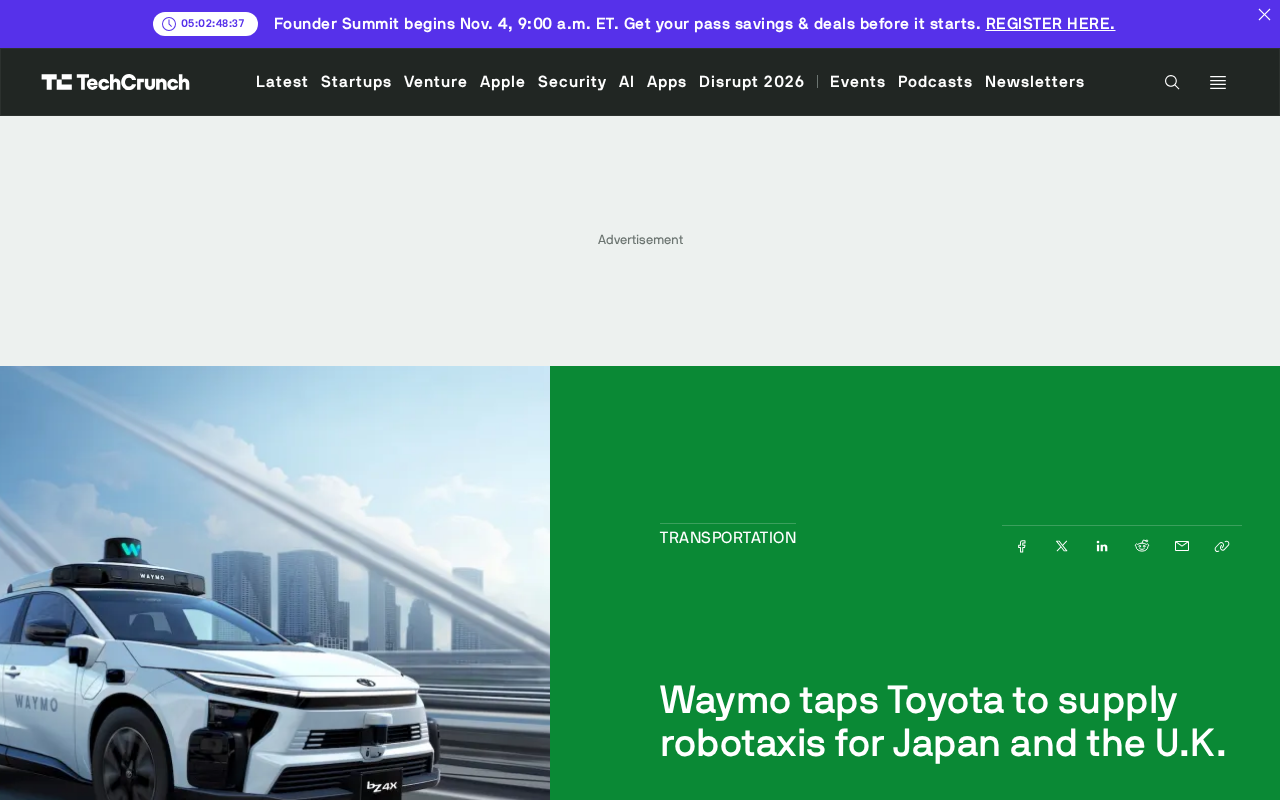
Partnership Model: Toyota Owns the Car, Waymo Owns the Brain
Based on information disclosed so far, Waymo won't build a dedicated vehicle for the Japanese market from scratch. Instead, it will directly use Toyota's all-electric bZ4X as the Robotaxi carrier, integrating the Waymo Driver autonomous driving system on top. Testing will begin in Japan next year.
This division of labor means Waymo can focus on adapting its autonomous driving software and operations system when entering new markets, while vehicle manufacturing, supply chain, and local compliance support are left to Toyota. For an autonomous driving company pushing deployment in multiple countries simultaneously, this "borrow a car to go global" approach is clearly more scalable than building its own fleet.
You may not have noticed, but Waymo previously relied mainly on models like the Jaguar I-Pace and Zeekr to build its fleet in the US market. The Toyota partnership is another expansion of its vehicle supply strategy.
Waymo Driver is Waymo's self-developed full autonomous driving system, comprising an onboard sensor suite (cameras, lidar, millimeter-wave radar), a computing platform, and a software stack responsible for perception, prediction, planning, and control. It is not a simple driver-assistance feature but a full-stack solution designed for L4-level driverless taxi operations, and has already been running commercial operations without safety drivers in Phoenix, San Francisco, and other locations. Integrating this system into third-party vehicles requires a series of engineering adaptations—sensor layout, drive-by-wire chassis interfaces, thermal management, and power supply—which form the technical foundation of the "vehicle supply + system supply" partnership model.
Why Japan and the UK
Japan's market is unique in its traffic environment and driving rules, and the country's regulatory framework for autonomous driving is gradually taking shape. As the host automaker, Toyota's accumulated experience in local testing permits, road data, and after-sales systems represents resources that Waymo would struggle to build on its own in the short term.
The UK is a market where Waymo has previously expressed interest. Using the Toyota bZ4X for Robotaxi supply in both Japan and the UK means the partnership is not a single-point experiment but follows a replicable regional expansion logic: a global automaker provides a unified vehicle platform, while Waymo handles system adaptation across different right-hand-drive and left-hand-drive markets.
Toyota bZ4X is Toyota's first global strategic all-electric SUV, built on the e-TNGA dedicated EV platform and launched in 2022, available in front-wheel-drive and all-wheel-drive versions. It was chosen as the Robotaxi carrier partly because its EV platform facilitates drive-by-wire and electrical/electronic architecture integration with autonomous driving systems, and partly because the model is already sold in multiple markets including Japan and the UK, with an existing supply chain and after-sales network that can significantly reduce vehicle compliance and maintenance costs when Waymo deploys fleets in new markets.
Impact on the Industry
This partnership reflects a trend in the autonomous driving industry: leading players are shifting from "full-stack in-house development and self-built fleets" to a hybrid model of "owning core algorithms while sourcing vehicles and local resources externally." Waymo has one of the most commercially experienced autonomous driving systems, while Toyota has global manufacturing and channel capabilities—the combination may move faster than either side could alone.
For Toyota, this is also a pragmatic bet. Rather than bearing the high investment and uncertainty of full-stack autonomous driving development alone, it makes sense to first become a Robotaxi fleet supplier and accumulate operational data and system integration experience through the partnership.
Robotaxi (autonomous taxi) refers to a mobility model in which the autonomous driving system handles all driving tasks and provides paid passenger services to the public, typically at L4-level autonomy. Unlike ordinary driver assistance, Robotaxis require no human safety driver intervention within designated operating areas, and their commercialization depends on regulatory permits, remote assistance systems, and fleet operations and dispatch capabilities. Waymo is currently one of the largest Robotaxi players by commercial operating scale globally, while Toyota has previously focused mostly on driver assistance and concept projects in autonomous driving. Entering as a vehicle supplier marks an important shift in its role in this space.
Open Questions
Public information remains limited: the specific test cities, fleet size, whether passenger services will be open to the public, and the UK market timeline are all unclear. Whether the Waymo-Toyota partnership can move from testing to scaled commercial operations will depend on regulatory approvals and the actual progress of localization efforts.
What is certain is that Waymo's internationalization is no longer just about "exporting the American model"—it is beginning to leverage automaker partners' local roots. If this path proves successful, it will offer direct reference value for other autonomous driving companies' global expansion strategies.
Related articles
Salesforce Acquires Rune for $375M: AI Logistics Tech Bolsters Defense Business
Salesforce reportedly acquires defense tech startup Rune for $375M. Rune's AI logistics tech will strengthen Salesforce's Missionforce defense platform, continuing its M&A spree.

Why Fair Use Benefits Everyone in the AI Era
Starting from a Hacker News discussion, this article analyzes the legal logic and controversies of the fair use principle in AI training and content creation, and its dual impact on creators and the tech ecosystem.

Mistral Large 4 Open-Sources a Trillion Parameters, Microsoft Offers Voluntary Severance to 60,000 Employees
Mistral Large 4 open-sources a trillion-parameter multimodal model with a coding agent score of 48; SanDisk earnings show AI inference reshaping NAND demand; Google Gemini adds in-app file editing, OpenAI raises Codex quotas, and Microsoft offers voluntary severance to 60,000 employees.