What Are the Engineering Highlights of America's Longest Highway Tunnel?

A Hacker News post about America's longest highway tunnel reveals the technical challenges and dissemination characteristics of ultra-long highway tunnels.
The article starts from a low-engagement Hacker News post about America's longest highway tunnel and discusses the engineering questions behind ultra-long highway tunnels. The author notes that tunnel length records reflect comprehensive capabilities in geological exploration, ventilation, fire emergency response, and boring, with ventilation and air quality control being the most critical due to exhaust accumulation. Safe evacuation and geological boring are also core challenges. It also analyzes why infrastructure topics have low dissemination volume but high discussion quality in tech communities, and notes that ultra-long highway tunnels are extending toward high-altitude, extremely cold, and complex geological regions, with energy consumption and ecological impact becoming new issues.
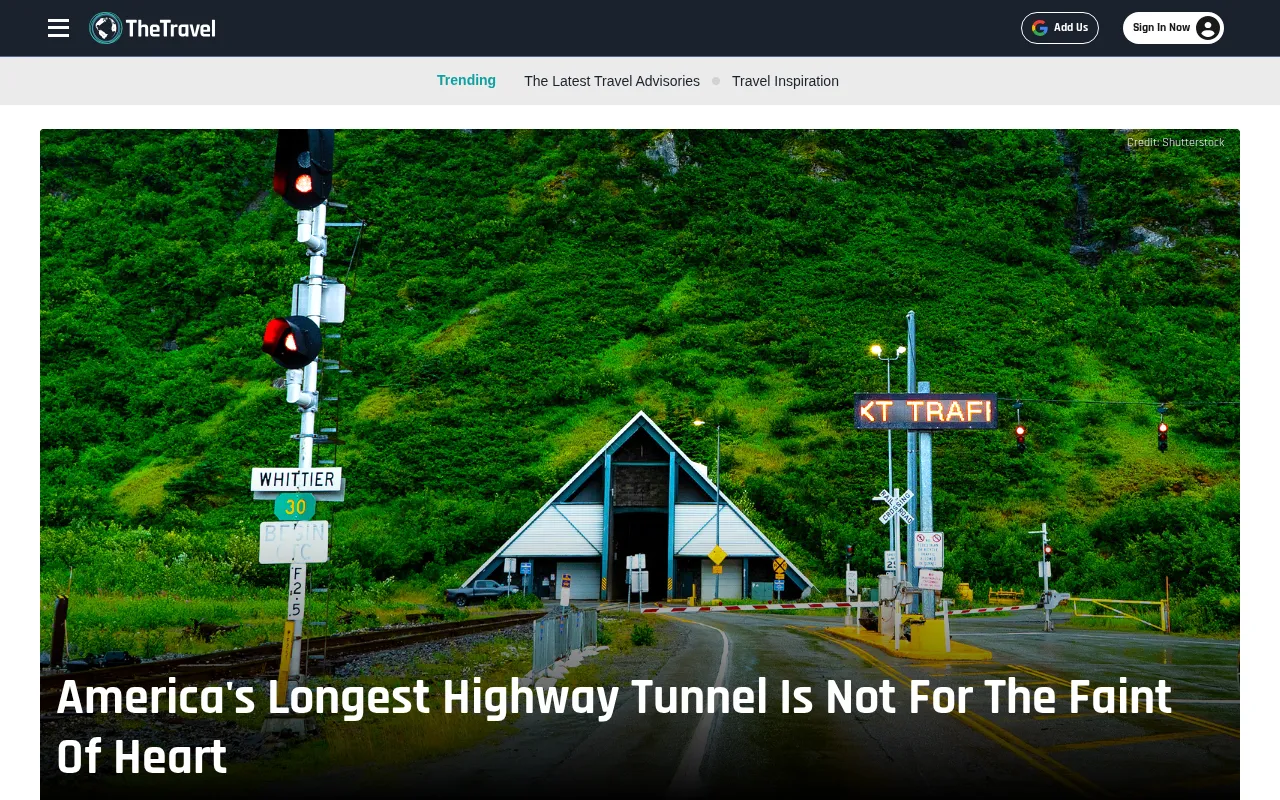
In the Hacker News tech community, a topic about infrastructure sometimes draws more attention from engineers than you might expect. Recently, a post titled "America's Longest Highway Tunnel" appeared in the discussion forum. Although engagement was low, the topic itself points to a grand yet concrete engineering question: in a highway transportation system, how do tunnels cross geographic barriers, and what kind of technical support is required?
Why the Longest Highway Tunnel Is Worth Paying Attention To
Record highway tunnel lengths are not just a contest of engineering numbers. They directly reflect a country's overall capabilities in geological exploration, ventilation systems, fire emergency response, and extra-large cross-section boring. Compared with railway tunnels, highway tunnels must handle more complex exhaust emission problems, because internal combustion engine vehicles continuously produce carbon monoxide, nitrogen oxides, and particulate matter. The longer the tunnel, the more exponentially difficult the design of ventilation and safe evacuation becomes.
For this reason, whenever the record for the "longest highway tunnel" is broken or discussed, the focus in engineering circles is often not the length itself, but which previously difficult technical bottlenecks were solved along the way.
Core Technical Challenges of Ultra-Long Highway Tunnels
Ventilation and Air Quality Control
In enclosed spaces several kilometers or even tens of kilometers long, the cumulative effect of vehicle exhaust is deadly. Modern ultra-long highway tunnels usually adopt a combination of longitudinal ventilation and transverse ventilation, equipped with real-time air quality monitoring systems. Once pollutant concentrations exceed a threshold, jet fans and ventilation shafts need to work together to complete air exchange within minutes.
Jet fans are the core equipment in longitudinal ventilation schemes. They are usually installed in groups on the tunnel crown or side walls, using high-speed air jets to induce surrounding air into overall flow, thereby pushing pollutants toward the portal along the direction of traffic for discharge. Their advantage is that they do not require additional cross-section space and offer flexible installation, but when used alone in ultra-long tunnels, pollutant concentrations rise linearly along the length, so they need to be combined with ventilation shafts. Ventilation shafts are vertical shafts drilled from the surface that divide the tunnel interior into segments along its length, with each segment independently supplying and exhausting air. This dilutes and discharges otherwise accumulating pollutants nearby within each segment, preventing uncontrolled concentrations at the far end. The siting of shafts must comprehensively consider terrain, burial depth, and surface land use, and their cost often accounts for a considerable proportion of the total ventilation system investment.
Safe Evacuation and Emergency Response
The longer the tunnel, the higher the chain risk of accidents. A fire or collision can cause severe congestion within a short time, making it difficult for rescue vehicles to enter. Therefore, in ultra-long tunnel design, cross passages, refuge chambers, and independent evacuation passages are standard. Some projects also set up dedicated rescue passage levels that are physically separated from the traffic level.
In ultra-long highway tunnels, cross passages are transverse connecting passages set at regular intervals (usually 250 to 500 meters) that connect the main tunnel with a parallel pilot tunnel or adjacent tunnel tubes. In a fire, people can move through them to a safe area. Refuge chambers are enclosed spaces with positive-pressure smoke prevention, independent air supply, and communication conditions, where people who cannot evacuate in time can temporarily wait for rescue. The International Tunnelling Association and national standards generally require that evacuation routes in ultra-long tunnels remain usable under fire conditions, and that cross passage spacing be determined comprehensively based on ventilation and smoke extraction capacity, walking speed, and traffic organization. In recent years, some projects have also introduced independent rescue passage levels, meaning dedicated passages below or beside the traffic level, allowing fire vehicles and rescue personnel to travel without relying on the main tunnel, significantly improving emergency response speed.
Geological Exploration and Boring Technology
Highway tunnels crossing mountains face uncertainties such as fault fracture zones, high-pressure water inflow, and high ground stress. The choice between tunnel boring machines (TBMs) and the drill-and-blast method depends on rock mass quality and schedule requirements. For ultra-long tunnels, contractors often need to bore simultaneously from multiple working faces, which imposes millimeter-level requirements on surveying and breakthrough accuracy.
A tunnel boring machine (TBM) is a large mechanized piece of equipment that integrates excavation, support, and mucking. It cuts rock through a rotating cutterhead. It is suitable for long tunnels with relatively intact rock mass and fixed cross-section form, offering fast boring speed and little disturbance to surrounding rock. However, equipment manufacturing and mobilization take a long time, initial investment is high, and its adaptability to adverse geology such as fault fracture zones is relatively weak. The drill-and-blast method excavates through drilling, charging, and blasting. It uses simple equipment and is highly flexible, capable of handling complex and variable geological conditions, but it involves more construction cycles, is slower, and causes greater disturbance to the surroundings. In ultra-long tunnels, the two methods are often combined according to geological segments. Multi-face boring refers to simultaneous excavation from both ends of the tunnel and from added inclined shafts or vertical shafts along the route, dividing a long tunnel into multiple short sections for parallel construction, thereby compressing the overall schedule. However, breakthrough surveying must control errors, otherwise the axes of each section cannot connect accurately.
Engineering Topic Dissemination Characteristics Seen from the HN Discussion
This post did not gain much traction on Hacker News, with only a small amount of interaction, but this precisely reflects a characteristic of content consumption in the tech community: compared with software and AI products, traditional infrastructure topics naturally have a smaller传播 volume. However, such content often attracts practitioners who are truly deeply engaged in civil, geological, or transportation engineering, and the quality of discussion is not low.
For readers concerned with engineering and urban development, the changing records of highway tunnels are a cross-section for observing a country's infrastructure capacity. It is not as intuitive as consumer products, yet it genuinely affects regional economic connectivity and logistics efficiency.
The Trend of Ultra-Long Highway Tunnels from a Global Perspective
From a global perspective, the construction of ultra-long highway tunnels is extending toward high-altitude, extremely cold, and geologically complex regions. The common issues these projects face include: how to ensure reliable operation of ventilation equipment in extreme environments, how to reduce operational energy consumption, and how to minimize the impact of construction on surrounding ecosystems.
You may not have noticed that competition over tunnel length is not the goal in itself. More often, it is the result of geographic conditions forcing the issue — when a detour means hours of extra driving, a tunnel becomes the only reasonable choice. Understanding this is more meaningful than remembering specific length figures.
Background Supplement
Common indicators for measuring the scale of ultra-long highway tunnels include total tunnel length, maximum burial depth, and cross-sectional area. Total length determines the difficulty of segmented design for ventilation and evacuation; maximum burial depth directly affects ground stress levels and the risks of rockburst and water inflow — the greater the burial depth, the more prominent the high ground stress problem; cross-sectional area relates to the number of lanes, ventilation volume, and selection of boring equipment. Typically, the single-tube excavation cross-section of a double-tube, four-lane tunnel is between 80 and 120 square meters. In addition, altitude is also a key parameter for high-altitude tunnels. The higher the altitude, the thinner the air, and the lower the efficiency of ventilation fans. At the same time, construction workers must face high-altitude hypoxia. These factors together constitute the technical threshold for ultra-long high-altitude highway tunnels.
One-line Summary
A Hacker News post about America's longest highway tunnel leads to the technical challenges and dissemination characteristics of ultra-long highway tunnels.
Paragraph Summary
Starting from a low-engagement Hacker News post about America's longest highway tunnel, the article discusses the engineering questions behind ultra-long highway tunnels. The author points out that tunnel length records essentially reflect comprehensive capabilities in geological exploration, ventilation, fire emergency response, and boring, among which ventilation and air quality control are most critical due to the accumulation of internal combustion engine exhaust. Safe evacuation and geological boring also constitute core challenges. The article also analyzes the phenomenon that infrastructure topics have low dissemination volume in the tech community but not low discussion quality, and from a global perspective notes that ultra-long highway tunnels are extending toward high-altitude, extremely cold, and geologically complex regions, with operational energy consumption and ecological impact becoming new issues. It emphasizes that tunnel length is more often the result of geographic conditions forcing the issue.
Related articles

Salesforce Acquires Rune for $375M: AI Logistics Tech Bolsters Defense Business
Salesforce reportedly acquires defense tech startup Rune for $375M. Rune's AI logistics tech will strengthen Salesforce's Missionforce defense platform, continuing its M&A spree.

Why Fair Use Benefits Everyone in the AI Era
Starting from a Hacker News discussion, this article analyzes the legal logic and controversies of the fair use principle in AI training and content creation, and its dual impact on creators and the tech ecosystem.

Mistral Large 4 Open-Sources a Trillion Parameters, Microsoft Offers Voluntary Severance to 60,000 Employees
Mistral Large 4 open-sources a trillion-parameter multimodal model with a coding agent score of 48; SanDisk earnings show AI inference reshaping NAND demand; Google Gemini adds in-app file editing, OpenAI raises Codex quotas, and Microsoft offers voluntary severance to 60,000 employees.