What Your AI Agent Demo Doesn't Tell You: Three Pitfalls Real Users Expose
AI Agent demos mask permission, scope, and handoff pitfalls that real users expose—limit capabilities and iterate fast.
Based on Reddit community discussions about the gap between AI Agent demos and real users, the article outlines typical problems demos can't simulate: missing information and expression differences causing frequent clarification, lax permission checks leading to unauthorized access, out-of-scope requests lowering success rates and adding risk, and rough human handoff degrading UX. Developers respond by narrowing scope, enhancing multi-turn clarification, and keeping human review at key points, with the core being to acknowledge the demo-reality gap and build a feedback loop.
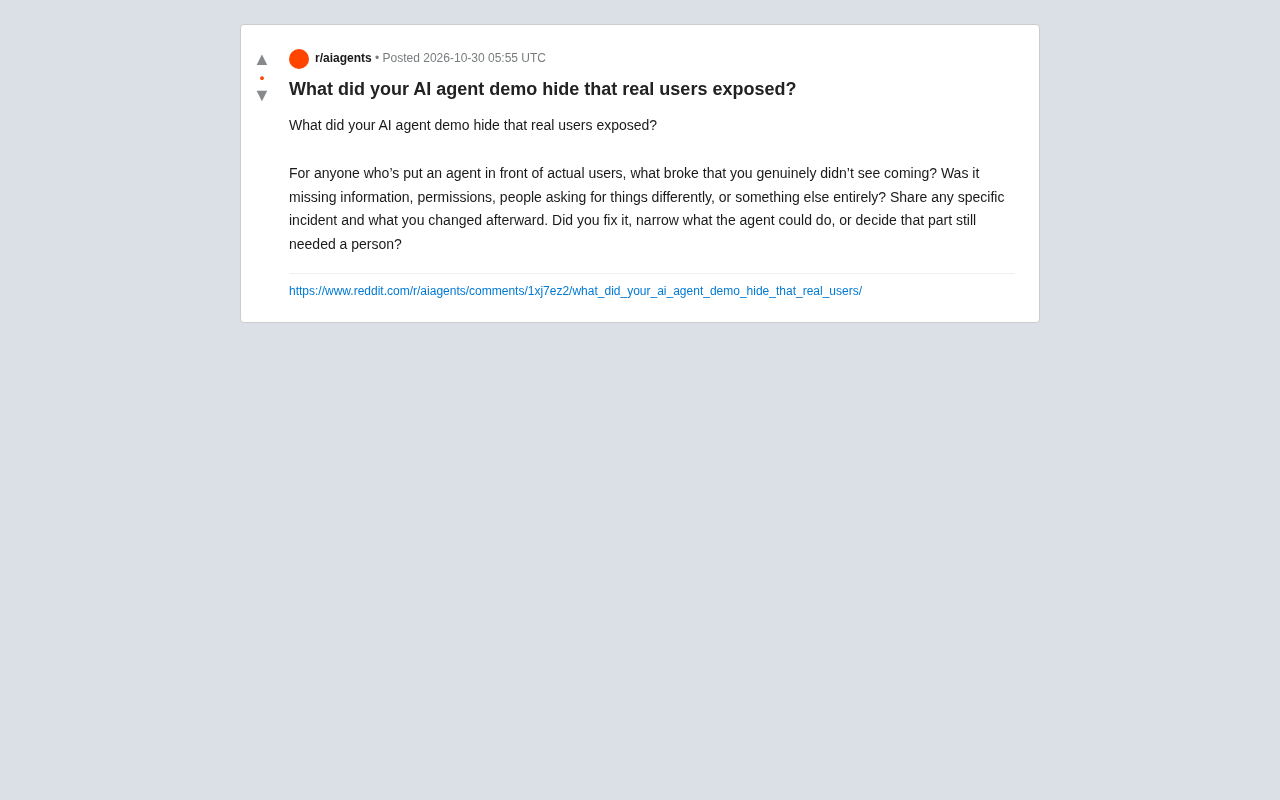
In the journey of AI Agents from demos to real-world applications, many teams have run into the awkward situation where "the demo looks great, but everything falls apart the moment users get their hands on it." A question from a developer on Reddit struck a chord with many: What did your AI agent demo hide that real users exposed? Was it missing information, permission issues, differences in how users express themselves, or something else entirely unexpected? This article combines community discussions and industry observations to break down these pitfalls and their countermeasures.
The Gap Between Demo Environments and the Real World
In controlled demos, AI Agents typically face carefully designed inputs and predefined flows. Real users, however, bring ambiguous instructions, contradictory context, and edge cases that never appeared in the demo. One developer shared that their customer service Agent could perfectly handle standard return requests during demos, but once live, users often mixed emotional language and irrelevant information into their problem descriptions, causing the Agent to frequently ask for clarification and significantly degrading the experience. This missing information and variation in expression is one of the most easily hidden problems in demos.
Typical Problems Exposed by Real Users
Permission and Security Blind Spots
Many teams overlook permission controls during demos. For example, an internal knowledge base Agent was tested only with an administrator account, but among real users, some tried to access sensitive data through the Agent, and the Agent nearly leaked information due to lax permission validation. The team subsequently had to tighten the Agent's access scope and add a manual review step.
Principle of Least Privilege is a foundational concept in security design, meaning a system should grant a subject only the minimum access permissions necessary to complete its task. In AI Agent scenarios, this means the Agent should not inherit all of the caller's permissions, but instead run with the permissions required by its own role, with secondary validation for sensitive operations. In practice, this is often implemented through Role-Based Access Control (RBAC) or Attribute-Based Access Control (ABAC) for fine-grained permission management. Agent permission design must also account for prompt injection attacks—malicious users may craft inputs to trick the Agent into performing unauthorized operations, so beyond permission validation, the Agent's outputs and actions also need auditing and restriction.
The Unpredictability of User Behavior
Users don't follow the demo script. Some will try to use the Agent for completely unrelated tasks, such as asking a customer service Agent to write code or check the weather. These out-of-scope requests not only lower task success rates but can also introduce security risks. One developer mentioned that they ultimately chose to add explicit capability boundary prompts to the Agent and guide users to the correct channels.
Out-of-scope requests are a common failure type in conversational AI evaluation. Users may—out of curiosity, misunderstanding, or malice—ask the Agent to perform tasks outside its design goals. Countermeasures typically include: clearly stating capability boundaries and the types of tasks it can handle in the system prompt; introducing an intent classifier at the entry point to identify and intercept out-of-scope requests; and providing friendly guidance rather than simple error messages for out-of-bounds requests. Additionally, guardrails mechanisms can filter the Agent's inputs and outputs to prevent it from being induced into dangerous operations or generating inappropriate content.
Flow Breaks and Human Handoff
When the Agent encounters a request it cannot handle, demos often just end or return a generic error. But real scenarios require a smooth handoff to a human. Some teams found that users are extremely sensitive to wait times when an Agent transfers to a human, so they optimized the handoff logic to immediately show "transferring you to a human agent" when the Agent is uncertain, rather than repeatedly retrying.
Human-in-the-Loop (HITL) refers to the mechanism of introducing human judgment or approval at key points in an automated workflow. In AI Agents, HITL is commonly used in three scenarios: high-risk decisions (such as refunds or permission changes), fallback when Agent confidence falls below a threshold, and ambiguous requests requiring subjective judgment. Effective HITL design requires clearly defining handoff trigger conditions, passing context to human agents, and ensuring the handoff process is transparent to users. Common industry patterns include the "suggest-confirm" pattern (the Agent makes a suggestion, and a human confirms before execution) and the "escalation" pattern (escalating to a human when the Agent cannot handle the request), with the latter having higher requirements for response latency and context completeness.
Learning from Failure: Improvement Strategies
Faced with these exposed problems, developers have adopted different strategies. Some chose to narrow the Agent's capability scope, handling only high-confidence tasks; others enhanced the Agent's clarification abilities, gathering necessary information through multi-turn conversations; and some teams decided to retain human review at key decision points. Regardless of the approach, the core is acknowledging the gap between demos and reality and establishing a fast-iterating feedback loop.
Multi-Source Perspectives: Community Consensus and Divergence
Drawing on multiple Reddit discussion threads and industry practices, one consensus is clear: demo environments cannot simulate the diversity and unpredictability of real users. The divergence lies in whether to expand the Agent's capabilities as much as possible to cover more scenarios, or to strictly limit scope to ensure reliability. Currently, the latter is favored in early deployments, because controllability matters more than coverage.
Conclusion
An AI Agent demo is like a beautifully drawn map, while real users are complex territory. Only through actual deployment, feedback collection, and continuous adjustment can an Agent become truly reliable. If your Agent hasn't encountered these problems yet, it may simply be that you don't have enough users yet.
One-line Summary
AI Agent demos mask pitfalls around permissions, scope, and handoffs that real users expose—limit capabilities and iterate fast.
Paragraph Summary
The article centers on Reddit community discussions about the gap between AI Agent demos and real users, outlining typical problems that demo environments cannot simulate: missing information and expression differences causing frequent clarification requests, lax permission validation leading to unauthorized access risks, out-of-scope user requests lowering success rates and introducing security concerns, and rough human handoff flows degrading the experience. To address these, developers have adopted strategies such as narrowing capability scope, enhancing multi-turn clarification, and retaining human review at key decision points—the core being to acknowledge the gap between demos and reality and establish a feedback loop. The community consensus is that demos cannot replicate user diversity; the divergence is whether to expand capabilities or limit scope, with the latter favored in early deployments.
Related articles

Vibe Coding Full-Stack in Practice: AI Programming from Beginner to Enterprise Deployment
From Cursor to Claude Code, this Bilibili AI programming course uses four progressive projects to cover full-stack development, open-source secondary development, and team collaboration. The article analyzes the shock to frontend roles, the efficiency shift from 50 people to 5, and the methodology required for enterprise-grade projects.

David Blaine's Global Quest for Real Magic: From South Africa to Japan and India
David Blaine travels to South Africa, Japan, and India in his Do Not Attempt special, documenting Spinning drivers, black mamba rescuers, iaijutsu masters, and ascetics—exploring the boundary between magic and real human极限 challenges.

Is a Touchscreen MacBook Coming? Vergecast Reveals Apple Executive's Response
Vergecast podcast reveals a conversation between a reporter and Apple executive John Ternus about a touchscreen MacBook and Apple Pencil support. Ternus says iPad is the best device for a stylus, while the reporter bets MacBook will eventually support Apple Pencil.